CHINA> National

|
CHINA> National
|
|
Mars probe set for Oct launch
By Xin Dingding (China Daily)
Updated: 2009-06-09 07:18 China's first Mars probe will have to stand the test of nearly nine hours in the freezing, dark shadow of the red planet during its one-year mission - the longest such period in exploration history - the scientist in charge of the probe's design has said. 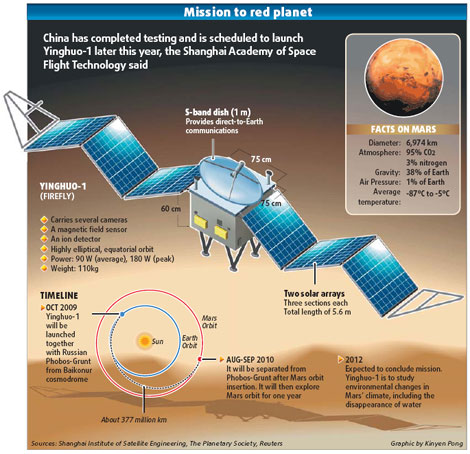
To conserve energy, part of the facilities on board will have to be switched off, and the probe will restart the facilities when the probe enters into sunshine, Chen said. Should anything go wrong, the orbiter could become "frozen" - like the United States' Phoenix Lander, which froze on the surface of the planet. Chen said he is relieved after the 110-kg micro satellite managed to survive lab tests in February that strictly simulated the Mars environment - 260 C below zero in the dark. His team has spent only 23 months on the satellite design, which typically takes three years or longer. After passing the research phase, Yinghuo-1 is ready to be transported to Moscow for compatibility tests, and will blast off atop a Russian launch vehicle from Baikonur Cosmodrome in Kazakhstan in October, Chen said. According to earlier reports, Yinghuo-1 will separate from the Russian landing craft Phobos-Grunt after a 10-month journey and stay in a Martian orbit while the latter continues on to Phobos, the larger and the closer of the planet's two moons. Chen said Yinghuo-1's orbital path is determined by Phobos-Grunt, and is different from the orbits of other countries' probes. Though China is relying on Russia for the launching, tracking and controlling of the micro-satellite, the Mars probe project is still regarded as a milestone that will take the country one big step further in deep-space exploration. Pang Zhihao, a researcher with the China Academy of Space Technology, said: "If Yinghuo-1 enters the preset orbit smoothly and works well, China will become only the fourth country or region that has ever succeeded in launching a Mars probe, following the United States, Russia and Europe." Its mission to explore the Martian space environment is also expected to fill in a blank in research, Pang said. Other countries usually focus on looking for signs of life, the weather on Mars and geological research. Yinghuo-1 is expected to provide clues as to whether the sun turned Mars dry by studying the relationship between oxygen molecules and solar winds. The probe will carry several cameras, a magnetic field sensor and an ion detector. The distance between Mars and Earth is between 56.7 million km and 400 million km, depending on their orbital positions. Yinghuo-1 will travel 350 million km over 11 months before entering the planet's orbit, and is expected to send back the first images of the red planet in September next year. However, the project is unlikely to achieve optimal results because its orbit entry point is not close enough to Mars, Ye Peijian, chief designer of the nation's first moon probe, told China Daily earlier. The country could explore Mars independently if it developed launch technology, and use the tracking experience from the lunar mission, he said. Jiao Weixin, a space scientist at Peking University, cautioned that the failure rate of Mars missions is high - of the more than 30 orbiters launched, about two-thirds have failed. Currently, only three orbiters and two rovers are operating. |
主站蜘蛛池模板: 又黄又无遮挡AAAAA毛片| 亚洲一区二区三区四区| 亚洲精品国产美女久久久| 成 人 免费 在线电影| 最近中文字幕高清免费大全1 | 国产破外女出血视频| 94人妻少妇偷人精品| 亚洲国产精品第一二三区| 香蕉人妻av久久久久天天| 国产av丝袜熟女一二三| 国产精品人成视频免费国产| 伊人久久精品无码麻豆一区| 亚洲综合av永久无码精品一区二区 | 成人亚洲av免费在线| 亚洲精品无码永久在线观看| 奶头好大揉着好爽视频| 亚洲人成小说网站色在线| 美国又粗又长久久性黄大片| 国产jizzjizz视频| 久久久精品94久久精品| 国产丰满乱子伦无码专区| 日韩丝袜人妻中文字幕| 国产精品人人爽人人做我的可爱| 天堂女人av一区二区| 你懂的亚洲一区二区三区| 天天夜碰日日摸日日澡性色AV| 天堂a无码a无线孕交| 国产精品福利自产拍久久| 永久免费av无码网站直播| 免费大片黄国产在线观看| 国产成人拍精品视频午夜网站| 人妻伦理在线一二三区| 国产精品剧情亚洲二区| 无码精品一区二区久久久| 亚欧洲乱码视频一二三区| 久久久精品人妻无码专区不卡| 激情啪啪啪一区二区三区| 国产人妻人伦精品婷婷| 久久人妻精品大屁股一区| 精品无码三级在线观看视频| 国产成人精品无码一区二|



