Economy
Toyota travails give no traction to others
By Dan Chinoy and Li Fangfang (China Daily)
Updated: 2010-03-12 06:45
 |
Large Medium Small |
Chinese brands do not have ability to cash in on recalls. Dan Chinoy and Li Fangfang report from Beijing.
 |
 |
|
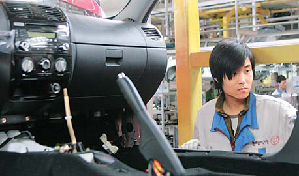
A worker fi ts a door frame on a BMW Brilliance A Series car in Liaoning.FENG YONGBIN/ CHINADAILY |
Production lines of the BMW Brilliance factory in the city of Shenyang.FENG YONGBIN/ CHINADAILY |
It may only be three months old but 2010 is already shaping up to be a terrible year for Toyota. After being forced to recall millions of its most popular models due to faulty brakes and accelerators, the Japanese giant has lost not only millions of dollars but also, for many people, its reputation for making some of the world's most reliable cars.
In the United States, sales dropped 8.7 percent after customers shied away from the brand. Meanwhile, Ford, one of its biggest competitors, saw its February sales grow 43 percent on last year.
But as Toyota struggles to repair its dented image - company president Akio Toyoda visited Beijing and Washington last month to deliver apologies for the quality problems - there is one bright spot: China.
Unlike the US, its competitors have been largely unable to capitalize on the scandal here to steal some of the automaker's market share.
Supported by the rapid growth of China's middle class and government policies, including nearly $15 billion in tax breaks and subsidies designed to encourage consumption in the wake of the financial crisis, China passed the US as the world's largest auto market for the first time last year. Car purchases increased almost 50 percent last year, bringing the number of cars on the country's road to about 31 million - five times more than in 2005.
It is this demand that has kept Toyota going in China. The company sold 626,886 units in 2009 and, despite the global recalls - which included the RAV-4 SUV in China - sales continued to rise in January and February, said the company. Only Volkswagen sells more cars.
"Toyota's recall in the US has had little impact on our business in China," said Zeng Qinghong, general manager of Guangzhou Automobile Industry Group (GAIG), which produces Toyota in China. "Demand in the market is still very robust."
With soaring demand and a major market leader reeling, why were Toyota's competitors unable to take advantage in China?
One reason, said John Zeng, an analyst with market research firm IHS Global Insight, is that the recall scandal has largely been seen as an "American problem". Cars made for the Chinese market come from different suppliers and go through different manufacturing processes, he said, adding that the media coverage of the problems here have been less widespread than in the US. However, that could be due to the fact that, unlike in the US, there have been no reports of crashes caused by faulty RAV-4 accelerators or breaks.
"The RAV-4s were just recalled (in China) out of caution. It's not like in the US where consumers have been hurt or died because of the problems," said John Zeng.
A more important factor for Toyota's resilience in China, however, may be its domestic competition. Although expanding, Chinese carmakers such as Geely, Chery, and BYD are still seen to lack Toyota's experience, expertise and rigor. Analysts say the buyers of these cheaper cars are those customers who cannot afford to buy better.
Just 6 percent of Chinese customers listed "quality" as the top reason for buying a domestic brand in a survey by global marketing services firm J.D. Power and Associates last year. The appeal, the poll found, was their price. Tony Liu, head of automotive business at Sinotrust, a Chinese market consultancy, estimated that Chinese brands are 30 or 40 percent less than foreign- or joint venture-made cars.
"When they got into the market, they realized it's very difficult to compete with foreign brands. Pricing is the best weapon to fight back," said John Zeng.
In the long term, if Chinese manufacturers want to compete with international companies like Toyota, whether in China or overseas, they must close the perceived quality gap, said Mei Songlin, chief analyst for J.D. Power and Associates in Shanghai. However, that means strengthening research and development, improving management and developing more sophisticated marketing techniques. In short: a wholesale corporate upgrade.
"(Chinese brands) lack experience, technology and experienced managers," said Liu. "They are new to the industry and because they are new they will make mistakes."
As late as the 1980s, China had no major consumer auto market. To attract technology and expertise, the government encouraged joint ventures with foreign carmakers. This head start, coupled with the knowledge and experience of major international carmakers, allowed these joint ventures to dominate the market.
The top three automakers in China are all joint ventures - Shanghai Volkswagen, Shanghai GM and FAW Volkswagen - and last year almost 70 percent of all passenger vehicles sold on the mainland were joint venture cars. Even the largest manufacturer of the country's ubiquitous minivans is a joint venture between State-owned engineering company Shanghai Automotive Industry Corporation, General Motors and Wuling, a small Chinese manufacturer.
In the face of this competition, analysts say newer Chinese firms are forced to essentially trade quality for price to enter the market in the only place they can: at the bottom.
"Chinese branded cars always give me an impression of not being reliable. They have only been around for a decade, while the foreign brands have existed for a century," said Pan Yue, a Beijing-based consultant, as he justified buying a Volkswagen instead of a Chinese car.