Society
Internet movie fans fear twist in the tale
By Jiang Xueqing (China Daily)
Updated: 2010-11-18 07:15
 |
Large Medium Small |
|
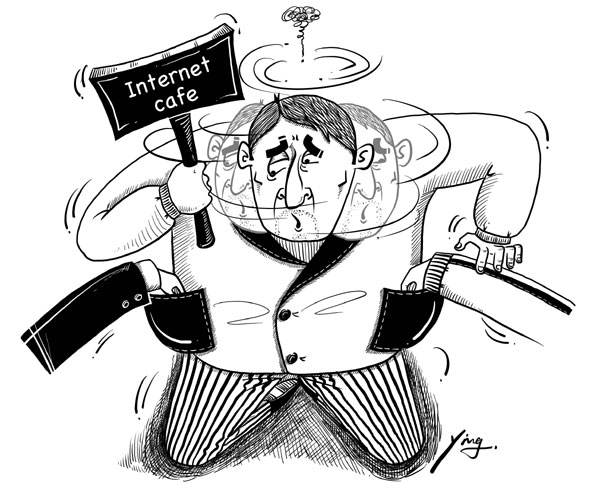 |
As a migrant worker on a tight budget, Zhang Jie spends a lot of spare time in Internet cafes watching movies.
| ||||


"People like me can afford 4 yuan ($0.60) an hour at most," said the 26-year-old salesman, as he sat watching the 1987 comedy A Chinese Ghost Story at 520 Casual Internet Cafe in Beijing.
"If the cafe starts charging 5 yuan or more, people will stop coming," he warned.
Zhang's fear about a price hike follows news that the China Film Copyright Association (CFCA) will soon hit wang ba (the Chinese term for Internet cafes) and long-distance bus companies with a set monthly fee for screening Chinese movies.
The levy, which will come into force on Jan 1, is being touted as a weapon against piracy.
Yet, cafe owners have slammed the move, claiming it is an unfair tax aimed at the wrong people.
Sun Jingbin, manager of 520 Casual and its 120 or so desktop computers, estimated at least 20 percent of its customers watch movies on the cafe's server.
However, since 2008, 520 Casual has paid 2,400 yuan a year to 365pub.com, the Shanghai-based company that installed the server, for downloads and maintenance. Under the contract, Sun said 365pub.com is responsible for obtaining copyright permission and handling legal issues.
It is a deal many wang ba nationwide have entered into, prompting many owners to ask why they are being forced to pay two copyright charges.
"We were told by (365pub.com) they have copyright licenses for these movies," said Sun. "If there's a problem, the association should ask the movie providers for a payment or compensation, rather than coming to us."
But the new regulations do not stipulate who should pay the royalties, Internet cafes or movie service providers, "so we'll just take whichever is more convenient", said Li Guomin, secretary-general of the CFCA.
"It's definitely easier to start with Internet cafes," he added.
|
 A woman browses at an Internet cafe in Beijing. Watching movies could soon cost more thanks to the new charge. Wang Jing/China Daily |
Paying attention
Since being set up in April, the CFCA has found the vast majority of China's 138,000 registered wang ba have contracts with 20 or so movie providers.
Although the companies claim to have copyright permission for Chinese films, a CFCA statement said most do not, accusing others of offering pirated versions. The 2,000 to 4,000 yuan a year they charge for their services is also unlikely to cover the cost of the licenses.
Legal experts warn that, even with a contract that puts the onus on movie providers to get clearance, Internet cafes are not immune to prosecution.
If a wang ba does not pay up and is found to be screening copyrighted movies without permission, the CFCA can sue them on behalf of its members. Individual copyright holders can also complain to local and central authorities.
Administrative penalties include warnings, fines and confiscation of equipment used in copyright violations.
"Internet cafe owners should pay due attention while obtaining copyright licensing from an agent company (such as movie providers)," said Wang Qian, a professor with the intellectual property school at East China University of Political Science and Law.
"They should ask for the original licensing contracts with the copyright owner and check the authenticity, rather than taking an agent's word for it," he said. "Otherwise, the Internet cafe will be held liable."
Business owners say, however, that they have neither the knowledge nor resources to double check the hundreds of movies downloaded onto their servers.
It is just not feasible, said Sun Qi, chairman of the Beijing Internet Cafe Association, who equated the suggestion to "asking every consumer who bought (tainted) Sanlu milk powder to check its safety before drinking".
"According to the business license, a wang ba can only provide Internet access services," he said. "So, checking film copyright information is beyond its duties and abilities."
At an August seminar hosted by the Supreme People's Court, Sun Qi urged authorities to accept the promise by movie providers in contracts as evidence of Internet cafes' due attention.
He also called for a public online platform where cafe managers can find basic copyright information on Chinese movies.
|
 |
Ready to charge
On top of the dispute about who to charge, question marks also remain over how much.
The CFCA's standard daily fee is based on two main factors: the number of computers an Internet cafe has and its hourly rates. Using the calculation given to China Daily, a business with 100 screens that charges 2 yuan an hour would be expected to pay roughly 15 yuan per day.
"That's too much," said Li Zhangjun, manager of Seaside Internet Cafe in Beijing's Chaoyang district. "Business is poor right now. We're barely making a living."
Seaside had 400 computers when it opened in 2006, although the number was reduced to 160 two years later when there were fewer migrant workers, its core customer base. Meanwhile, expenses have soared due to spikes in rental prices and living costs.
According to statistics from the Beijing Internet Cafe Association, the daily income of a wang ba with 100 to 150 computers is now about 40 percent lower than in 2006.
"The China Film Copyright Association has a responsibility to explain and prove whether the fee is reasonable," said Qu Sanqiang, a professor at Peking University's intellectual property school.
"In countries like the United States and Japan, where the legal system is comparatively mature, copyright collective management groups usually make an effort to negotiate and reach an agreement with related industry organizations."
As the CFCA only sells the right to copy and screen a movie, and no other services, Internet cafes still need movie providers for downloads. This has led many to argue that the royalties charge will fail to tackle the rampant bootlegging.
"Even if we pay the charge, copyright violations will remain as long as the providers keep offering pirate movies," said Li at Seaside Internet Cafe.
However, the new regulations do not question where an Internet cafe obtains a movie, as long as it has permission from the CFCA to copy and screen it.
"Even if they buy a pirated DVD on the street, it's still legal for a cafe to copy the film to its server and make it available to customers," added Wang at East China University of Political Science and Law.
By directly charging wang ba royalties, "we can prevent them from building pirate movie servers", said CFCA secretary-general Li Guomin, who argued that if both his association and Internet cafes check for copyright licenses, companies that offer download services will be deterred from offering bootlegs.
Cafe owners disagree, however. Those who talked to China Daily said they see the new fees simply as an extra tax on their businesses.
Sun Qi of the Beijing Internet Cafe Association said he believes the crackdown is "just an excuse to collect money" and will have little to no impact in battling piracy.
Distribution concern
The CFCA is making efforts to cooperate with movie providers. It invited 10 companies to attend to talks in Beijing on Nov 9, with a view to giving them the option of joining the association or becoming a partner. (When China Daily contacted the CFCA on Wednesday, a spokeswoman refused to confirm whether the meeting was successful or had even gone ahead.)
However, as the firms are already used to making large profits from selling films without the copyright licenses, experts say it is impossible to predict whether an agreement can be reached.
Beijing Netmovies Co Ltd, which supplies digital entertainment content, has already signed a contract with the CFCA, according to marketing director Cheng Tianyu.
"The association doesn't have enough people," said Cheng. "We'll help with collecting the (royalties) and distributing authorized movies to wang ba (in more than 30 cities) on the association's behalf."
Negotiations with authorities in potential pilot cities - likely Beijing, Shanghai and several prosperous cities in Guangdong, Jiangsu and Fujian provinces - are also under way. If successful, the CFCA will appoint a chief representative to find local partners, like Beijing Netmovies, to collect cash and provide other services.
Secretary-general Li Guomin said the target is to collect at least 20 million yuan in 2011 and 100 million yuan by 2014. Ninety percent of the money will go to its members, with the rest going toward administration costs.
However, concerns remain over how the money will be distributed.
As the CFCA has no way of recording exactly which movies are being played or where, it is planning a sample survey on selected Internet cafes. Decisions about who will get a greater share of the royalties will be based on the results of that trial.
"We have reservations about the measures being taken" by the CFCA, said a public relations officer at one of China's largest private film production and distribution companies, who did not want to be identified.
"If it will bring our company more financial income and increase our reputation, we'd be more than happy to cooperate, but I haven't seen a large-scale operation model," she said. "I don't know what's going to happen."
She said her company has not yet signed a contract authorizing the CFCA to manage its copyright issues, despite it being listed on the association's website as one of its 64 members.
"Distribution of the money is still something we need to discuss," added the PR officer, who suggested many other film companies are also in the same position.?
 主站蜘蛛池模板:
亚洲综合精品香蕉久久网|
国产一区二区三区免费观看|
中文字幕亚洲精品人妻|
亚洲欧美伊人久久综合一区二区|
国产精品一区二区插插插|
成人免费无遮挡无码黄漫视频|
波多野结系列18部无码观看a|
免费无码又爽又刺激高潮虎虎视频|
国产成人户外露出视频在线|
麻豆久久天天躁夜夜狠狠躁|
国产精品久久久一区二区三区|
久久无码中文字幕免费影院蜜桃|
中文字幕成人精品久久不卡|
av天堂午夜精品一区二区三区|
人妻少妇精品中文字幕|
东京热加勒比无码少妇|
日韩高清在线亚洲专区国产|
国产自在自线午夜精品|
亚洲乱码国产乱码精品精|
欧美性69式xxxx护士|
暖暖影院日本高清...免费|
亚洲AV天天做在线观看|
18禁男女污污污午夜网站免费|
一区二区三区国产偷拍|
亚洲AV无码成人精品区一本二本|
亚洲熟妇一区二区三个区|
毛片免费观看视频|
亚洲av中文久久精品国内|
毛片网站在线观看|
伊人中文在线最新版天堂|
丝袜老师办公室里做好紧好爽|
亚洲欧美日韩综合一区在线
|
夜夜嗨久久人成在日日夜夜|
亚洲人成网站观看在线观看
|
亚洲欧美综合人成在线|
亚洲老熟女@tubeumtv|
岛国岛国免费v片在线观看|
精品视频无码一区二区三区|
色欲综合久久中文字幕网|
久久青草精品38国产免费|
国产精品一区 在线播放|
主站蜘蛛池模板:
亚洲综合精品香蕉久久网|
国产一区二区三区免费观看|
中文字幕亚洲精品人妻|
亚洲欧美伊人久久综合一区二区|
国产精品一区二区插插插|
成人免费无遮挡无码黄漫视频|
波多野结系列18部无码观看a|
免费无码又爽又刺激高潮虎虎视频|
国产成人户外露出视频在线|
麻豆久久天天躁夜夜狠狠躁|
国产精品久久久一区二区三区|
久久无码中文字幕免费影院蜜桃|
中文字幕成人精品久久不卡|
av天堂午夜精品一区二区三区|
人妻少妇精品中文字幕|
东京热加勒比无码少妇|
日韩高清在线亚洲专区国产|
国产自在自线午夜精品|
亚洲乱码国产乱码精品精|
欧美性69式xxxx护士|
暖暖影院日本高清...免费|
亚洲AV天天做在线观看|
18禁男女污污污午夜网站免费|
一区二区三区国产偷拍|
亚洲AV无码成人精品区一本二本|
亚洲熟妇一区二区三个区|
毛片免费观看视频|
亚洲av中文久久精品国内|
毛片网站在线观看|
伊人中文在线最新版天堂|
丝袜老师办公室里做好紧好爽|
亚洲欧美日韩综合一区在线
|
夜夜嗨久久人成在日日夜夜|
亚洲人成网站观看在线观看
|
亚洲欧美综合人成在线|
亚洲老熟女@tubeumtv|
岛国岛国免费v片在线观看|
精品视频无码一区二区三区|
色欲综合久久中文字幕网|
久久青草精品38国产免费|
国产精品一区 在线播放|