Society
Is water pipeline project merely a pipe dream?
By Jiang Xueqing and Shao Wei (China Daily)
Updated: 2010-11-29 07:05
 |
Large Medium Small |
|
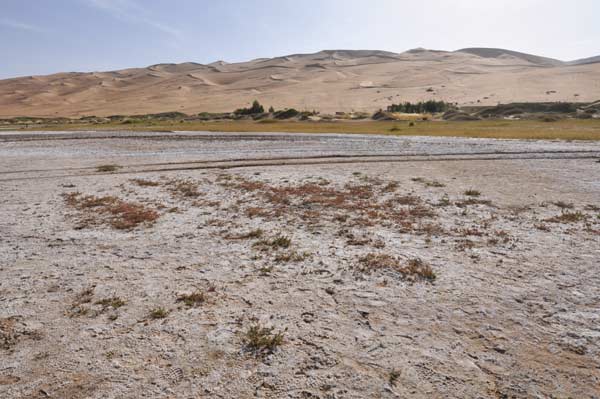 A dried lake in Badain Jaran desert, which spans 47,000 km in Inner Mongolia’s Alxa Right Banner. If approved, the east-to-west water pipeline will run through the desert. [Dong Naide/for China Daily]
 Tourists stroll along the shore of Bohai Sea in Qinhuangdao, Hebei province, during this year’s National Day holidays. Dong Naide / for China Daily] |
According to Wang, the China Institute of Water Resources and Hydropower Research (IWHR) has already done basic research and passed it on to China Water Resources Beifang Investigation, Design and Research Co Ltd (BIDR) for a feasibility study. He said he gave that study to China International Engineering Consulting Corporation for evaluation in 2008.
A manager in charge of the evaluation who did not want to be identified told China Daily the report was done in a hurry and that the corporation's engineers raised questions about potential technical, environmental and investment problems.
"We asked them to revise the study report and send in supplementary materials, which they never did," said the manager. "The evaluation has so far been postponed for a year."
Wang explained the Inner Mongolia Water Resources and Hydropower Survey and Design Institute will do the follow-up work. However, when contacted by China Daily last week, the IWHR declined to comment, the BIDR denied it ever did the feasibility study and the Inner Mongolia institute said it is "incapable of handling such a big project".
China International Engineering Consulting Corporation advised Hongyuan to have the environmental impact evaluated by an independent institute, yet Wang said the appraisal is being performed by an institution under the Ministry of Environmental Protection and will not be finished for three to five years. He refused to name the institution.
'Matter of time'
As the seawater pipeline will involve both Liaoning and Inner Mongolia, it must win approval from the National Development and Reform Commission (NDRC). However, China's regulations only cover the transfer of freshwater.
"There's no precedent for seawater transfer," said Zhao Ping in Xilin Gol. "That's what makes the project difficult. Even the NDRC's chairman may not be sure which department should take care of it."
Xilin Gol's government originally filed the project with the NDRC in the name of developing its eco-industry. It was rejected in November 2007.
In a written reply, the NDRC raised concerns about technologies, sustainable economic development and ecological protection. It concluded that, as it is hard to tell what the environmental impact will be, "relevant projects are not yet qualified for approval".
Officials in Xilin Gol revised the plan and re-filed the proposals in June last year, this time in the name of developing a cyclical industrial economy. No reply has so far been received.
Despite still waiting for approval, Wang at Hongyuan Seawater Desalination Corporation is confident it is "only a matter of time". With support from the league's authorities, on April 9 he started preparation work, including scientific experiments, at five construction sites.
"If our experimental projects succeed, they will lay the foundations for the real ones to be approved," said Zhao. "The NDRC may feel worried but if we achieve something to show them, (I don't think) they'd hesitate to give (us) permission."
Although the public suspects transferring seawater to Inner Mongolia will destroy the local ecology, experts say it is basically an industrial project that has little to do with the environment.
"The only problem left (for architects of the project) is to make sure that, first, the seawater is stored safely after it arrives at Inner Mongolia," said Xia Qing, who heads a team of eco-environment experts on the South-to-North Water Diversion Project and is a former vice-president of the Chinese Research Academy of Environmental Sciences.
"Second," he continued, "all the salt in the water must be chemically recycled, and third, byproducts and waste from the salt chemical industry need to be well taken care of.
"To ensure the project will have zero effect on the environment, professionals need to calculate the cost," added Xia.
According to estimates by China BCEL International Engineering Co Ltd, total investment in the entire cyclical economy project will top 109 billion yuan ($16.34 billion). Hongyuan, which has a registered capital of 20 million yuan, has already injected 260 million yuan in the preparation work, said Wang.
|
 |
Pilot project
Feasibility studies show seawater transfer costs 4.2 yuan per cu m, while desalination costs 4 yuan. Hongyuan plans to sell desalinated water to large enterprises for 10 yuan a ton. Although some energy giants, such as Shenhua Group, have accepted the price with written promises, they can still renege as the promises are not legally binding.
If the transfer project in Inner Mongolia does succeed, however, it will set a good example for Xinjiang, which has similar problems and economic development goals.
The company insider told China Daily that a pilot station will be built in an Inner Mongolian desert that has roughly the same geological and climate conditions as further west.
Li Xin'e, deputy director of Xin-jiang government's development and research center, attended a seminar on seawater transfer in Xilin Gol in April.
After learning about the league's experiences, she said her region will also use seawater to develop its salt chemical industry, as well as use it to refill shrinking or dried lakes.
When seawater transfer was first proposed in 1990s by professors Chen Changli and Huo Youguang, "they were mainly thinking about improving ecological environment of the region - but we care more about economic development", said Zhao, head of the Xilin Gol leading group.
"Only when we solve development problems will ecology become our concern," he added.
(China Daily 11/29/2010 page1)
 主站蜘蛛池模板:
日韩在线欧美在线|
亚洲精品福利一区二区三区蜜桃|
国产色视频一区二区三区|
农村老熟妇乱子伦视频|
亚洲av二区三区在线|
午夜福利激情一区二区三区|
少妇人妻偷人免费观看|
国产亚洲人成网站在线观看
|
亚洲人黑人一区二区三区|
欧美日韩精品一区二区三区高清视频|
91精品国产免费久久久久久
|
久久不见久久见免费影院|
欧美人成精品网站播放|
亚洲第一福利视频导航|
亚洲国产美国产综合一区|
国产一区二区三区在线看|
国产精品一区二区插插插|
国产超碰无码最新上传|
少妇久久久被弄到高潮|
国产V日韩V亚洲欧美久久|
97人人添人澡人人爽超碰|
国产乱人伦AV在线麻豆A|
色优久久久久综合网鬼色|
狠狠做五月深爱婷婷伊人|
国产精品推荐一区二区|
中文无码乱人伦中文视频在线|
一个人看的www视频播放在线观看
色综合久久久久综合99
|
六十路老熟妇乱子伦视频|
国产日韩综合av在线|
国内精品视频一区二区三区八戒|
国产精品自产拍在线观看花钱看
|
久久精品人妻无码一区二区三区|
潮喷无码正在播放|
亚洲中文字幕在线精品一区|
亚洲一区二区中文av|
国产亚洲精品第一综合另类|
国模粉嫩小泬视频在线观看|
久久99国产精品久久99小说|
国产资源站|
A三级三级成人网站在线视频|
欧美日韩v中文在线|
主站蜘蛛池模板:
日韩在线欧美在线|
亚洲精品福利一区二区三区蜜桃|
国产色视频一区二区三区|
农村老熟妇乱子伦视频|
亚洲av二区三区在线|
午夜福利激情一区二区三区|
少妇人妻偷人免费观看|
国产亚洲人成网站在线观看
|
亚洲人黑人一区二区三区|
欧美日韩精品一区二区三区高清视频|
91精品国产免费久久久久久
|
久久不见久久见免费影院|
欧美人成精品网站播放|
亚洲第一福利视频导航|
亚洲国产美国产综合一区|
国产一区二区三区在线看|
国产精品一区二区插插插|
国产超碰无码最新上传|
少妇久久久被弄到高潮|
国产V日韩V亚洲欧美久久|
97人人添人澡人人爽超碰|
国产乱人伦AV在线麻豆A|
色优久久久久综合网鬼色|
狠狠做五月深爱婷婷伊人|
国产精品推荐一区二区|
中文无码乱人伦中文视频在线|
一个人看的www视频播放在线观看
色综合久久久久综合99
|
六十路老熟妇乱子伦视频|
国产日韩综合av在线|
国内精品视频一区二区三区八戒|
国产精品自产拍在线观看花钱看
|
久久精品人妻无码一区二区三区|
潮喷无码正在播放|
亚洲中文字幕在线精品一区|
亚洲一区二区中文av|
国产亚洲精品第一综合另类|
国模粉嫩小泬视频在线观看|
久久99国产精品久久99小说|
国产资源站|
A三级三级成人网站在线视频|
欧美日韩v中文在线|