Society
High-speed train sparks controversy
(Xinhua)
Updated: 2011-01-18 15:20
 |
Large Medium Small |
BEIJING - When waves of people anxiously begin their journey back home for the Spring Festival, the Chinese lunar New Year, migrant worker Liu Weidong finally was able to purchase three tickets for his family, and now has a lighter purse but heavier heart.
"We only were able to get tickets for the high-speed trains. They were more costly than the ordinary ones," said the man in his 40s.
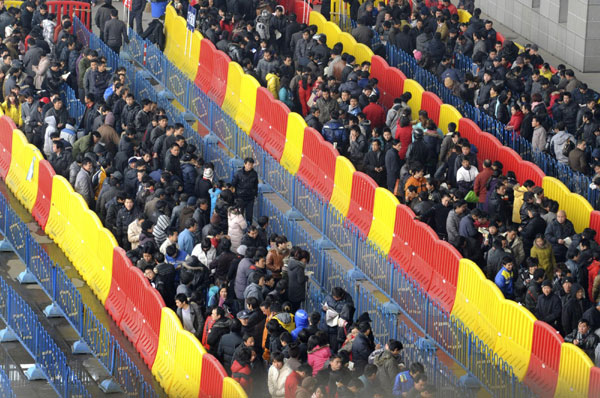 People wait in line to buy train tickets at a temporary ticket office in Ningbo, East China's Zhejiang province, Jan 9, 2011. [Photo/Xinhua]? |
| ||||


Liu and his wife are from East China's Jiangxi province and began working in Hangzhou, capital city of Zhejiang province, a few years ago.
In the past, the ordinary train tickets cost them 76 yuan ($11) apiece. This year, due to the operation of high-speed trains, the number of ordinary trains in service was reduced and cheaper tickets for traveling in these ordinary trains were hard to get.
Liu's wife queued for five hours, but still could not purchase tickets for ordinary trains and the price of a ticket for a second-class seat on the high-speed train plying the railroad between Hangzhou and Nanchang, capital of Jiangxi, was 199 yuan. Therefore, a rail journey back home this year will cost the family an extra 400 yuan, which was about one-third of Liu's monthly salary.
"The time for the rail journey will be, indeed, cut by several hours by traveling in the high-speed train, but I would rather stand for 40 hours in the ordinary train, which is normally crowded," Liu said.
"To us, 400 yuan is a lot of money. With the money, we can buy many things for the festival."
MORE SPEEDY, COMFORTABLE, BUT EXPENSIVE
In fact, Liu's remarks reflected the concerns of many migrant workers and students.
Spring Festival, which will fall on February 3 this year, is the most important traditional festival in China and an occasion for reunions of family members and friends.
The peak travel season during the festival, or Chunyun, which has been dubbed as the "largest migration on the planet", will start on Wednesday.
An estimate by the Ministry of Railways suggests that during the 40-day period, about 230 million trips will be made on China's railway system.
China has the ambition to build the world's fastest rail network as rail cars with the name "China Railway High Speed (CRH)" began appearing in growing numbers in recent years.
According to the Ministry of Railways, China will have a rail network of 110,000 kilometers by 2012, with 13,000 kilometers of high-speed rail.
The latest milestone were high-speed trains between Shanghai and Hangzhou, which began service last October. The prices for first- and second-class seats from Hangzhou to Shanghai soared by 108 and 56 percent, respectively.
At the same time, the number of ordinary trains in service has dwindled.
"Before 2010, about dozens of ordinary trains shuttled between Hangzhou and Nanchang," said Liu Weidong, the migrant worker.
"After four pairs of CRH trains were put into service, however, only ten ordinary train services are still available, making it harder to get cheaper train tickets."
The situation is similar elsewhere. A high-speed train service between Shanghai and Jiangsu province started operating on July 1 last year. Meanwhile, 25 express trains between Shanghai and Nanjing, capital of Jiangsu, ceased operations.
Ma Xinhua from the Zhejiang University of Technology said that 90 percent of the students in his department chose to travel in high-speed trains, though many of them had their expenses doubled because of the travel.
Han Xiaoyang, another college student, feared that ordinary trains would be gradually replaced by high-speed ones.
Her expense budget was 600 yuan a month. Yet the ticket for the lowest-class seat on the high-speed train from Chengdu to Beijing would cost her 322 yuan.
At the same time, trains are becoming increasingly luxurious, which have also helped push up ticket prices.
Dubbed the "most luxurious trains in history", high-speed trains plying between Shanghai and Chengdu, as well as Shanghai and Chongqing, started operations on January 11. Soft berths on trains on both rail routes were all equipped with audio-video displaying system. Within high-class sleeping carriages with cushioned berths on the trains, there were also small meeting rooms. The highest price for a soft berth in the trains plying between Shanghai and Chengdu tops 2,330 yuan, about the price for a night in a 5-star hotel.
CRITICISM AND SUGGESTION
Sun Zhang, a transportation professor with Shanghai-based Tongji University, suggested that in the peak travel season, limited traffic resources be reserved for the needy, low-income passengers.
"Like the migrant workers, they can only go home once a year," he said. "They would rather stand. So can we transform the berth to seats to reduce the cost and improve the capacity?"
Also, columnist Xin Haiguang suggested that government provide subsidies to the railway system to reduce ticket prices.
"To some extent, the railways in China are linked to the public interests and we shouldn't solely pursue commercial profits," he said.
Migrant worker Liu Weidong said he was lucky, as some of his fellow migrant workers who couldn't get ordinary train tickets nor afford the high prices for tickets to travel in high-speed trains, had to give up on the idea of going home during the Spring Festival.
"The high-speed and luxurious trains were for the rich, which has nothing to do with us," Liu said.
"If there is not a fast train, we can take a slower one. If there are no seats we can stand during the journey," he said. "But don't leave us one choice."
 主站蜘蛛池模板:
一本色道久久综合狠狠躁篇|
自拍视频一区二区三区四区|
久久热这里这里只有精品|
久久se精品一区精品二区国产
|
亚洲va久久久噜噜噜久久狠狠|
狠狠色噜噜狠狠亚洲AV|
换着玩人妻中文字幕|
国产一区二区在线有码|
日韩在线成年视频人网站观看|
亚洲精品天堂在线观看|
国产精品高清一区二区三区|
国产精品午夜无码AV天美传媒|
国产suv精品一区二区四|
亚洲VA欧美VA国产综合|
成人国产激情福利久久精品|
国产美女裸体无遮挡免费视频下载
|
日韩毛片在线视频x|
日本一高清二区视频久二区|
四虎库影成人在线播放|
经典三级久久|
国产一区二区牛影视|
日韩精品国产另类专区|
亚洲精品成人一二三专区|
亚洲gay片在线gv网站|
欧美大胆老熟妇乱子伦视频|
国产精品无码av不卡|
亚洲成av人无码免费观看|
我的漂亮老师2中文字幕版|
国产精品麻豆成人av网|
国产精品综合色区av|
一区二区三区激情都市|
亚洲gay片在线gv网站|
97国产成人无码精品久久久|
四虎国产精品永久地址49|
日韩一区二区三区一级片|
国厂精品114福利电影免费|
国产精品久久久久久久专区|
青青草a国产免费观看|
国产精品美女久久久久|
亚洲国产系列|
亚洲A综合一区二区三区|
主站蜘蛛池模板:
一本色道久久综合狠狠躁篇|
自拍视频一区二区三区四区|
久久热这里这里只有精品|
久久se精品一区精品二区国产
|
亚洲va久久久噜噜噜久久狠狠|
狠狠色噜噜狠狠亚洲AV|
换着玩人妻中文字幕|
国产一区二区在线有码|
日韩在线成年视频人网站观看|
亚洲精品天堂在线观看|
国产精品高清一区二区三区|
国产精品午夜无码AV天美传媒|
国产suv精品一区二区四|
亚洲VA欧美VA国产综合|
成人国产激情福利久久精品|
国产美女裸体无遮挡免费视频下载
|
日韩毛片在线视频x|
日本一高清二区视频久二区|
四虎库影成人在线播放|
经典三级久久|
国产一区二区牛影视|
日韩精品国产另类专区|
亚洲精品成人一二三专区|
亚洲gay片在线gv网站|
欧美大胆老熟妇乱子伦视频|
国产精品无码av不卡|
亚洲成av人无码免费观看|
我的漂亮老师2中文字幕版|
国产精品麻豆成人av网|
国产精品综合色区av|
一区二区三区激情都市|
亚洲gay片在线gv网站|
97国产成人无码精品久久久|
四虎国产精品永久地址49|
日韩一区二区三区一级片|
国厂精品114福利电影免费|
国产精品久久久久久久专区|
青青草a国产免费观看|
国产精品美女久久久久|
亚洲国产系列|
亚洲A综合一区二区三区|