Highlights
Fire alarm over high-rise buildings
By Zhang Yan and Cao Yin (China Daily)
Updated: 2011-04-19 08:49
 |
Large Medium Small |
BEIJING - The growing number of high-rise buildings, along with the increasing use of inflammable insulation, is posing a major challenge for urban fire control, a senior police officer warned.
Du Lanping, chief engineer of the fire control bureau under the Ministry of Public Security, said upgrades to firefighting equipment lag far behind the pace of construction of high-rise buildings.
Rapid urbanization has seen an increasing number of super high-rises, with the country now boasting 253 skyscrapers above 150 meters in height, including 46 above 300 meters.
A high-rise in China is defined as a building with more than 10 floors or above 24 meters in height.
But inadequate firefighting equipment, especially hydraulic lifts and water supply devices, cannot guarantee fire control for high-rises, Du acknowledged.
A shortage of manpower is also a problem, she said.
 |
|
Du Lanping is chief engineer of the fire control bureau under the Ministry of Public Security. [China Daily] |
There are only 160,000 people involved in firefighting nationally, a number that is just one twentieth that of the United States, and one tenth that of Russia, she said.
"The lack of qualified firefighters and professional skills pose the biggest challenge we face with rapid urbanization," Du told China Daily in an exclusive interview.
Du also warned that the growing use of inflammable insulation on the outside of high-rise buildings is a hidden danger that allows fires to quickly spread.
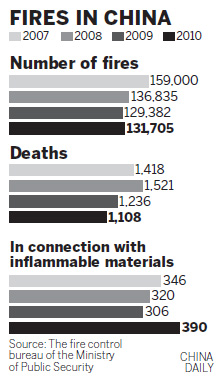
From 2007 to 2010, the country saw a total of 1,359 fire disasters connected to the use of insulation, claiming 75 lives and injuring 87 people and leading to economic losses of billions of yuan, according to the fire control bureau.
Four billion square meters of new buildings in China, including nearly half of the 1,000 high-rises in Beijing, have used inflammable insulation.
The insulation is mainly made up of polystyrene and polyurethane foam plastic, which are widely used because of their energy-saving qualities, including heat preservation, cheap price and easy maneuverability, Du said.
"But they are inflammable and combustible and when burning they produce large amounts of toxic gases, such as carbon monoxide and hydrogen cyanide, posing a threat to life," she said.
A blaze at a 28-floor apart-ment building in Shanghai that killed 58 people and injured 71 on Nov 5, 2010, was caused by polyurethane being ignited by welding equipment and catching fire.
Du said her ministry has issued a regulation banning the use of inflammable insulation for new residential buildings.
The regulation stipulates that local authorities should tighten the management and supervision of the use of this type of insulation for existing residential buildings, and take it into account when conducting a safety inspection, she said.
New residential buildings are required to use class-A noncombustible, inorganic material, rather than thermal layers of combustible insulation on outside walls, she said.
For approved buildings under construction, if they have used inflammable insulation, local governments will supervise construction units to remove them, Du said.
In regard to insulation for completed residential buildings, the fire control department are currently working with housing and urban-rural development authorities to carry out safety inspections, Du said.
Kang Qingchun, a professor specializing in fire control research at the Chinese People's Armed Police Force Academy, said China is suffering a shortage of advanced facilities and firefighters as well as insufficient training in tackling fires. "Moreover, the command system is far from perfect, with poor communication and cooperation in fighting fires," he said.