Society
Census: Population hits 1.37b
By Shan Juan (China Daily)
Updated: 2011-04-29 07:41
 |
Large Medium Small |
Nearly half live in urban areas and 13 percent are over 60
BEIJING - As China's population hits 1.37 billion people, challenges, including an ageing society and labor crunches, may prompt the authorities to fine-tune the 30-year-old family planning policy.
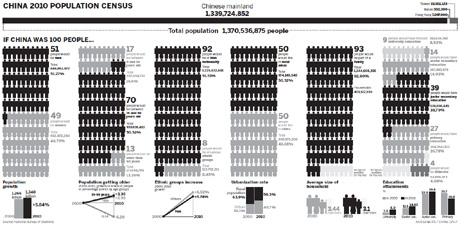
The population increased slightly by 73.9 million people in the past decade, due largely to the policy limiting most urban couples to just one child, according to preliminary results from the sixth national census released on Thursday by the National Bureau of Statistics (NBS).
Rapid urbanization has been a notable feature of the past decade and the census also revealed an ageing population. Nearly half of the 1.37 billion people, including 1.34 billion on the mainland, now live in urban areas, up 13.46 percentage points from 2000. Those over the age of 60 make up 13.26 percent of the population, up 2.93 percentage points from the count a decade ago.
|
||||


The search for better opportunities was the reason people left poorer inland areas to go to eastern costal areas, NBS chief Ma Jiantang said.
The economic engine of Guangdong province, where many migrant workers flocked to for employment, replaced agricultural Henan province in Central China as the most populous area on the mainland.
"That migration benefits both regions in terms of local economic development," Ma said.
However, he also conceded that the sheer scale of the floating population was also a challenge to social economic development.
Policies like the hukou system, or household registration, have meant migrant workers do not enjoy social welfare at their new place of living, and there were fears that this could threaten social stability.
President Hu Jintao stressed on Tuesday that services for the floating population should be improved.
Other major challenges, according to Ma, include youths accounting for a lower percentage of the population, an ultra low fertility rate, and a skewed sex ratio at birth, he noted.
The proportion of mainland people aged 14 or younger was 16.6 percent, a fall of 6.29 percentage points from the 2000 census.
In East China's Shanghai municipality the fertility rate (the total number of children a woman would bear during her lifetime) of 0.8, is among the world's lowest, according to official statistics. In most developed countries, a fertility rate of 2.1 is needed to replace the population over time.
"Over the past 10 years, the population of all of the 31 provinces, municipalities and autonomous regions (on the Chinese mainland) have increased, and all face the problem of rapid ageing," Ma told reporters.
"These need to be urgently addressed with more balanced, comprehensive, and targeted policies."
The family planning policy has managed to substantially lower the country's fertility rate from 5.8 in the 1970s to the current 1.8 in just 30 years, Ji Baocheng, president of Renmin University of China, said.
Ma admitted that the "somewhat compulsory and unnatural" intervention had also caused and worsened the problems.
But he also emphasized the contribution of the family planning policy in curbing population growth decades ago.
Yuan Xin, a professor with Tianjin-based Nankai University's population and development institute, told China Daily that rising government recognition of problems stemming from the family planning policy might herald further improvements, if not changes, to population policy.
"Given that the situation varies regionally, there won't be uniform adjustments nationwide," he said.
"Regions like Shanghai might take the lead in change, probably by first easing the ban on urban couples. If either was an only child they might be allowed to have a second."
 Click for the larger picture |
Ma said that generally speaking eastern costal areas were facing steeper challenges.
Currently only urban couples who were both single children can have a second child.
However, media reports citing surveys showed a rising number of urban dwellers were reluctant to have more than one child, due to financial burdens.
Yuan said that was in line with a global trend.
He also expected that, eventually, the disparity concerning the allowed number of children to couples in both urban and rural areas would be eliminated.
However, given that the population issue is complicated with far-reaching consequences, "time, study, and great caution are needed to improve the situation in a comprehensive manner," Ma said.
President Hu said on Tuesday that China should adhere to the basic State policy of family planning and deal with its population problems with the aim of achieving the all-round development of its people.
China will stick to, and improve, its current family planning policy and maintain a rationally low birth rate, the president said.
Problems concerning the birth-sex ratio should be addressed, and gender equality efforts enhanced, he said.