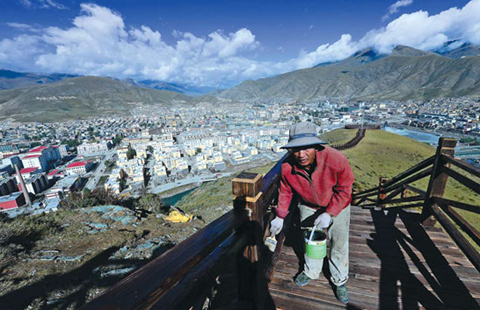
LHASA - Much to Tibetan herder Druse's delight, his income has kept rising over the past few years, as his livestock have been well-fed on a pasture that has been turning ever greener, thanks to initiatives that have effectively eased the deterioration of grasslands.
Druse's improved outlook is shared by many other herders on the Qinghai-Tibet Plateau, as China has been strengthening efforts to protect the area's natural credentials at a time when global warming and over-exploitation are endangering the roof of the world.
The officials, environmentalists and farmers involved are all reflecting on their success as the world prepares to mark "Earth Day," an annual promotion of the Earth's natural environment, on Sunday. But they are also aware that many challenges lie ahead.
In the past five years, southwest China's Tibet autonomous region has invested more than 10 billion yuan ($1.58 billion) in ecological preservation, says Zhang Yongze, the regional environmental protection chief.
Zhang says a project aiming at returning grazing land to grassland, which has been in place since 2004, has significantly increased grass production in the region.
Tibet has planted 114,733 hectares of trees, prevented 42,666 hectares of land from desertification and reverted 39,000 hectares of farmlands into forests during the past five years, the official adds.
Tibetan farmer Phurbu Tsering has found that the strong sandstorms that used to disrupt his work in spring have been greatly eased in recent years. "The weather has been very nice during spring ploughing this year and sandstorms are rarely seen," he says.
According to the local environmental protection department, the number of days witnessing sandstorms in Lhasa, Xigaze, and Shannan prefectures has reduced by more than 30 a year from three decades ago.
"I am so happy to see that grasslands in my hometown have been turning greener and denser during the past several years and some shrinking lakes have also been restored," notes Changdri, a herder in Maduo county, northwest China's Qinghai province.
Changdri is one of the 50,000 people who have been relocated from grasslands to cities and townships after a 7.5-billion-yuan project was launched by the central government in 2005 to repair the ecology of Sanjiangyuan and transform it into an unpopulated nature reserve.
The 395,000-square-km Sanjiangyuan region is the source of China's three major rivers: the Yangtze, Yellow and Lancang waterways.
"Surveillance data showed that an average of 56.435 billion cubic meters of water flowed out of the region annually from 2005 to 2010, compared with 47.7 billion cubic meters in 2004," according to Li Xiaonan, deputy director of the Sanjiangyuan Ecological Preservation and Construction Office.
In the same period, the region's major lakes swelled by 245 square km, he adds.
With abundant glacier resources, rivers, wild animals and plants, the Qinghai-Tibet Plateau region is widely recognized as a potential regulator against climate change for Asia and the entire Northern Hemisphere.
However, experts warn, although part of the plateau has witnessed environmental restoration, the overall natural environment there is worsening, as the plateau is extremely susceptible to global warming and the rate at which its temperatures are rising is above the global average.
Data from the Sanjiangyuan Ecological Preservation and Construction Office shows that the average temperature of Qinghai province rose by about 0.35 centigrade every 10 years from 1961 to 2008, and the rate in Tibet was 0.32 centigrade. This compares unfavorably to the national average of 0.05 to 0.08 centigrade degrees every 10 years.


Copyright 1995 - . All rights reserved. The content (including but not limited to text, photo, multimedia information, etc) published in this site belongs to China Daily Information Co (CDIC). Without written authorization from CDIC, such content shall not be republished or used in any form. Note: Browsers with 1024*768 or higher resolution are suggested for this site.
License for publishing multimedia online 0108263 Registration Number: 130349