Comments()
  Print
Print  Mail
Mail  Large Medium Small
 |
|
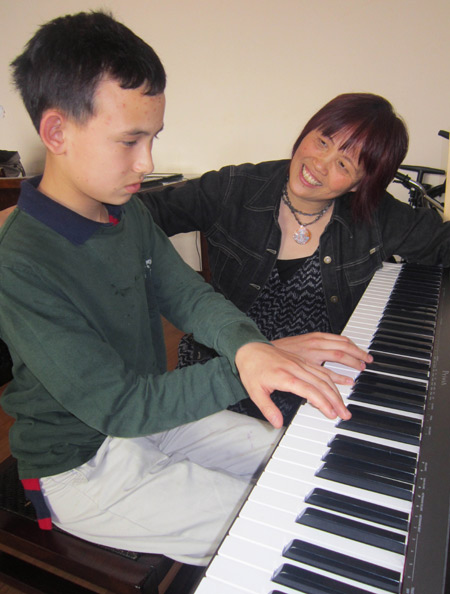
Lin Yancheng watches as her 13-year-old son Samuel plays the piano in their Beijing home PROVIDED TO CHINA DAILY |
He looked a little excited about his first trip to China, and kept giggling in the minibus speeding down the country road in a Beijing suburb.
When the giggling turned into shrieks, his mother Lin Yansheng stopped him immediately.
"Samuel, do you still want to perform?"
"Yes."
"Then what?"
"Quiet," said the boy, looking down at the teddy bears without any other words.
For the past 13 years in the United States, as a mother with an autistic child, Lin is used to this kind of conversation.
"Samuel just won't be good for any period of time unless he is playing some musical instrument," Lin said.
Despite the special efforts required, her son learned to play the piano, the cello and the pipa, a stringed Chinese lute, in the past nine years.
"It was unimaginably difficult to teach a child like Samuel, but I managed. So I brought him to China with his friends to let more Chinese parents with autistic children know that there is still hope for these children," Lin said.
Born and raised in China, Lin left her post as a college teacher in 1991 to study education in the US. Then she married and settled there.
However, when Samuel was four years old, he was diagnosed with autism, a neural development characterized by impaired social interaction and communication, and by restricted and repetitive behavior.
"For a year, I was just shocked. I thought I must have done something bad, that God was punishing me," Lin said. "It took me a whole year to recover from the depression."
Lin quit her job and became a full-time caregiver for Samuel, but she found what she had learned from college didn't work on Samuel at all.
"You can't imagine how difficult it was to teach him to sit on a chair, to look at me and say hello," Lin said. "You just repeat the simple move for months before he starts to understand."
Lin bought countless teaching aids, including tools to teach autistic child about traffic lights, telling time or counting money.
"Meanwhile, I was also wondering whether it was possible to buy these kinds of tools in the Chinese market. If not, how did parents there cope with the education of autistic children?" Lin asked.
Last December, Lin came back to China to find answers. After investigating several NGOs for autistic children, Lin made up her mind to do something.
"Official organizations for disabled people focus more on protecting the rights of visually impaired people or physically disabled people, but do not pay much attention to those with mental disabilities. In society, few know about autism, let alone have educational aids or services provided for this group," Lin said.
Lin packed four suitcases with teaching tools that she bought over the years and donated them all to China NGOs.
Sun Zhongkai, director of a Chinese NGO for autistic children, said his NGO Xingxingyu is sharing the tools with four other NGOs, which they have found very helpful.
"Chinese parents usually care more about children's academic performance, but they tend to neglect the fact that autistic children can be trained with a lot of other skills, though they are not good at communication," Sun said.
What made Lin feel even worse is that some autistic children lead "invisible" lives.
"The parents hide these children at home, being afraid of other people's discrimination," Lin said.
To encourage the parents, Lin hopes to use her own story as an example, to let them know about autistic children's talent for music and art.
Last December Lin collected a fund of 35,000 yuan ($5,500) from a TV program with Jiangsu Television Station. With the fund, she managed to gather another five autistic children to form a small band in the US. Then she brought the band to Beijing and gave two performances in a small theater in Beijing's Daxing suburb in April.
After the show, around 300 parents and their autistic children swarmed the stage and took photos with the band, some with tears in their eyes.
"At first I worried that people would make comments if they found I had an autistic child, so I didn't want to take part in the show," said Yang Haiping, a 32-year-old mother from Beijing.
"Actually it was not only me, but all the parents like me have this concern. But I saw a US child playing electronic drums, which are easy for the child to control. I thought, maybe my child could play that, too," Yang continued.
"After all, you can't always hide your child at home."
chengyingqi@chinadaily.com.cn

 Modeling contest part of China-US exchange
 Specially fertilized tea
 Simulator to support A320neo commissioned
 China's cultural sector sees steady growth in 2011
 Travel chaos after snowstorm hits NE China
 Inflation expected to rebound in November
 Grain output grows for 9th consecutive year
 White House-like buildings in E China city
Copyright 1995 - 2010 . All rights reserved. The content (including but not limited to text, photo, multimedia information, etc) published in this site belongs to China Daily Information Co (CDIC). Without written authorization from CDIC, such content shall not be republished or used in any form. Note: Browsers with 1024*768 or higher resolution are suggested for this site.
Registration Number: 20100000002731