While battle movies are not as popular as they once were in China, August First
Film Studio is keeping the red flag flying and updating the genre. Sun Li reports.
War movies are no longer a popular category for jaded audiences, but August First Film Studio, a unit of the Chinese military, has been enhancing the charisma of the genre.
Founded on Aug 1, 1952, to coincide with the anniversary of the founding of the People's Liberation Army (PLA) in 1927, the studio has produced more than 2,200 films that range from features to documentaries. Many of them are considered to be timeless masterpieces and have won prestigious awards.
As the studio is about to celebrate its 60th anniversary, a retrospective is underway on CCTV-6, showcasing a series of classic revolutionary films, which mostly premiered in the 1950s and 1960s.
Feng Enhe, a veteran actor with the studio, says when August First is mentioned most people automatically think of the studio's black-and-white movies.
 |
|
Actress Yao Chen stars in My Long March, which narrates the story from a child soldier's angle. |
"In the past, people didn't have as much entertainment as today's folk do," the 62-year-old says, adding that watching films was a major pastime and patriotic revolution-themed films were then in vogue.
"Blending intriguing plotline, intensive battle scenes and vivid portraits of characters played by marquee idols of that time, many old war films of the studio have been seared into the collective consciousness," Feng says.
"For people around and above the age of 40, August First's old films are still a hot topic."
Liu Jianwei, vice-president of the studio, acknowledges the studio is encountering a challenge replicating its erstwhile cinematic glory.
"The thing is, almost every monumental event of the various war periods in which the PLA were involved, has been covered in previous decades," Liu says.
"Even though you know a film is a remake of a classic, it has to have some changes to avoid being a cheesy repetition and win over audiences.
"In the mid-1990s, Hollywood blockbusters marched into domestic cinemas and stole the spotlight," Liu continues.
"Foreign war movies that feature more realistic and grandiose combat scenes and often bring a human touch to the harshness of war have influenced audiences' taste for military movies."
 |
|
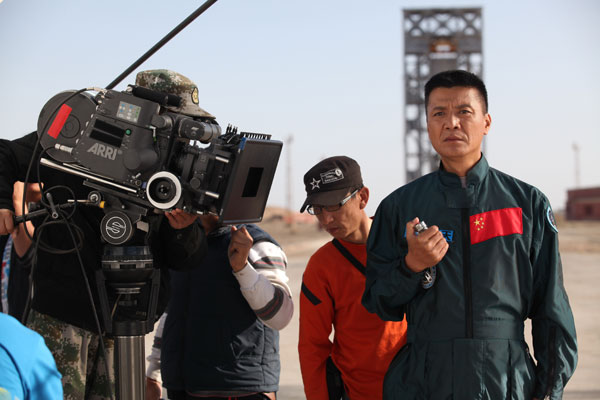
Shenzhou II, which depicts astronauts on a manned space mission, broadens the boundary of war films. |
"The war film as a genre is not as popular as it used to be. Also competing for viewers' attention these days are other categories of films such as comedies and costume dramas," Liu adds.
As a PLA-backed studio, August First has advantages when it comes to shooting war films.
In the early 1990s, to chronicle the War of Liberation (1946-49), the studio produced a three-part film that is 25 hours and 10 minutes long, in total. More than 3 million PLA soldiers participated in the filming of the epic.
To shoot Sky Fighters (2011), a Top Gun-style film featuring a state-of-the-art jet battle, the studio borrowed real J-10 fighters.
"But to revive war films, the essential thing is to make changes," Liu says, noting one stereotype of classic war films is that the heroes are always flawless, while the villains are stereotypes.
"If the studio does not abandon this outdated narrative and characterization, its films will be ignored," Liu says.
Representing this change is Taihang Mountain (2005), a film about the first three years of the War of Resistance against Japanese Aggression (1937-45).
Instead of centering on former chairman Mao Zedong, a common protagonist in films set during this period, the movie omitted Mao and focused on Zhu De, another army leader.
Another example is My Long March (2006), which depicts the famous military maneuver led by the Communist Party of China, from 1934 to 1936, from a child soldier's perspective.
Song Yeming, a director with the studio, believes modern war movies need to cater to the post-1980s audience.
In Song's The First of August (2007), a film about the birth and the rise of the PLA, Hong Kong actor Ray Lui plays the general Ye Ting.
Using Hong Kong stars, rather than "special-type" actors who have a strong physical resemblance to political leaders, is a trend in today's war films as Hong Kong casts can enlarge the film's appeal to the mainland's young audience, Song observes.
Even if the changes work, war films are not likely to be as popular as they used to be, August First's Liu says.
"In peacetime, the army's mission has changed from attacking, to defending the country. So the angle and the subject of today's war films also require modification," Liu says.
Liu says war films should be broadly defined and points to two films on which he was a screenwriter, namely Stands Still, the Last Great Wall (2009), about a group of soldiers rescuing victims of an earthquake; and Shenzhou11 (2011), about astronauts carrying out a manned space docking mission.
"Both the two films I wrote bear the core imprint of war movies," Liu says.
"The enemy now becomes the natural disaster and modern soldiers deal with space warfare. To complete a mission nowadays is like winning a war in the past. It requires collective efforts and it values people's courage, wisdom and fortitude."
Commenting on the studio's latest film about the CPC Central Commission for Discipline Inspection's anti-corruption campaign, Liu says the conception of the "war film" will continue to evolve.
The studio is also involved in film dubbing and produced the Chinese soundtrack for such blockbusters as Saving Private Ryan and Pearl Harbor.
The studio is expected to conduct more dubbing missions for foreign war films in the future as the annual quota for foreign films to China has increased from 20 to 34, Liu says.
Contact the writer at sunli@chinadaily.com.cn.


Copyright 1995 - . All rights reserved. The content (including but not limited to text, photo, multimedia information, etc) published in this site belongs to China Daily Information Co (CDIC). Without written authorization from CDIC, such content shall not be republished or used in any form. Note: Browsers with 1024*768 or higher resolution are suggested for this site.
License for publishing multimedia online 0108263 Registration Number: 130349