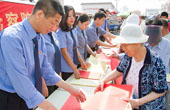
Should a charity organization pay its volunteers for the good deeds they do?
Judging by the reaction to the news that Shilehui, a Web-based charity gives its workers a 15 percent commission on money they raise, it would suggest many would say "no".
Experts have said giving fundraisers commissions is a risky move, largely due to the lack of regulations preventing fraud and other abuses.
|
 |
Fang Lu, founder of Shilehui, which supports disadvantaged individuals through online fundraising, dismissed the controversy about his group's methods on Tuesday. Fang said the "rewards" merely cover the volunteers' expenses. He blamed the reaction on a lack of public understanding of the industry.
Based in East China's Zhejiang province, Shilehui has been operating since 2009 and is registered with Jinhua city's civil affairs bureau.
"We support poor students, people with disabilities, the elderly and those struggling to pay medical fees for severe diseases," Fang said. "From our previous experience, we realized most people in tough economic circumstances can't afford to, or don't know how to, access the Internet, so we need volunteers to look for the needy, check their identities and then raise funds for them."
With only 11 permanent staff members, the group began recruiting volunteers — at first unpaid — to handle fundraising and other operations in March last year.
Relying on unpaid volunteers, however, resulted in low efficiency and poor quality projects, Fang said.
"Some volunteers collected incomplete information from people who needed urgent help. Sometimes those people passed away before enough money was collected to help them."
More than half of the 30 people initially recruited nationwide quit due to a lack of financial support.
This was largely due to the way Shilehui operates. It works like an e-commerce charity, with registered donors playing the part of "buyer" and having accounts they can top up, while the fundraisers are "sellers" who promote their campaigns to attract attention.
However, it means volunteers have to hand over their own money to intended beneficiaries before a campaign begins, and then raising the funds to recoup their loss.
"So, in April, we decided to explore recruiting fundraisers by offering a financial reward for every campaign completed," Fang said.
Controversy
In July, netizens began raising concerns about the charity. Some accused it of sending "spam" e-mails, while others claimed it was being used as a tool to make profit.
According to a recent Oriental Morning Post report, which cited information from Shilehui's website and calculations from a Web user, a volunteer in Henan province earned 2,700 yuan ($425) commission from raising a total of 18,000 yuan in a day from online donors to help nine elderly people.
Fang confirmed that the maximum amount a volunteer can receive is 15 percent, but he said the example used by the paper was "an extreme case".
"By the end of August, our 60 (paid volunteers) have raised about 2 million yuan and received less than 200,000 yuan as commission," he said.
Zhang Xiaoya, 35, from Nanyang in Henan province was ranked second on Shilehui's latest list of the top five fundraisers, after she collected more than 76,000 yuan in August. She used to run an accessory store but decided to begin working full-time as a Shilehui fundraiser in May.
"It's not a high income job, as 300 yuan is the payment cap for each campaign we complete," she said, adding that she has invested 50,000 yuan but has so far only claimed 12 percent from the Shilehui account that donations are paid into.
"It's definitely a high pressure job because we have to give money to those people in need in advance and if we can't reach our target sum our own hip pocket takes a hit," she said.
According to the Shilehui website, among the people Zhang has helped is Qin Shengsong from Nanyang.
A post dedicated to raising money for the 74-year-old villager showed Zhang visited him on Aug 21 and gave him 1,200 yuan to help with his living expenses. It said Qin, who is a bachelor, has diabetes and high blood pressure.
Pictures uploaded include one showing Qin holding the money with two volunteers and a village official outside his shabby home. Alongside it is a pledge signed by Qin to prove he received the money and a letter carrying the stamp of the village committee.
Zhang aimed to raise 1,400 yuan, 200 yuan of which was to cover her food, transport and cell phone costs during visits to Qin.
"We have not signed any employment contract with Shilehui but the work requires regular visits to remote or mountainous areas to reach the poor, so sometimes I also worry that no one will take care of my safety if I have an accident," she said.
Volunteers also run the risk of being left out of pocket.
Fang said that about 100 of the more than 700 campaigns launched by their voluntary fundraisers have not reached their intended target.
When asked about how to avoid charity fraud, the charity founder said four permanent staff members make calls to confirm the information of both paid volunteers and beneficiaries. He also encouraged netizens to supervise by following information published on its website.
But does it work?
Although controversial, the model of using paid fundraisers appears to have worked for Shilehui.
Fang said the organization has raised 12 million yuan in the first eight months of this year, compared with 9.18 million in 2011 and 2.7 million in 2010, and helped some 7,300 families in need.
An official who gave his name only as Mao at Jinhua's civil affairs bureau, said on Tuesday that Shilehui had passed all annual inspections on its operations and financial management since 2009.
China has no specific regulation on the use of paid volunteers, according to Meng Zhiqiang at the Ministry of Civil Affairs' philanthropy division.
Song Zonghe, information director for the China Charity and Donation Information Center, a nonprofit organization in Beijing, said paid fundraising is common in developed countries, and suggested the controversy it triggered in China was due to the public being ignorant of how charities are run.
Song urged the government to speed up the development of a standard for the profession, and to create rules to allow a reasonable proportion of donations to be deducted as payment for fundraisers.
Deng Guosheng, a professor of philanthropic studies at Tsinghua University, agreed and called for the establishment of an industry association to guide and supervise the conduct of fundraisers.
Contact the writer at hedan@chinadaily.com.cn


Copyright 1995 - . All rights reserved. The content (including but not limited to text, photo, multimedia information, etc) published in this site belongs to China Daily Information Co (CDIC). Without written authorization from CDIC, such content shall not be republished or used in any form. Note: Browsers with 1024*768 or higher resolution are suggested for this site.
License for publishing multimedia online 0108263 Registration Number: 130349