| ?
 |
|
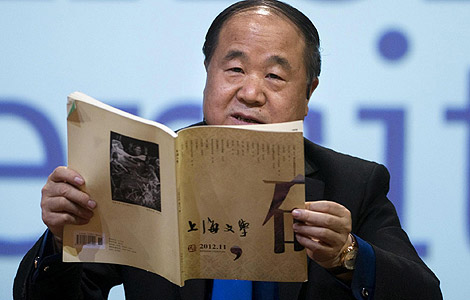
?2012 Nobel Literature Prizewinner Mo Yan of China reads from a book during a public reading of his works at Aula Magna, Stockholm University, December 9, 2012.[Photo/Agencies]
|
The overseas edition of the People's Daily, the flagship newspaper of the Communist Party of China, on Monday published the full text of Mo's lecture, and there has been much discussion of its content among literature pundits and members of the public.
In the lecture, the Nobel laureate talked about how he started storytelling as a child and shared with listeners his memories of childhood and his mother, "the person who is most on my mind at this moment."
"Misery, humanity, love, understanding and tolerance are the key words of Mo's speech. Through them, he responds to the universal values of the human," Ye Kai, senior editor of noted Chinese literature magazine "Harvest," said in a post on Sina Weibo, China's Twitter-like microblogging service.
"Mo's speech, which teems with love for his mother and his hometown, touched me greatly. Can an author use love in their heart to create a success in his writing?" wrote weibo user "westerntercel0205."
In addition to the emotional resonations, more people said Mo's lecture, which underscored the writer's desire to tell stories, should be regarded as therapy for a Chinese literature circle which is facing a shrinking readership.
In the lecture, titled "Storytellers," Mo described himself as a storyteller and said that it is this characteristic that earned him the prize.
"I have yet to read any of Mo's books, but watching his speech in Sweden, I like his stories rolling off the tip of his tongue. Maybe he was born to be a good storyteller, and loving listening to stories is the nature of all human beings." said weibo user "Liltiff."
Mo's lecture has reminded many Chinese writers to retrieve their ability to tell stories, said Chen Jibing, a commentator in Shanghai.
While many blame the difficulties of Chinese contemporary literature on the external environment, it should be realized that the true reason lies in our slipping capability, as well as enthusiasm, of telling good stories, Chen said in an article published in Monday's edition of the Beijing News.
Chinese culture and literature encompass many profound concepts. Mo's narrative writing, that takes complicated stories and simplifies them into vivid accounts, has reduced the "cultural discount," a loss of connotations that occurs in cross-cultural communications, and helped him to be better understood by Western readers, according to Zhang Yiwu, a cultural critic and professor with Peking University.
However, the lucid story-telling style of Mo's writing also received criticism from others.
Wolfgang Kubin, a sinologist at Bonn University in Germany, previously criticized Mo's writing as outmoded and "without independent thought."
Fang Xingdong, founder of popular blogging site bokee.com, said in a microblogging entry that the obscurity of Mo's works reflects his lack of writing technique, rather than his wisdom or profundity.
"It was lucky for him to win the prize, but we have to admit that he can't qualify as a top 10 writer in China," Fang said.
Cultural critic Zhang Yiwu disagrees. "Different people's opinions on a same literary work may vary, and I think Mo's books contain his incisive observation of human nature and reflection of a man's destiny."
However, Zhang stressed that narrative writing should not become the only fashion for Chinese literature, and authors should still explore their own distinctive styles to attract domestic and foreign readers.
Mo Yan, a pseudonym for Guan Moye, was born in 1955 and grew up in Gaomi in east China's Shandong Province.
In his writing, Mo draws on his youth and the province of his birth, which are most apparent in his novel "Red Sorghum," which was made into a film by director Zhang Yimou.
"Big Breasts and Wide Hips" and "Life and Death are Wearing Me Out" are also among his most famous works. His works have been translated and published in English, French, Swedish, Spanish, German, Italian and Japanese.
In Mo's works, "hallucinatory realism merges with folk tales, history and the contemporary," according to the official Noble citation.



Copyright 1995 - . All rights reserved. The content (including but not limited to text, photo, multimedia information, etc) published in this site belongs to China Daily Information Co (CDIC). Without written authorization from CDIC, such content shall not be republished or used in any form. Note: Browsers with 1024*768 or higher resolution are suggested for this site.
License for publishing multimedia online 0108263 Registration Number: 130349