

 Comments()
  Print
Print  Mail
Mail  Large Medium Small
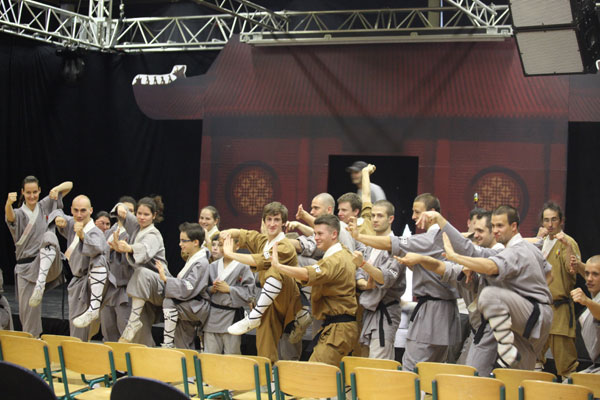
Hungarians are rehearsing their kong fu performance in the bilingual Hungary-China School based in the outskirt of Budapest, to welcome visiting Vice-Premier Li Keqiang on Monday afternoon. [Photo/China Daily]
Erdelyi Zsuzsanna is an ambitious headmistress at a Hungarian school who says her students, who study Chinese and Hungarian, will have more chances than others to compete for Nobel prizes later in life.
The logic behind her belief is simple: Hungary, with population of only 10 million, has produced 14 Nobel laureates to date. Some say such an impressive achievement is mainly because the complexity of speaking Hungarian makes people smarter.
"Our students learn Chinese and Hungarian, among the world's hardest languages, and such training may well prepare some of my students to reach that high level," Zsuzsanna said in her office at the bilingual Hungary-China School in the outskirts of Budapest.
"In addition, the hard-working spirit of Chinese kids is a plus to achieve that."
The school, the only bilingual one in Europe where Chinese is taught, has recruited nearly 300 students, and more than half of them are Hungarians. Under an agreement between the governments, the school started in September 2004.
Though she said she would feel proud of her students if they win Nobels prizes one day, Zsuzsanna says her primary goal is to turn the students into global citizens who can understand one another's cultures.
"And when they grow up, they should take a leading role in bridging the gap of understanding among cultures," said Zsuzsanna, who is also learning Chinese now.
Guo Jiaming, deputy headmaster, said the school is already an international community and the children from many countries have joined the Chinese and Hungarians.
Especially since the 2008 Beijing Olympics, Guo said, the enrollment has seen more and more Hungarians. "China has become increasingly prominent globally since the Olympics, and I think their parents have made a good decision," said Guo.
Sixty-five percent of the courses are taught in Hungarian and the rest in Chinese, Guo said.
"From everyday growth and understanding each other's cultures, these kids will hand down a lasting friendship between China and Hungary when they grow up," said Guo, who left Beijing for Hungary in 1997.
Guo said the school has won support from Hungarian and Chinese leaders. Premier Wen Jiabao and Vice-President Xi Jinping have visited it.
And now it is the turn of Vice-Premier Li Keqiang, during his 10-day tour of Russia, Hungary and Belgium and the headquarters of European Union. Li was to visit the school on Monday afternoon.
Meanwhile, a team of Hungarians would perform Chinese kung fu and tai chi for Li and his delegation.
"With the performance, we will send a message to Vice-Premier Li that we are educating the next generation of Chinese and Hungarian who are assimilating each other's cultures," said Zsuzsanna. "And they will become backbone of lasting Chinese-Hungarian friendship."
Exchange track
Chinese arts and cultures are popular in Hungary now as frequent economic, trade and people-to-people exchanges have occurred during the recent years. About 30,000 Chinese live in Hungary.
"Cultural exchanges between the People's Republic of China and the Republic of Hungary started early in the 1950s", said Yang Song, division chief of Liaison Office of the Ministry of Culture.
In 1951, the two countries signed an agreement on bilateral cultural cooperation from 1952 to 1966. Under the framework of the agreement, they carried out extensive cultural exchange in variousl fields in the following years.
The exchanges were interrupted in the 1970s, however, by the "cultural revolution" (1966-76). In the 1980s, the Sino-Hungarian cultural exchanges resumed and gradually gained momentum.
As the Hungarian economy rose in the 1990s, unofficial cultural exchanges between the two peoples gradually emerged. After Hungary joined the EU on May 1, 2004, Sino-Hungarian exchanges increased dramatically.
Recent years have seen official and unofficial exchanges grow. In 2005 and 2007, the Hungarian Economic and Cultural Week and Hungary Festival were held in Beijing.
The year 2009 brought the 60th anniversary of the founding of the Sino-Hungarian Friendly Diplomatic Relations and a Chinese Cultural Festival was staged in Budapest.
The event featured performances of ethnic song and dance, Chinese ink art exhibitions and screenings of Chinese movies.
At least 10,000 Hungarians visited the festival, lifting the exchanges to new heights, said Li Wennan, an organizer with Liaison Office of Ministry of Culture.
From June 14 to July 4, 2011 a grand Hungarian Contemporary Art Exhibition was be held at the National Art Museum of China in Beijing. In return, a grand exhibition of Chinese art titled Openness and Integration will be held from Aug 8 to Sept 9 at the Museum of Fine Arts Budapest.
"As a key cultural exchange program between the two countries, the art exhibition is aimed at presenting a great variety of Chinese contemporary art to the Hungarian people," said Fan Di'an, director of the National Art Museum of China.
Beginning in 1978, with China's opening up and reform, Chinese art turned a new page and found room to develop. The exhibition chronicles the rise of contemporary Chinese art from 1978.
The three-part exhibition will show 133 Chinese ink paintings, calligraphic scrolls, oil works, lithographs, and sculptures, giving viewers a glimpse of the active and diverse contemporary art scene in China.
"I believe Hungarian people will be enchanted by the unique styles and creative vitality of Chinese artists. And through these artworks, they can feel the pulse of a rapidly changing Chinese society," said Fan.
Contact the writers at fujing@chinadaily.com.cn and zhulinyong@chinadaily.com.cn
Copyright 1995 - 2010 . All rights reserved. The content (including but not limited to text, photo, multimedia information, etc) published in this site belongs to China Daily Information Co (CDIC). Without written authorization from CDIC, such content shall not be republished or used in any form. Note: Browsers with 1024*768 or higher resolution are suggested for this site.
License for publishing multimedia online 0108263 Registration Number: 20100000002731 
