Comments
  Print
Print  Mail
Mail  Large Medium Small
6. Efforts to ensure and improve the people's wellbeing were comprehensively strengthened.
Urban and rural incomes continued to grow. Urban per capita disposable income and rural per capita net income reached 19,109 yuan and 5,919 yuan respectively, up 1,934 yuan and 766 yuan, or 7.8% and 10.9% from the previous year in real terms after adjusting for inflation, and 1.8 and 4.9 percentage points higher than the target figures. This is the first time since 1998 that rural income growth has surpassed urban income growth.
(Figure 10: Real Growth in Urban and Rural Incomes in the Eleventh Five-Year Plan Period)
Employment grew steadily. We intensified the implementation of a proactive employment policy. We improved primary-level public service facilities for employment and social security, and set up 162 county-level and 610 township-level service centers in the central and western regions. Over the year, 11.68 million urban residents entered the workforce for the first time, exceeding the target by 2.68 million, and the urban registered unemployment rate was 4.1%, which met the target.
The level of social security continued to rise. By the end of 2010, the number of urban participants in basic pension insurance reached 256.73 million, 16.73 million more than planned; and we extended the trials of a new pension insurance system for rural residents to 24% of the country's counties. The methods for transferring basic pension accounts for employees of urban enterprises and transferring basic medical insurance accounts for migrant workers were implemented smoothly. Basic medical insurance covered 432.06 million urban residents, an increase of 30.59 million over the previous year; and 835 million rural residents, or 96.3% of the rural population, signed up for the new rural cooperative medical care system, 2.1 percentage points higher than the previous year. We raised the standards of subsistence allowances for urban and rural residents, unemployment insurance benefits, the basic pension for enterprise retirees, subsidies and living allowances to entitled groups, and government aid to students from poor families. Post-disaster recovery and rebuilding work progressed smoothly, the three-year post-Wenchuan earthquake recovery and reconstruction tasks were basically completed within two years, and the recovery and rebuilding work is well underway in Yushu and Zhugqu.
(Figure 11: Participation Rates in the New Rural Cooperative Medical Care System in the Eleventh Five-Year Plan Period)
The development of low-income housing projects was carried out on a large scale. The central government further raised subsidies for building low-rent housing and renovating rural dilapidated houses in the central and western regions, expedited the development of public rental housing, and included it in the low-income housing program. In 2010, work was begun to build low-income housing and renovate run-down areas across the country with a total of 5.9 million units, surpassing the target by 100,000 units. This figure consists of 3.22 million units of low-income housing and 2.68 million units of housing in run-down areas; and throughout 2010 work was basically completed on 3.7 million units.
Social development was strengthened.
The National Medium- and Long-Term Plan for Education Reform and Development and the National Medium- and Long-Term Plan for Human Resources Development were promulgated and implemented. A total of 13.25 million square meters of primary and secondary school buildings were renovated in rural areas, and construction was completed on 2.12 million square meters of secondary vocational school buildings. The goals of making nine-year compulsory education universally available and basically eliminating illiteracy among young and middle-aged adults were attained for 100% of the target population in the country. The junior secondary school retention rate reached 94%. The secondary gross enrollment ratio reached 82.5%, up 3.3 percentage points. The tertiary gross enrollment ratio was 26.5%, with 6.618 million undergraduate students and 538,000 graduate students enrolled.
Smooth progress was made in developing the medical and health service system. We supported the construction and renovation of 891 county-level hospitals, 1,620 central health clinics in towns and townships, 1,228 community-based health service centers and 116 institutions for preventing and treating mental health problems. The natural population growth rate of about 5 per thousand met the target, and the national population reached 1.341 billion at the end of 2010.
Steady progress was made in the project to extend radio and television coverage to all villages, the construction of multipurpose cultural centers in towns and townships, the Tibet-Xinjiang Project, and the national cultural information resource sharing project. Work on major cultural projects such as the National Museum of China and the National Theater Company of China proceeded smoothly, and the number of public museums, memorial halls, and patriotic education centers across the country opened to the public free of charge reached 1,743.
We improved infrastructure at major tourist attractions, and actively worked to turn Hainan into an international tourist island. Philosophy and the social sciences, the press and publishing, and literature and art all flourished. The Shanghai World Expo was a complete success, and a total of 246 countries and international organizations participated -- more than any other world expo in history. We successfully hosted the Guangzhou Asian Games and Asian Para Games. Recreational sports work entered a new stage, and over 230,000 sports and fitness projects were completed for rural residents. Social welfare programs developed more rapidly, and the number of beds in social service institutions reached 3.123 million, up 4.3%.
Despite a complex and volatile economic environment abroad and frequent natural disasters at home, China's economy maintained steady and rapid development in 2010, and we further consolidated the momentum of our economic turnaround. These achievements did not come easily. They were the result of the overall planning and firm leadership of the Party Central Committee and the State Council, as well as the conscientious implementation of the central leadership's principles and policies, close collaboration and hard work of all localities and departments. They were also attributable to the concerted efforts of the people of all our ethnic groups in tackling difficulties head-on. After five years of efforts, of the 22 major targets for economic and social development set forth in the Eleventh Five-Year Plan, all eight obligatory targets were met and we achieved all the other 14 anticipated targets except three -- the proportion of employment in the service sector, the proportion of value-added of the service sector contributed to GDP, and the spending on R&D as a percentage of GDP.
As we look at these achievements, we must also be keenly aware that there are still some serious conflicts and problems facing domestic development.
First, the foundation for steady increases in grain production and rural incomes is not solid. Constraints from insufficient resources including farmland and fresh water are intensifying; water conservancy infrastructure remains weak; the overall level of agricultural science and technology is not high; the returns from agriculture have been comparatively low for a long time; and rural migrant workers still face institutional obstacles in seeking urban employment.
Second, our tasks for economic restructuring are arduous. Improving our capacity for independent innovation is constrained by inadequacies in incentive mechanisms and shortages of core technologies and highly talented people; haphazard investment and excess production capacity in certain fields is increasingly evident; eliminating backward production capacity is becoming more difficult; development of the service sector still lags behind; and unbalanced and uncoordinated development between urban and rural areas and between different regions remains a serious problem.
Third, there are strong inflationary pressures. Imported inflationary pressure is on the rise; there is loose liquidity in the market; hot money speculation is soaring; and increases in the costs of resources, land, labor and other factors of production have become a long-term stimulus to price rises. Last year, about 70% of price rises were due to growth in food prices, adding pressure on the lives of urban and rural residents, and especially low- and middle-income families. House prices rise too fast in some large and medium-sized cities, and it is still very hard for ordinary people to solve their housing problems on the market.
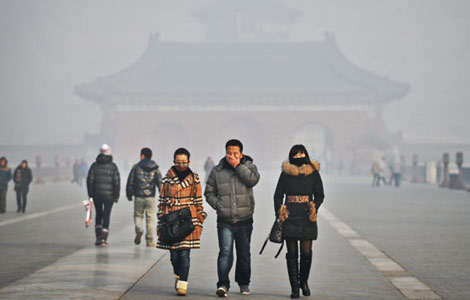
Fourth, resource and environmental constraints have intensified. Total energy and resource consumption is too large and is growing too quickly, and emissions of major pollutants are high. A permanent mechanism for saving energy and reducing emissions has yet to be established, and energy-intensive and highly polluting industries are still growing too fast. Consequently, we face mounting pressure to save energy, reduce emissions, and respond to climate change, and great challenges in sustainable development.
Fifth, social problems have increased. Our work on income distribution, social security, schooling, and medical care still fall considerably short of the demands of the people. Actions that harm people's interests in such areas as food and drug safety, land expropriation, housing demolition and resident relocation, and industrial safety are still occurring.
In addition, world economic recovery is a painstaking and tortuous process, some countries are saddled with huge debts and persistently high unemployment rates, global liquidity continues to increase, and international market prices for major commodities and exchange rates among major currencies remain in turmoil. All these instabilities and uncertainties have made it even more difficult to do this year's domestic work well.
We need to take all the above problems seriously and adopt effective measures to solve them.
Copyright 1995 - 2010 . All rights reserved. The content (including but not limited to text, photo, multimedia information, etc) published in this site belongs to China Daily Information Co (CDIC). Without written authorization from CDIC, such content shall not be republished or used in any form. Note: Browsers with 1024*768 or higher resolution are suggested for this site.
License for publishing multimedia online 0108263 Registration Number: 20100000002731