Comments
  Print
Print  Mail
Mail  Large Medium Small
Spending on services set to be a major driver of long-term and sound economic growth, reports Wei Tian
The service sector is likely to be the next big driver of domestic consumption in China, helping to bring about long-term and sound economic expansion, experts said.
By 2012, consumption was already contributing more to the growth of China's gross domestic product than investment, a result in part of low inflation, an increase in disposable incomes and the support provided by a series of government policies.
Data from the National Bureau of Statistics suggest that consumption contributed 4.2 percentage points to the 7.7 percent GDP growth the country achieved in the first three quarters of 2012.
The rate of increase for retail sales of consumer goods went from 18.1 percent at the end of 2011 to 13.2 percent in August 2012. Yet the year-on-year growth rate of per capita consumption increased 9.8 percent in the first quarter of 2012, from the 8.5 percent average seen since 2003 and it was the highest record since the outbreak of the global financial crisis in 2008.
Xu Qiyuan, a researcher with the Chinese Academy of Social Sciences, said:"This is a sign that consumers are spending much more in the service sector."
Lu Zhengwei, chief economist with Industrial Bank Co Ltd, said service consumption will give a further boost to urbanization, which the country's new leadership has said is one of its main tasks.
"Vice-premier Li Keqiang stressed the importance of transforming migrant workers into urban inhabitants, instead of simply adding up the size and population of cities.
"Ensuring migrant workers receive the same treatment as urban citizens will place a large demand on the service industry. That is what Li said will help create jobs and stimulate domestic demand."
Lu was echoed by Ye Tan, a financial commentator, who said a lot of domestic consumption will be of services.
Even so, she said China's consumption structure is still unbalanced, as the rich continue to spend lavishly while the middle class' purchasing power remains frail.
Two other sources of concern are middle-aged and senior citizens, whose spending power has been reduced amid concerns over the future of social services. Ye said improving the social security system is the best way to increase that power.
A recent survey by the marketing research company ACNeilson suggests that consumer confidence stabilized in China in the third quarter. Middle-class consumers in the largest cities, buoyed by a low consumer price index and measures to stimulate consumption, were much more willing to spend in the third quarter than in the previous one.
Changing appetite
While China's purchasing power remains strong, consumers' tastes are changing. They now tend to show less enthusiasm for fancy brands, and instead pay more attention to services.
In the first nine months of 2012, the amount of tax rebates Chinese customers received on goods bought overseas increased by 63 percent, according to Global Blue, a Switzerland-based shopping tourism company.
A survey conducted by Boston Consulting Group Inc suggested that, despite the country's slowing GDP growth, 40 percent of Chinese consumers plan to spend more on "non-mandatory products" by 2013.
Consulting company McKinsey & Co said China will overtake Japan to become the world's largest consumer of luxury products in the next three years, a result of a rapid increase in the number of middle-class families in China.
The company said tastes are changing. Rather than engaging in conspicuous consumption, people are now tending to pursue quality and good shopping experiences.
"After 20 years, the purpose of consuming luxuries in China has gone from showing off to being something more practical," said Zhou Ting, head of Fortune Character, a magazine that covers luxury markets.
Luxury buyers are now tending to think that highly noticeable logos are obnoxious, she said.
In another sign of the trend, a larger number of consumers are now shopping overseas. A report from the National Tourism Administration said 77 million Chinese tourists may have traveled abroad in 2012 and spent $80 billion. A year before, 70 million had gone abroad and spent $69 billion.
Shen Danyang, spokesman for the Ministry of Commerce, said the country's consumption patterns have changed, noting that sales of home appliances and automobiles, as well as in restaurants, are increasing at a slower rate.
"These trends suggest we'll face significant pressure in the expansion of consumption in 2013," he said.
He also agreed the service industry may be the next big driver of consumption. One indicator of the trend is that more foreign capital is now being transferred from manufacturing to the service industries, Shen said.
Contact the writer at weitian@chinadaily.com.cn
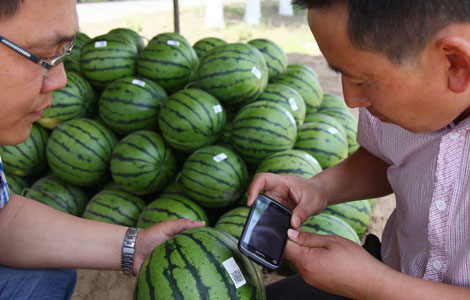
 Watermelons now come with scannable data
 Rubber Duck falls into Victoria Harbor
 Car wreck over car parts quality claim
 Gales, hailstorms batter villages in SW China
 Ram with artificial heart sets survival record
 The future of wearable computers
 Anniversary quake drill jolts students
 15,000 tour memorial hall on quake anniversary
Copyright 1995 - 2010 . All rights reserved. The content (including but not limited to text, photo, multimedia information, etc) published in this site belongs to China Daily Information Co (CDIC). Without written authorization from CDIC, such content shall not be republished or used in any form. Note: Browsers with 1024*768 or higher resolution are suggested for this site.
License for publishing multimedia online 0108263 Registration Number: 20100000002731