Traditional teaching tenet
 |
|
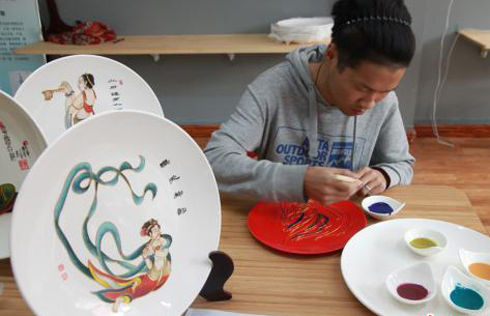
Although Mohism has been long forgotten by most, this theory now forms the basis of a new learning system in a school deep in Beijing's hutong. Photos Provided to China Daily |
A school teaching Chinese in Beijing has adopted Mozi's philosophy. Zhang Lei investigates and finds that virtue and hard work are an aid to learning Mandarin.
A Mandarin school deep in Beijing's hutong is using ancient Chinese philosophy as the basis of its teaching methods. More than 2,000 years ago, Mozi, a peasant philosopher born around the time that Confucius died, developed a theory of life that stressed virtue and hard work, which he called "all embracing love and peace".
Although Mohism never reached the status of Confucianism and has been long forgotten by most, this theory now forms the basis of a new learning system in Beijing.
Jiao Yu and his 50 employees have been using Mozi's philosophy to underpin Mandarin language training methods at Jiao's school, based in a traditional Beijing courtyard near the Drum and Bell Towers, for eight years.
 |
|
Jiao Yu and his 50 employees have been using Mozi;s philosophy to underpin Mandarin language training methodes. |
The two-story school is divided into eight classrooms, each with a wooden plate hanging at its entrance engraved with a Mohist saying.
"What I like about Mohism is that its philosophy is a better fit with China's new demand for modernization in either macro management or minute details," Jiao says.
"Through our teaching and Chinese cultural activities, we manage to draw out a silhouette of a multi-cultural China that is already embedded in traditional Chinese philosophy. What I want to present to my students is not just that the language is not as difficult as they thought, but also that China has a pragmatic and sober philosophy system they can benefit from."
In 136 BC, Dong Zhongshu, a Han Dynasty (206 BC-AD 220) scholar, banned Mohism and all other belief systems apart from Confucianism, which was established as the country's State ideology.
Jiao believes that the rigidity of thought that this spawned kept Chinese learning systems narrow in their ideas, and this continues today.
"To put Chinese language teaching into focus, you basically have two contrasting theories. The university method stresses the study of theory and grammar, while the private school method focuses on oral lessons," he says.
Unlike most Western languages, Chinese characters are usually monosyllabic. One syllable however can have many different meanings depending on tone. The result is many words or phrases that sound similar but have different meanings.
"If a foreign student has about 100 hours of Chinese oral lessons using pinyin (a phonetic way of writing Mandarin) without at least identifying the Chinese character attached to the word, he will hit what you could call the glass ceiling," Jiao says.
For example the characters xiu (羞) and xiu (休) mean shame and stop, although both are pronounced 'xiu' in pinyin. Ultimately, without learning characters as well as pinyin, a student will become confused and unable to move forward with learning, according to Jiao.
This happens most often in private schools, which often ignore Chinese character lessons for fear of putting students off learning.
According to Jiao, there are 300 commonly used characters on which schools should concentrate. These allow the student to read simple news articles and this instills a sense of confidence.
His school, the Sinology Institute, uses what he calls the 3S Theory of teaching Mandarin - separation of speech and script.
"The English language has more than 4,000 syllables, whereas the Chinese language only has 400," he says.
"It is important for us to use lots of pictures in correlation with Chinese characters to stimulate the students' visual recognition.
"When we start to teach students Chinese characters, we choose those that have less evolution in character form and are closer to the original pictographic connotation. Once the student establishes a link between the character and the meaning, they won't forget it easily."
Chinese is the only existing ideographical writing system in the world and because its characters often bear a resemblance to the object they describe, this makes it actually easier to learn, Jiao believes.
The new HSK system, China's official standardized Chinese language test, divides students into six levels. At level three, students are required to learn 600 words, including 300 words that appeared in levels one and two. Jiao says with the help of his school's method, a student can remember 600 words in one month.
Jiao worked before as a documentary producer at China Central Television during 2001 and 2002, specializing in education programs. In one program he retraced the path of Chinese workers during the Wild West period in the US and through doing so gained an insight into the evolution of the Chinese language overseas.
Since 2004, he and his team have been testing a new online 3S teaching system.
"We analyze student reactions to our classes in Beijing and use them to develop our online system."
After eight years working as a language teacher, Jiao believes hard work brings rewards.
"Teaching language to foreign students is a cultural mission that only can only survive on your reputation," he says.
However, he fears that the language teaching business as a whole has started to ossify. "State schools and Hanban, China's official language teaching headquarters, have already set up a teaching system that will not accept new theories," he says.
"I don't think there should be just one style of learning. We need to break through prejudices about learning to provide a happy study experience."
Contact the writer at zhanglei@chinadaily.com.cn.