Comments
  Print
Print  Mail
Mail  Large Medium Small
1. What is the influenza A(H7N9) virus?
Influenza A H7 viruses are a group of influenza viruses that normally circulate among birds. The influenza A(H7N9) virus is one subgroup among the larger group of H7 viruses. Although some H7 viruses (H7N2, H7N3 and H7N7) have occasionally been found to infect humans, no human infections with H7N9 viruses have been reported until recent reports from China.
2. What are the main symptoms of human infection with influenza A(H7N9) virus?
Thus far, most patients with this infection have had severe pneumonia. Symptoms include fever, cough and shortness of breath. However, information is still limited about the full spectrum of disease that infection with influenza A(H7N9) virus might cause.
3. Why is this virus infecting humans now?
We do not know the answer to this question yet, because we do not know the source of exposure for these human infections. However, analysis of the genes of these viruses suggests that although they have evolved from avian (bird) viruses, they show signs of adaption to growth in mammalian species. These adaptations include an ability to bind to mammalian cells, and to grow at temperatures close to the normal body temperature of mammals (which is lower than that of birds).
4. What is known about previous human infections with H7 influenza viruses globally?
From 1996 to 2012, human infections with H7 influenza viruses (H7N2, H7N3, and H7N7) were reported in the Netherlands, Italy, Canada, United States of America, Mexico and the United Kingdom. Most of these infections occurred in association with poultry outbreaks. The infections mainly resulted in conjunctivitis and mild upper respiratory symptoms, with the exception of one death, which occurred in the Netherlands. Until now, no human infections with H7 influenza viruses have been reported in China.
5. How did people become infected with the influenza A(H7N9) virus?
Some of the confirmed cases had contact with animals or with an animal environment. The virus has been found in a pigeon in a market in Shanghai. It is not yet known how persons became infected. The possibility of animal-to-human transmission is being investigated, as is the possibility of person-to-person transmission.
6. Is the influenza A(H7N9) virus different from influenza A(H1N1) and A(H5N1) viruses?
Yes. All three viruses are influenza A viruses but they are distinct from each other. H7N9 and H5N1 are considered animal influenza viruses that sometimes infect people. H1N1 viruses can be divided into those that normally infect people and those that normally infect animals.
7. Is it safe to eat meat, i.e. poultry and pork products?
Influenza viruses are not transmitted through consuming well-cooked food. Because influenza viruses are inactivated by normal temperatures used for cooking (so that food reaches 70°C in all parts— "piping" hot — no "pink" parts), it is safe to eat properly prepared and cooked meat, including from poultry and game birds.
Diseased animals and animals that have died of diseases should not be eaten.
In areas experiencing outbreaks, meat products can be safely consumed provided that these items are properly cooked and properly handled during food preparation. The consumption of raw meat and uncooked blood-based dishes is a high-risk practice and should be discouraged.
8. Is there a vaccine for the influenza A(H7N9) virus?
No vaccine for the prevention of influenza A(H7N9) infections is currently available. However, viruses have already been isolated and characterized from the initial cases. The first step in development of a vaccine is the selection of candidate viruses that could go into a vaccine. WHO, in collaboration with partners, will continue to characterize available influenza A(H7N9) viruses to identify the best candidate viruses. These candidate vaccine viruses can then be used for the manufacture of vaccine if this step becomes necessary.
9. Is the general population at risk from the influenza A(H7N9) virus?
We do not yet know enough about these infections to determine whether there is a significant risk of community spread. This possibility is the subject of epidemiological investigations that are now taking place.
10. Is it safe to travel to China?
The number of cases identified in China is very low. WHO does not advise the application of any travel measures with respect to visitors to China nor to persons leaving China.
11. Are Chinese products safe?
There is no evidence to link the current cases with any Chinese products. WHO advises against any restrictions to trade at this time.
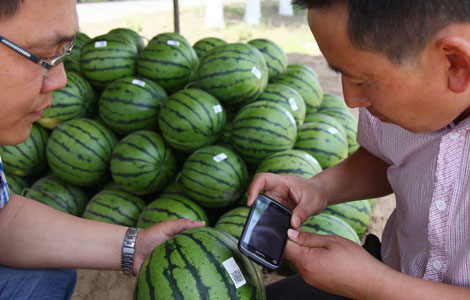
 Watermelons now come with scannable data
 Rubber Duck falls into Victoria Harbor
 Car wreck over car parts quality claim
 Gales, hailstorms batter villages in SW China
 Ram with artificial heart sets survival record
 The future of wearable computers
 Anniversary quake drill jolts students
 15,000 tour memorial hall on quake anniversary
Copyright 1995 - 2010 . All rights reserved. The content (including but not limited to text, photo, multimedia information, etc) published in this site belongs to China Daily Information Co (CDIC). Without written authorization from CDIC, such content shall not be republished or used in any form. Note: Browsers with 1024*768 or higher resolution are suggested for this site.
License for publishing multimedia online 0108263 Registration Number: 20100000002731