


Qinghai-Tibet Railway expands its reach
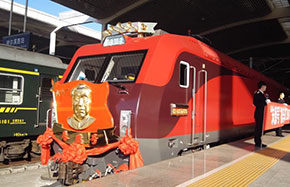
XINING - Seven years after the Qinghai-Tibet Railway went into operation, the "roof of the world" is about to see more railways connecting it to other parts of China.
Several new railway lines are either under construction or being planned to form a rail network in the sparsely populated Qinghai-Tibet Plateau in western China, according to the Qinghai-Tibet Railway Company, the operator of the world's highest railway.
During China's 12th Five Year Plan ?(2011-2015) period, the Qinghai-Tibet Railway will branch out in all directions, ending the history of no railways in the southern part of Tibet Autonomous Region and strengthening its ties with neighboring provinces.
The Qinghai-Tibet Railway, which spans 1,956 km from Xining, Qinghai province, to Lhasa, regional capital of Tibet, carried 10.76 million people and 56.06 million tonnes of cargo in 2012. With these new extension lines in place, the company estimates that its passenger and cargo loads will increase to 14 million and 90 tonnes, respectively, in 2015.
The railway has led to a boom in tourism in Tibet. In 2012, more than 10 million tourists visited the autonomous region, up 21.7 percent year on year, and tourism revenue surged 30.3 percent to 12.64 billion yuan ($2.06 billion).
According to Zhu Jianping, the company's vice general manager, the railway network will bring major cities in western China closer.
One of the first extensions to be completed will be a 253-km line linking Lhasa to Xigaze, a historical city in southwestern Tibet.
Construction of the line began in September 2010, and is expected to finish at the end of this year, Losang Jamcan, chairman of the Tibet regional government, said during China's annual parliamentary session in March.
The company is also considering a line between Lhasa to Nyingchi, a prefecture in the southeastern part of the autonomous region famous for its virgin forests.
Meanwhile, two new lines will extend from Golmud, a city in Qinghai that serves as an important junction on the Qinghai-Tibet Railway. One will run toward Dunhuang in northwest China's Gansu Province and the other to Korla, Xinjiang Uygur Autonomous Region.
With 12.9 billion yuan in investment, construction on the Golmud-Dunhuang line was kicked off last October and is expected to be completed in five years, company spokesperson Wang Tao told Xinhua.
This extension will join existing railways that link Xinjiang with Qinghai and Gansu provinces, forming a circular railway network upon completion.
The proposal for the Golmud-Korla line passed a feasibility test in June. With a length of 1,222.9 km and an investment of 33.5 billion yuan, this extension will, for the first time, provide direct rail transportation between Tibet and Xinjiang, reducing the trip between Lhasa and Urumqi by more than 1,000 km.
In a bid to make the plateau more accessible to southwest China, authorities in Qinghai have also proposed adding two more lines linking economic powerhouse Chengdu, Sichuan Province, to Golmud and Xining.
However, building and operating railways on the world's highest plateau are no easy feats. The Qinghai-Tibet Railway was designed and built with ?ecological considerations in mind. More than 1.5 billion yuan was spent on environmental conservation along its route, accounting for 5 percent of the project's total spending.
The railway has 33 special passageways for rare animals, including the critically-endangered Tibetan antelope. It also bypassed celestial burial grounds and lamaseries to show respect to local custom and protect religious sites.
Wang Jinchang, a section manager with the engineering affairs department of the Qinghai-Tibet Railway Company, said an additional 195 million yuan has been invested over the past seven years to improve local ecology and protect wildlife.
"The Qinghai-Tibet Railway has provided a lot of experience for us to draw on for the construction and operation of future railway projects," Zhu said.
"The plateau railway network will be energy-efficient, environmentally-friendly and have minimal ecological impact," he added.













Registration Number: 130349


