


Tibetan culture on display during Shoton Festival
|
 |
|
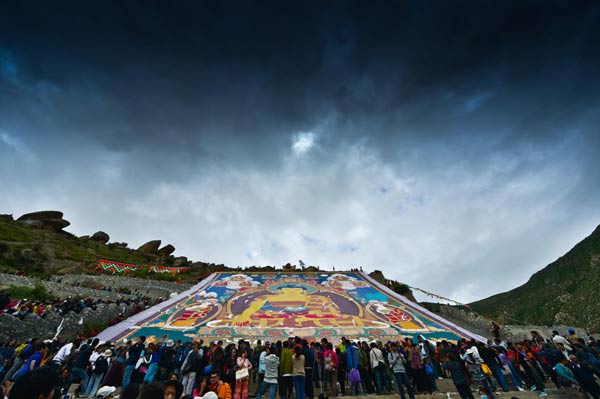
Visitors look at a giant thangka on the mountain behind Drepung Monastery in Lhasa, capital of the Tibet autonomous region, Aug 6, 2013. [Photo/Xinhua] |
The weeklong event, also known as the Yogurt Banquet festival, started with the "sunning of the Buddha" ceremony held in the 600-year-old Drepung Monastery.
Pious Buddhists walked around a 1,480-square-meter portrait of Buddha and prayed while excited tourists recorded the sacred rite with their mobile phones.
Situated at the foot of Mt. Gambo Utse, the Drepung Monastery is one of the most important monasteries in Tibetan Buddhism. The Shoton Festival originated in the monastery more than 1,000 years ago.
Losang Danba, deputy secretary of the Lhasa municipal committee of the Communist Party of China (CPC), said the regional government spent more than 14 million yuan (2.28 million U.S. dollars) to widen roads leading to the monastery in order to make transport more safe and convenient.
Tibetan opera performances were also staged at the Norbu Lingka park during the festival, attracting more than 80,000 people each day.
Accompanied by lively drum beats, performers wearing masks painted with elaborate patterns danced passionately for their audiences.
Surrounding the stage, the viewers, most of whom were Tibetans, sat on their own rugs or stools and drank homemade butter tea and highland barley wine while watching performances by different troupes.
The 600-year-old Tibetan opera incorporates local literature, music, dance, painting and acrobatics, with stories mainly based on folklore and Buddhist scripture. The artform has long been a significant part of the Shoton Festival and was added to UNESCO's World Heritage List in 2009.
"I bring my whole family to watch Tibetan opera during every Shoton Festival. The audiences are large and we have to come early in order to get seats," said 62-year-old Soinam Zhaxi.
"The performers' colorful costumes are very beautiful. Although I can't understand what they are singing, their movements and expressions impress me. I can feel their sincerity and enthusiasm, " said Deng Xiaolong, a 24-year-old tourist from south China's Guangdong Province.
Yangzom, a veteran actress with Lhasa's Nyangrain Folk Opera Troupe, described her job as her life. "I'll keep performing until I can no longer walk," she said.
Tibetan operas used to be performed exclusively in open spaces in villages, farms and nobles' yards on festive occasions, with the only instruments being drums and cymbals. But in modern times, many troupes have turned to stages and adopted modern technology to create new visual and acoustic effects.
"Moving to stages from squares is the future trend. It will help non-Tibetan viewers understand the opera and even help the ancient art form go global," said Liu Wenfeng, a researcher with the Chinese National Academy of Arts.
Festival organizers also staged an exhibition dedicated to "thangkas," or Tibetan painted scrolls with a history of more than 1,300 years.
An exhibition of Tibetan calligraphy was also featured at the festival, showcasing a 206-meter-long scroll recognized by Guinness World Records as the lengthiest work of Tibetan calligraphy.
The festival was originally a religious occasion, when local people would offer yogurt to monks who had finished meditation retreats. It has been held since the 17th century and is considered one of the most important festivals on the Tibetan calendar.
Tibet saw robust growth in tourism in the first half of the year, with the number of visiting tourists reaching 3.43 million, an increase of 21.8 percent from the same period last year. Its tourism revenues surged 32.1 percent year on year to 3.2 billion yuan in the period.
The plateau region typically experiences a three-month peak travel season starting from July.








Registration Number: 130349


