Comments
  Print
Print  Mail
Mail  Large Medium Small
 |
|
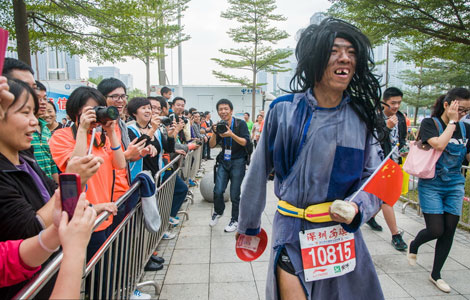
Performers celebrate the opening of the Qingdao Beer Festival in August 2013. [Photo by Xu Chongde/For China Daily] |
Chinese are swilling more beer than ever - both in volume and in variety. But while better brews are washing over the market, watery factory-bottled offerings will likely carve out an even larger share than their currently dominant slice, some experts say.
This is the mix of what remains surging demand - fertile terrain for enterprise wars - that has grown in all dimensions. From the creatively conjured, pricier home brews to the most industrialized - and hence cheapest - distillations, China's beer market has created a deluge of market share rise as wine and spirit growth are drying up.
Beer surged 30 percent a year from 2007 to 2011, during which time wine's annual growth evaporated from 50 percent to 12. Spirits also dropped 8 percentage points to 16 percent year-on-year growth by 2011.
Paulaner Brauhaus, The Kempinski Hotel Beijing Lufthansa Center's beer master Zhang Wei says this is perhaps a continuation, if not an acceleration, of beer consumption's transformation he has seen since the early days of his 21 years in the industry and 12 with Paulaner.
"Compared to 20 years ago, so many more (Chinese) people are willing to drink beer," he says. "And there's new demand for diversity."
Most customers were Germans when Beijing's Paulaner opened in 1992. Now, half are Chinese, Zhang says.
"You can now find beers from around the world in (Beijing's) supermarkets. Chinese consumers have become discerning in taste. They demand better quality." Many Chinese German-style beerhouse copycats tried replicating the European beer icon's style but were shuttered because of quality problems, Zhang says.
"But Beijing's German beer houses are so much better now," he says. "They take brewing seriously."
Paulaner's historical standing creates a recipe for popularity that keeps Zhang busy conjuring for the annual Oktoberfest from Oct 11 to 27.
Last Oktoberfest's 8,500 attendees chugged 14 tons of beer, he says. They also gobbled 3,500 sausages and 1,500 pork knuckles - Bavarian delicacies - Kempinski marking manager Liu Shuchi recalls.
But while more Chinese are imbibing more beer, their boozing culture remains distinctive.
German brew master Thomas Dobiezynski says that's one of the first things he noticed when he took his trade to Beijing 10 months ago.
"It's a traditional thing to do to - ganbei, 'bottoms up'," he explains, referring to the Mandarin toast calling upon drinkers to chug the entire glass. "It's a new experience for me. Back home, nobody does it."
Dobiezynski works as brewer for Hopfenstube Restaurant & Bar and DK 1308 Restaurant's Tianjin branch. He says some Chinese friends try to "make you do bottoms up and bring you down".
Presumably, he means down to ground level, as in drunkenly horizontal.
The China Alcoholic Drinks Association's beer branch's general secretary He Yong explains beer is more about relationships than taste in China. "Chinese people and some other Eastern countries like to share beer and other alcoholic beverages," He says. "That's different from the West. It has to do with culture, history and humanity."
Hosts are expected to push booze on guests, especially in northern China, where the population is believed to be able to handle their drink.
Adages proclaim: "It's not a proper banquet without alcohol" and "empty the glass if your feelings are deep".
Especially formal banquets center on jiuwenhua (drinking culture), a complex etiquette regime governing the copious toasts that are arguably more important to social networks formed at dinner tables than the food. In fact, edibles are often more of a means to soak up excessive booze.
This psyche might contribute to the larger and growing sales of low-alcohol beer that allow people to down a multiplication of mugs without getting sloshed, He Yong says.
"Only some Chinese drink strong beer," he says.
Chinese industry experts divide beer by taste into nongchun (strong) and danshuang (light). That technical categorization overlaps with, but is distinct from, such Western countries' as the United States' definitions of "light". In China, it refers to taste, while in the West, "light" often technically measures a legally designated low-alcohol content and calorie tally.
That said, either cultural definition of light beer is more commonplace Stateside and in Asia, while stronger beers are European conventions.
But globalization is washing over both traditions. There are more heavy beers flowing into Asia and China, and more light beers are seeping into Europe.
Dobiezynski points out there are many Oktoberfest activities throughout China this year. German bands' schedules are tightest this month.
"German beer is becoming more popular in China," he says. "Chinese people like to drink fruity, sweet beer with a lot of (flower) bulbs and ones that are not so bitter."
So he's tinkering with an Indian pale ale to release next spring that he hopes Chinese customers enjoy.
More high-end products are emerging outside of China's craft beer market. Some new arrivals are Tsingtao's Augerta, Snow Beer's super premium - adorned with a Peking Opera mask - and Blue Ribbon's 1844.
"Rising living standards have propelled these up-market creations," He says. "And the industry faces overflow. They need new profit points."
China's beer consumption engulfed Germany's as the world's No 2 in 1998 and surpassed the US' top spot in 2002.
In 2012, China's production and sales reached 49 million kiloliters. That's double the US' 23 million kl.
China imports 0.11 million kl of beer yearly - about 0.001 percent of its domestic production. Its production and sales account for 74.6 percent of booze - five times the amount of the traditional white liquor (baijiu) consumption. Growth has sustained 23 years. There are 146 enterprises with 411 factories.
Some say archaeological evidence indicates China produced a beer-type alcoholic drink about 9,000 years ago.
The association's He says white liquor's record is more detailed although discoveries seem to indicate both were invented around the same time.
"If the accounts are true, what they drank must be very different from modern beer," he says.
Contemporary beer's more-distilled recipe is believed to have been discovered 3,700 years ago in Babylon.
The soul of this type of brewing was given new life in 1079 AD, when the Germans used hops in brewing. Yeast and filtering technology was advanced in France and Denmark in the mid-19th century.
Most global brands have by now invested in China.
The country's top five respective names are Snow, Tsingtao, ABInBev (Budweiser), Yanjing and Carlsberg. The association's He says these five occupy 72 percent of the sector. He expects their high market share to soon rise to 85 percent.
"Big groups will seize most of the industry," he believes. "Mid-sized enterprises will decline. But small manufacturers, such as craft beer-makers and microbreweries, will grow."
That, he believes, is the culturally concocted recipe of China's future beer market.
Contact the writer at yejun@chinadaily.com.cn.


Copyright 1995 - . All rights reserved. The content (including but not limited to text, photo, multimedia information, etc) published in this site belongs to China Daily Information Co (CDIC). Without written authorization from CDIC, such content shall not be republished or used in any form. Note: Browsers with 1024*768 or higher resolution are suggested for this site.
License for publishing multimedia online 0108263 Registration Number: 20100000002731