Comments
  Print
Print  Mail
Mail  Large Medium Small
 |
|
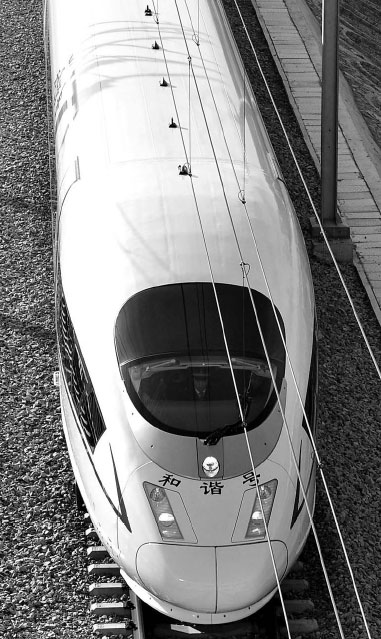
China's high-speed train service. The next round of development will feature more infrastructure. Provided to China Daily |
In China, it seems like everyone's always talking about reform. Over the past 35 years, Chinese have been doing more than talking. They've been making reforms all the time, even as they debated and aspired to new reforms to come.
You'll hear the word a lot more in the coming week. The nation's leaders will meet from Nov 9 to 12 to draw up a comprehensive plan for the next stage of reform, when they convene for the Third Plenum of the 18th Central Committee of the Communist Party of China. The Party's third plenums have a history as sources of reform.
How much reform has China carried out? The following are what the Chinese call "theoretical breakthroughs," or the changes to inspire more reforms to come.
1978 - In the beginning
This was "the mother of all changes". The Third Plenum of the 11th Central Committee adopted guidelines that were aimed at emancipating minds, seeking truth from facts and uniting in a "forward-looking" manner. The leaders decided to undertake a comprehensive economic restructuring and national modernization, encapsulated in a phrase that endures to this day: "Reform and opening up". They steered the country onto a course completely different from late chairman Mao Zedong's "cultural revolution" (1966-76).
1978-79 SOE reform
The 1978 Third Plenum called for allowing market forces to direct the economy. It also decided to expand the managerial autonomy of enterprises (which were all owned by the State or collectives at the time) and link workers' material interests to enterprise performance.
In July 1979, five documents from the State Council (China's cabinet) set the rules for reform of State-owned enterprises. They shifted decision-making power to factory managers and away from the government, and allowed managers to give bonuses to more productive workers.
1979-80 First SEZs
To facilitate "opening up" to the rest of the world, the State Council decided in July 1979 to create four special economic zones in Shenzhen, Zhuhai, Shantou (all in Guangdong province) and Xiamen (in Fujian province).
The Shenzhen SEZ was established on Aug 26, 1980. What was once a fishing village adjacent to Hong Kong became a key business center for the nation.
1982 Communes gone
The CPC Central Committee issued its 1982 Document No 1 on rural reform, which resulted in the dismantling of the People's Commune system and sweeping changes under which farmers regained the rights and responsi-bilities of managing family plots, based on government guidelines and collective support.
1983-85 More rural reform
The CPC Central Committee devoted its Document No 1 in each of the three years to rural reform. During this process, fixed prices in the State procurement system for all farm products were abolished. Farmers were allowed to grow more cash crops for themselves. Privately held cottage industries sprung up like mushrooms, becoming the nation's first generation of enterprises.
Document No 1 later became a tradition. Since 2004, the CPC Central Committee's Document No 1 each year has been devoted to rural reform and development. This tradition underscores the leadership's resolve to honor the promises it made to farmers in the early days of reform.
1987 Joint-stock companies
Authorities approved the formation of joint-stock companies. This structure is now the primary one for companies being set up in China, either as reformed SOEs or new ventures by private investors. Since 1987, the number of stock market investors in the nation has grown to more than 60 million, with some 2,000 companies listed on the A-share markets in Shanghai and Shenzhen. Hundreds more are listed overseas.
1988 Liberalizing prices
The 13th Central Committee of the CPC held its Third Plenum in 1988. It decided to extend reform from successes in the countryside into the cities. It took a huge risk in liberalizing the price regime in a society where practically everything had a fixed price. Following that daring move came several years of tumultuous changes, including double-digit inflation and a widespread slowdown.
1992 Reform's comeback
Then-paramount leader and "chief architect" of reform, Deng Xiaoping, toured some of the southern provinces in early 1992, calling for greater courage and renewed efforts at reform. Deng's famous "southern tour" is regarded as a turning point in China's economy history, which led to a whole new series of reforms.
In October that year, the CPC held its 14th National Congress, during which a "socialist market economy" was designated as the goal of reforms and written into the CPC program.
1993 Shanghai's new role
More than three years after the central government promised flexible policies, the administrative committee was established on New Year's Day for Shanghai's Pudong Area. This became a new experimental zone for reform, making the city the platform for a new financial sector more in tune with global markets. China would later build on the experience of Pudong in 2013, as it approved the formation of the China (Shanghai) Pilot Free Trade Zone.
1997 'Hong Kong, Hong Kong'
Hong Kong, which had long been the conduit for most foreign direct investment in China, and the market where most key Chinese companies were listed, was returned to Chinese sovereignty. It's now largest renminbi business center outside the Chinese mainland.
1998 Dramatic moment
The CPC's 15th Central Committee held its Third Plenum in 1998 as broad SOE reform proceeded. During that process, millions of workers lost their jobs and were relocated into other employment. The meeting also came after Beijing had helped Hong Kong's financial system withstand a currency attack amid the Asian financial crisis. This event made China more cautious about the health of its financial system and major banks.
2003 Improved markets
The CPC 16th Central Committee held its Third Plenum in 2003, promising to build a socialist market economy featuring more efficient SOEs, strong private businesses and improved government functions. It also promised better protection of property rights.
2008 Global crisis
Many reforms were promised during the CPC 17th Central Committee's Third Plenum in 2008, including a shift away from small family plots to larger farms. But global financial and economic turmoil, sparked by the US subprime loan crisis and later the eurozone's sovereign debt crisis, engulfed China. A weak world economy crippled Chinese exports and signaled that China's export-led strategy had reached its limits.
2012- Transition time
The nation's transition last year involved both a shift in power and a change in its economic model.
In the power transition, Xi Jinping was elected General Secretary of the Communist Party of China at its 18th National Congress in November 2012, and Li Keqiang was appointed Premier in March 2013.
Since then, intense work has gone into the preparations for an economic transition, from export-led growth to expansion driven by domestic consumption.


Copyright 1995 - . All rights reserved. The content (including but not limited to text, photo, multimedia information, etc) published in this site belongs to China Daily Information Co (CDIC). Without written authorization from CDIC, such content shall not be republished or used in any form. Note: Browsers with 1024*768 or higher resolution are suggested for this site.
License for publishing multimedia online 0108263 Registration Number: 20100000002731