

China will resume initial public offerings in January after a freeze lasting longer than a year, and a reform plan on new listings has been carried out to boost the country's stock market over the long term.
A total of 83 Chinese companies completed the examination and received approval from the China Securities Regulatory Commission. About 50 are expected to have finished all IPO procedures and be listed before the end of January 2014. More than 760 companies are in line for approval, and it will take about a year to audit all the applications.
 |
|
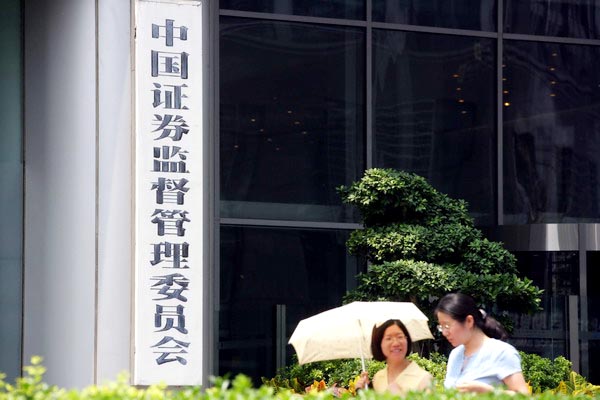
Headquarters of China Securities Regulatory Commision in Beijing. [File photo / CFP] |
China has not had a new listing since October 2012, when the commission cracked down on fraud and misconduct among advisers.
In the IPO reform plan announced on Saturday, the CSRC will only be responsible for examining applicants' qualifications, leaving investors and the markets to make their own judgments about a company's value and the risks of buying its shares.
Previously, companies aspiring to list on China's stock markets had to undergo a review and approval process, where the CSRC had the sole discretion to decide whether a company was fit to list.
"We want to emphasize the market should not see the registration system as a sign the government won't supervise and regulate the market anymore," said a CSRC official, who refused to be named.
"We will review and make sure the application materials carry appropriate and legitimate information but leave it to investors to decide whether such stocks are worth investing in."
The pricing of new shares has become more market-oriented in that issuers and underwriters can negotiate offering prices according to Chinese law. Pricing information must be released in a statement.
To control prices, the rules state the issuer and underwriter must cancel the highest offer price from investors and 10 percent of the amount of shares offered at that price.
The reform plan also states the principal underwriter can decide the new share placement. At least 40 percent of shares placed offline should first ask for public offering funds and social security funds.
A callback mechanism between online and offline placements has been created to respect small and medium-sized investors' willingness. If the online purchase is positive, the proportion of the online purchase amount can at most be 80 percent of the total amount.
"The reform is good for investors because it is more market-oriented, and more private capital can participate in the stock market," said Bao Fan, founder and CEO of China Renaissance Partners, a leading independent investment bank in China.
Bao said the reform is in accord with international practice and is good for protecting the interests of investors, especially small and medium-sized investors.
The first batch of companies will likely be popular among investors, not only because they have experienced a round of strict financial verifications led by the CSRC but also because the market has long awaited new shares, Bao said.
Bao added that the reform will accelerate IPO processing and companies in line for approval can expect faster listings.
"The reform plan and resumption of IPOs is significant for China's stock market in the long run, although the short-term effect might not be positive," said Hong Hao, managing director and chief strategist at BOCOM International Holdings Co Ltd.
Hong said China faces a funding shortage and Chinese companies face high financing costs, so companies' issuing prices can be low.
Also, the resumption of IPOs will divert capital from the secondary market. The ChiNext market will be the first to be influenced. The negative effect will spread to the small and medium-sized enterprises' board and main boards, which will put the country's stock market in the negative in the short term.
Hong added that the time between when companies are approved and go public may enable the secondary market to offset some negative consequences.
He said listed companies' designated placements, property investments and financial products can attract much funding, which makes funding currently inadequate in China.
The country's benchmark Shanghai Composite Index has dropped 2.1 percent this year, and the CSI300 Index has fallen 3.3 percent. They have been the worst performers among 20 primary equity indexes in the Asia-Pacific region tracked by Bloomberg.
The CSRC is also promoting preferred shares. Not only Chinese companies can apply to issue preferred shares but also unlisted Chinese companies and listed overseas enterprises that have registered domestically can apply, the commission said on Saturday.
|
|
|
|
|
|
|
|

Copyright 1995 - . All rights reserved. The content (including but not limited to text, photo, multimedia information, etc) published in this site belongs to China Daily Information Co (CDIC). Without written authorization from CDIC, such content shall not be republished or used in any form. Note: Browsers with 1024*768 or higher resolution are suggested for this site.
License for publishing multimedia online 0108263 Registration Number: 20100000002731 








 Op Rana
 Berlin Fang
 Zhu Yuan
 Huang Xiangyang
 Chen Weihua
 Liu Shinan