|
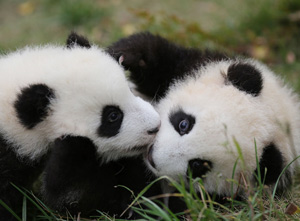
The world loves pandas. The enigmatic, retiring beasts have become a global symbol of international friendship since the People's Republic of China first began sending them as gifts to foreign powers in the 1950s. Until now, that is. In September, the decision by the Belgian Prime Minister Elio Di Rupo to locate a pair of giant pandas at Pairi Daiza zoo in the French-speaking region of Wallonia sparked widespread anger among the country’s Flemish-speaking population. Di Rupo, a former mayor of the francophone city of Mons, was accused of a black and white case of "diplomatic favoritism". The Belgian media dubbed the spat "Pandagate" and in one fell swoop the animals — a male, Xinhui, and a female called Haohao — had, albeit unwittingly, exacerbated Belgium’s deep-rooted linguistic divide and caused a major furore, a far remove from the ideals of one of China’s major soft-power triumphs of recent decades, "Panda diplomacy". More >> |
|
History of panda diplomacy |
|||
|
1st Phase (1957-1982) – diplomatic gift In 1957, giant panda Pinging was bestowed as a national gift to the Soviet Union, a symbolic gesture of thanks for recognizing the founding of the People's Republic of China, and Soviet Union is the first country in the world that established diplomatic relations with China. In 1959, An'an was sent to Moscow Zoo as Pingping's company. |
2nd Phase (1982-present) - "on tour" to "10-year loans" In 1982, China officially ceased this practice of giving pandas away as gifts due to dwindling number of pandas in its own. The old method was later in the 1990s replaced by renewable loans for a period of 10 years. From 1994, the loans shifted to an emphasis on partnership of scientific studies to protect the endangered species. |
||
|
China gave away five giant pandas Yihao, Erhao, Lingling, Sanxing and Danan to the DPRK from 1965 to 1880. Two months after US President Richard Nixon's historic visit to China in February 1972, giant panda Hsinghsing and Lingling arrived in Washington, DC. Warmly welcomed by the local people, the two bears are considered as a symbol of normalized China-US diplomatic relations. |
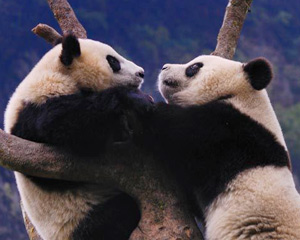 |
On the eve of the Los Angeles Olympics in 1984, China and the US reached a three-month loan agreement on one pair of giant pandas. Yongyong and Yingxin from Beijing Zoo thus became the first two pandas on tour abroad. The two giant pandas later were transferred on loan to the San Francisco Zoo. This opened the door to an influx of foreign zoos signing short panda leases with Chinese zoos. |
|
|
France hosted a panda couple Yenyen and Lili in Zoo de Vincennes during the term of President Pompidou that was offered to him as a gift in 1973. France is the first Western power that established diplomatic relations with China in 1964. A total of 23 giant pandas were given away to nine countries during this phase. Besides the above, other countries that were awarded with pandas as a gift are Mexico, the UK, Spain, Germany and Japan. |
From 1984 to 1988, more than 14 cities inNorth Americagot at least panda-on-tour deal. In the early 1990s, China banned such practice, and only 10 year loan was allowed. In 1994, China andJapanjointly launched a panda breeding research program, marking the new shift of panda diplomacy. Panda couple Meimei and Yongming was sent to Japan. Their cub Xingbang returned to China in March 2010. |
||
|
Da Mao and Er Shun in Canada |
||
|
|
|
 |
|
Tian Tian and Yang Guang in Edinburgh |
||
|
|
|
 |
|
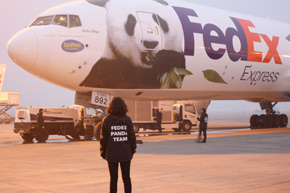
Yuan Zai and Huan Huan in France |
||
|
|
 |
 |
|
1. The practice of Panda Diplomacy dates back more than 1,000 years ago. It existed as far back as the Tang Dynasty. During the reign of Empress Wu Zetian (625-705), she sent a pair of pandas to the Japanese emperor in 658 AD. The Japanese Imperial yearbook also made similar records. 2. On Sep 18, 658 AD (Chinese lunar calendar), two spacious tall cages draped with red flowers were surrounded by imperial guards and animal trainers. They rode on the post road express, starting from Chang'an the capital, and sped eastward. When they arrived at the Chinese port Yangzhou, they boarded on the ship, along with the Japanese students to Japan. At that time panda was called white bear. 3. Pandas are very picky at their choice of beverage. Bison, goats, deer love to drink slightly salted water, panda hate it. 4. Pandas have been long leading the dimly lit jungle life, their vision is not very good, but long-loitering will not get them lost. Each panda has its own "territory". 5. During the winter, to escape chilling weather and famine, many animals go into hibernation. However, pandas still walk through the snow-pressed thick bamboos, like living in a white tent. They are not at all afraid of winter. The answer is in their "clothes". |
6. Due to the low nutrition and low digestibility of bamboo, pandas have to keep on eating. An adult giant panda approximately consume 12.5 kilograms of bamboo a day, and their eating often lasts more than 13 hours. Correspondingly the number of times they excrete is also very impressive. 7. Pandas were originally carnivorous animals just like their cousin bear. However, the giant panda is the only opposite case, and they chose the most difficult thing to digest. High-fiber bamboo is difficult to digest. 8. New research shows that panda genome is insensitive to the flavor of fresh meat, resulting panda not feeling the love for meat any more. Another reason is that panda living environment has been constantly on the change. 9. Docile and cute, pandas are not predator, but they catch bamboo rats, because they are a threat to panda's staple food bamboo. Although pandas look clumsy, they are particularly sensitive to any smell. 10. When pandas drink, they behave like a toddler. They drink a few mouthfuls and leave, walk a few steps and return to the river to drink water again – Back and forth non-stop. |
Copyright 1995 - . All rights reserved. The content (including but not limited to text, photo, multimedia information, etc) published in this site belongs to China Daily Information Co (CDIC). Without written authorization from CDIC, such content shall not be republished or used in any form. Note: Browsers with 1024*768 or higher resolution are suggested for this site.
License for publishing multimedia online 0108263 Registration Number: 20100000002731