 |
|
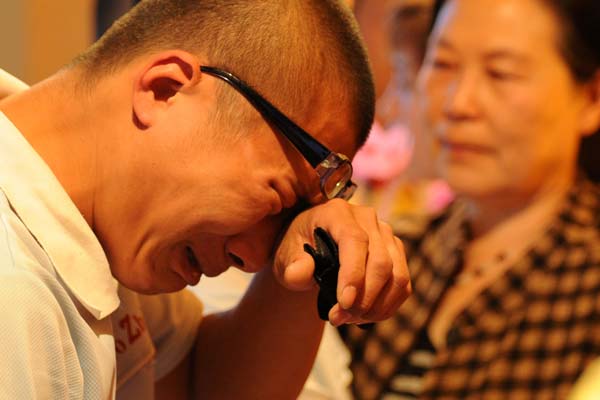
An inmate sobs after he meets his mother at a laojiao detention house in Taiyuan, Shanxi province, in May. The Third Plenum of the 18th CPC Central Committee announced on Friday the laojiao system would end.[DENG YINMING / FOR CHINA DAILY] |
The system, known as laojiao, was created in 1957 when the top legislature endorsed a proposal submitted by the State Council to allow laojiao committees to detain minor wrongdoers for up to four years without an open trial.
Inmates in labor camps are usually drug addicts undergoing treatment or other such cases in which the wrongdoing does not constitute a crime.
"Officially ending the system also requires the National People's Congress to declare the 1957 decision invalid," said Jiang Ming'an, a law professor at Peking University.
"That will make it possible to terminate the program as early as late December, when the top legislature is scheduled to open its next bimonthly meeting," he said.
Yi Xiangde, a research fellow at the Chinese Academy of Social Sciences, said that both the courts and government would then have to issue new rules on how to handle offenders that laojiao currently deals with.
"We'll need judicial explanations on how to punish minor offenders. The Ministry of Justice will need to speed up community correction programs to fill the void after the laojiao program is abolished," Yi said.
Under the current system, a laojiao committee consists of government departments such as police, civil affairs and education departments, usually with the police chief as its head.
Wang Gongyi, a former senior researcher with the Ministry of Justice, said no rigid procedures are in place to regulate how the committee should determine the criminal facts and apply punishment.
"It is not good for the protection of human rights to deprive a citizen of his personal freedom without a court proceeding," Wang said.
Although the system helped consolidate the country and create social order after decades of revolution, it faces growing criticism.
The system has made domestic and international headlines since last year, when Tang Hui, mother of a kidnapping and rape victim in Yongzhou, Hunan province, received a laojiao sentence for repeatedly petitioning for harsher sentences for her daughter's attackers.
Tang was released within a week under social pressure, but academics, media and the public began to question the legitimacy of the system.
In March, one of the first promises made by then-newly elected Premier Li Keqiang was that China would work out a plan to reform the laojiao system by the end of the year — the first time a clear timetable had been offered.
The decision to abolish the system was included in the detailed reform plan adopted at the Third Plenary Session of the 18th CPC Central Committee, which ended on Tuesday. The full text of the reform plan was made public on Friday.
The reform plan also calls for improving laws relating to correction and punishment. Community correction programs that helps former prisoners return to society will also be improved, it stipulates.
Last month, Zhou Qiang, president of the Supreme People's Court, urged courts nationwide to "take concerted action" in aiding laojiao reform by streamlining court hearing procedures for minor offenses and promoting the use of community correction to better rehabilitate criminals.
However, Xu Xin, a law professor at Beijing Institute of Technology, questioned whether community correction systems could effectively replace laojiao.
While acknowledging the method to rehabilitate offenders by sending them for correctional education at a local community, the law professor said he doubts the method can be implemented smoothly.
"Before an offender is introduced, it should be considered whether a vote is needed among local community residents, who may not agree to receive a laojiao offender in their neighborhood," Xu said.
"Secondly, a community is an open and interactive area. Offenders serving a community sentence must be absolutely nonviolent, especially when there are seniors and minors around," he said.
Contact the writers at zhaoyinan@chinadaily.com.cn and zhuzhe@chinadaily.com.cn.
Xinhua contributed to this story.
|
|
|
|
|
|
|
|

Copyright 1995 - . All rights reserved. The content (including but not limited to text, photo, multimedia information, etc) published in this site belongs to China Daily Information Co (CDIC). Without written authorization from CDIC, such content shall not be republished or used in any form. Note: Browsers with 1024*768 or higher resolution are suggested for this site.
License for publishing multimedia online 0108263 Registration Number: 20100000002731 








 Op Rana
 Berlin Fang
 Zhu Yuan
 Huang Xiangyang
 Chen Weihua
 Liu Shinan