|
 |
|
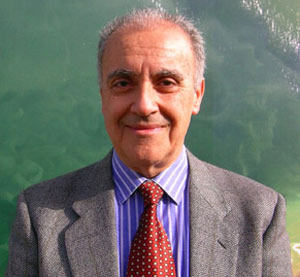
Fabio Rocca, from Italy, emeritus professor of digital signal processing at the Politecnico di Milano. |
In your opinion, what were the main factors behind your success in the award?
In Milan, we had developed a system to detect very small motions (millimeters) of the Earth using radar satellite data. Since 1991, we could carry out leveling from space, basically everywhere on land, using satellites developed by the European Space Agency. In 2004, this agency established a cooperation program with China, and we were able to interact with the colleagues of the University of Wuhan, professors Li Deren and Liao Mingsheng. They appreciated our research and immediately contributed to its development and its diffusion within China. Today, many groups in the country are able to use this methodology to measure town subsidence say due to water pumping, post seismic and infrastructures motions. For one, we can measure from space thermal dilation of buildings and, in cases, detect static problems. So, practical problems can be solved using modern technologies. The complexity of separating the different contributions to the measurements, identifying and canceling the unwanted ones, was immediately mastered in China and Chinese scientists are today at the forefront developing the technology further. The main factor for the success was an initial openness, showing that a complex problem could be broken into many simpler ones that could be attached and solved in cooperation. This attracted very many Chinese PhD students who could see how they could contribute to the technology. The traditional competence in earth measurements could be rejuvenated combining old savvy and new technologies.
What has been your most important accomplishment in China?
I think that the use of radar satellites technologies can be very useful to control the continuous landslide motions and the impact on infrastructures. For one, in the case of the gigantic Three Gorges Dam, doctor Wang Teng was able to show in his PhD thesis, joint between Wuhan University and Politecnico di Milano, that the structure of the dam was as strong as the bedrock. He proved that the increasing pressure of water due to the increasing level of the lake made the dam lean upstream with the subsiding bedrock rather than downstream.
What do you think about the level of research carried out in China compared with other places around the world?
Chinese scientists are clever, dedicated, and unselfish and their progress cannot be limited. Many started their work on radar satellites within the cooperation with the European Space Agency in 2004 but now Chinese Scientists are at the forefront in all methodologies, with competent and deep new Journal publications every week, I would say.
What plans do you have to carry out work related to China in the next five to 10 years?
I am strongly attracted to China and to the cooperation with the dedicated Chinese scientists. I plan to continue working with them as long as I will be able to contribute.
How do you feel about winning this award?
I have always been an admirer of Chinese civilization and to receive such an award makes me very proud. I am convinced that many other scientists could have received this award with very good reasons, and I represent just one case. So I feel that while the award goes to me, at the same time it goes through me to the many other scientists who had the opportunity to work with Chinese colleagues for the advancement of sciences and technologies.
How has your work in China helped your career develop in your native country?
I am now retired, and my interactions with China happened toward the end of my career. As the Politecnico di Milano intends to develop the connections with Chinese Scientists, direct relations have been established between Politecnico and Wuhan University and also with other Chinese Universities. I will be able to help in fostering and improving these connections. Further, as most of my relations with China developed within the Dragon Program of the European Space Agency and the Ministry of Science and Technology of China, and I contribute in the Advisory Committees for ESA radar satellites Sentinel 1 and BIOMASS, these will be further occasions for cooperation.


Copyright 1995 - . All rights reserved. The content (including but not limited to text, photo, multimedia information, etc) published in this site belongs to China Daily Information Co (CDIC). Without written authorization from CDIC, such content shall not be republished or used in any form. Note: Browsers with 1024*768 or higher resolution are suggested for this site.
License for publishing multimedia online 0108263 Registration Number: 130349