 |
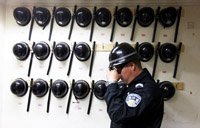
| Police patrols safeguard hospital in Taizhou? |
 |
| Hospital holds taekwondo training |
The nation's top-tier public hospitals — about 1,000 across the country — each treat more than 10,000 outpatients daily and have seen a rise in disputes escalating into violence as well as random attacks, said Sun Haibo, a department chief in the public security management bureau of the Ministry of Public Security.
Two or three police officers will be stationed at each hospital to deter fatal attacks and disputes that may lead to physical violence, and to generally ensure a safe environment for the medical personnel, Sun said.
They will also train security guards in the hospital to offer mediation, to identify situations that could lead to violence, provide immediate help if a situation escalates and gather evidence.
"In serous situations, the police will arrest and detain suspects, and, in less serious situations, the police will be able to defuse a dispute,'' Sun said.
Hospitals should also link alarm systems with the local public security office, Sun suggested.
Wei Zeng, a senior police officer at the ministry's public security management bureau, also suggested hospitals improve monitoring systems.
"Audio-video surveillance systems should be upgraded, especially at entrances and exits and at the outpatient department," Wei said.
Security posts can also be established at the main gates, and X-ray machines, similar to those used in the subway, will examine bag contents, and any prohibited items, such as knives, will be confiscated, Wei said.
Between 2012 and 2013, the Ministry of Public Security and the National Health and Family Planning Commission issued a number of notices to improve hospital security. However, the number of serious attacks has increased.
According to Chinese Hospital Association studies, hospitals witnessed an average 27.3 violent cases in 2012, compared with 20.6 in 2008.
The latest incident occurred on Thursday, when a patient was placed in detention for 12 days after attacking a pregnant nurse at a hospital in Hangzhou, Zhejiang province. The nurse escaped serious injury and the suspect was detained, police said on Sunday.
In Yixian county, Hebei province, a surgeon's throat was slashed on Tuesday by a patient who was reportedly unsatisfied with his medical treatment. The surgeon survived but remains in intensive care.
The day before, a 45-year-old doctor at a hospital in Qiqihar, Heilongjiang province, was bludgeoned to death by a young patient. The 19-year-old broke into the doctor's office and hit him on the head with a steel pipe.
About 75 percent of hospital attack victims were doctors, and the rest were nurses.
Patients carried out about 30 percent of the attacks, and about 60 percent of the attackers were relatives of patients who were dissatisfied with the medical service.
Hospitals are often scenes of intense emotion as relatives and friends can be overwhelmed with grief and act out of character. Mediation can be immensely helpful, but the safety of medical personnel is paramount, Sun said.
The National Health and Family Planning Commission said that a key factor behind these measures was to "improve and perfect medical care and the overall healthcare environment", according to a statement provided to China Daily by the commission.
The commission is also pushing for clearly defined and improved communication channels between patients, families and medical workers.
Li Jing, a lawyer from the Beijing Law Society who specializes in medical disputes, said sending more police officers to hospitals will serve as a deterrent, but it's only a temporary measure.
She said healthcare reform is the best way to ease the tension between patients and medical workers.
"Hospitals have to pay more attention to public welfare rather than the pursuit of profit."
Contact the writers at zhangyan1@chinadaily.com.cn and wangqingyun@chinadaily.com.cn


Copyright 1995 - . All rights reserved. The content (including but not limited to text, photo, multimedia information, etc) published in this site belongs to China Daily Information Co (CDIC). Without written authorization from CDIC, such content shall not be republished or used in any form. Note: Browsers with 1024*768 or higher resolution are suggested for this site.
License for publishing multimedia online 0108263 Registration Number: 130349