Ground level: China Daily is publishing a series of reports focusing on efforts that help the country to move forward.
 |
|
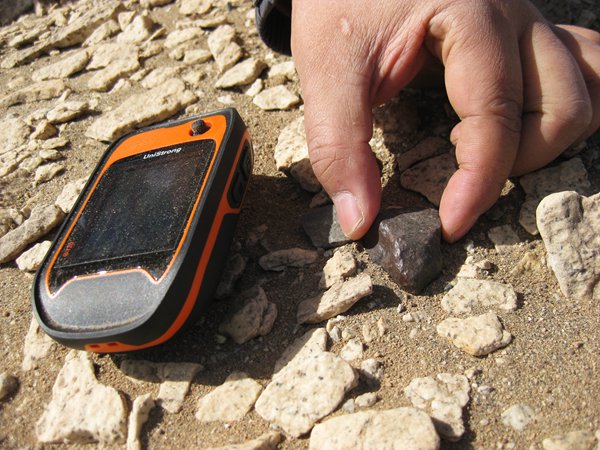
A meteorite "hunter" uses GPS to fix the location of an object his team discovered in Lop Nur, Xinjiang. [Photo by Zhao Yuxian / for China Daily] |
As the market grows in China, a dedicated band of professionals are risking life and limb searching for extraterrestrial material in the deserts of the Xinjiang Uygur autonomous region. Cui Jia reports from Urumqi.
Zhao Yuxian always refers to himself as a "hunter", even though his prey doesn't originate on Earth.
"I'm looking for space rocks that aliens throw at us. Of course, most people call them meteorites," the 31-year-old joked as he spun a wedding ring made from an iron meteorite on his finger. "Meteorites can be as old as the Earth, so a ring made from one is a better way of representing eternity than diamonds."
Although the sky-high prices they fetch at auction has seen public interest in meteorites growing in China in recent years, the dangers associated with finding fragments mean that few people are active hunters.
To his peers in the Xinjiang Uygur autonomous region, a hardcore group of a few dozen professional meteorite hunters who prefer to be known by their nicknames, Zhao is "Falcon". He said the dry climate and flat topography of the nearby Taklimakan Desert make it one of the best places in the world, and certainly the best in China, to find meteorites.
Zhao was still excited when he recalled how in February he and two other hunters discovered a fragment of an iron meteorite in Lop Nur, a dried-out salt lake between the Taklimakan and the Kumtag Desert in Xinjiang. It was the only piece of extraterrestrial material he had found so far this year.
'Another planet'
"Discovering meteorites in the vast and depopulated Gobi, or any desert, is never an easy task, no matter how big they are. Sometimes when I look at the desert landscape I feel as though I am standing on another planet," he said.
Scientists have discovered that most meteorites, solid pieces of debris from sources such as asteroids or comets, survive impact, and most of the ones that land on Earth come from the asteroid belt, between the orbits of Mars and Jupiter.
Collisions in the densely crowded belt can cause asteroids to change course and head toward Earth, and because the asteriod belt was formed during the early history of the Solar System, they can be as old as the Earth, if not older.
According to Zhao, it's a little-known fact that meteorites hit the Earth every day.
Although collectively they can be measured in metric tons, many are as small as grains of sand, or are just space dust that no one notices, and meteorites with a diameter of about 1 millimeter hit the Earth about every 30 seconds.
"We hunt meteorites by examining and following the patterns in which they break away from the original meteor. The fragments become smaller and smaller the farther they are from the main point of impact. When we find one piece of meteorite, there are usually others nearby. What we need to do is work out the direction from which they hit our planet," he said.
Although the hunters use metal detectors to search for iron meteorites, which are mainly composed of an alloy of iron and nickel, when the space rock is made of stone, they have nothing to rely on except their eyes.
"When we find a meteorite, the first thing we do is to record its GPS and analyze its position, which can provide clues about which part of it hit Earth first. I am always fascinated by the journey the rock has to take from outer space to Earth," Zhao said. "Then comes the most rewarding part of meteorite hunting: We find it, dig it out, and give it a little kiss."
However, before 2010, Zhao, who has been in and out of the Lop Nur four times so far this year, knew nothing about meteorites. "I heard a news report that a fist-sized meteorite that landed in a village in Qitai county in Xinjiang in 2009 had been put up for sale for 80 million yuan ($13 million). I became curious to know how a piece of ugly black rock could be that valuable," he said. "That was the time Chinese collectors began to invest in the meteorite market."


Copyright 1995 - . All rights reserved. The content (including but not limited to text, photo, multimedia information, etc) published in this site belongs to China Daily Information Co (CDIC). Without written authorization from CDIC, such content shall not be republished or used in any form. Note: Browsers with 1024*768 or higher resolution are suggested for this site.
License for publishing multimedia online 0108263 Registration Number: 130349