|
|
Jiarken Xiadat's horse stumbled in a rut as another rider rushed, sending the boy hurtling from his horse and smack onto the grassland. The nomads watching the race from a vantage point on a nearby knoll roared in excitement.
The 12-year-old member of the Kazak ethnic group picked himself up and sauntered off, his neck wilting forward, his eyes cast toward the ground. Behind him, a man chased the spooked, riderless steed away from the racetrack.
"It's fine," Jiarken said a few minutes later, his chin held high. "Happens all the time."
Blood oozed from his nose to form a twin trail with the trickle that dribbled from his split lip. The wet slicks glazed his face, which had been painted a deep matte by swirls of dust.
"My muscles are a little sore. That's all," he said.
It seemed the most serious injury was to his pride. Boys in Zhaosu county in Ili Kazak autonomous prefecture in the Xinjiang Uygur autonomous region don't use saddles, so they not only learn how to ride, they also learn how to fall, he said.
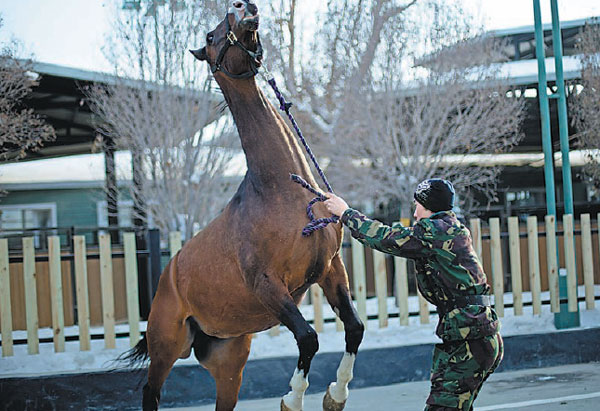
This is China's horse country, and has been for thousands of years. More than 100,000 pedigree equines roam the country's biggest horse-breeding range.
It's a place where, with the exception of a few modern conveniences, the nomads lead a life-style perpetuated through millennia - one largely based on horses.
For thousands of years Zhaosu's totem has been the "Heavenly Horse", sometimes translated as "Pegasus". The name was coined by Hanwudi, a Han Dynasty (206 BC-AD 24) emperor, because he noticed that Ili's native steeds often grazed above the clouds that halo the area's snowcapped peaks.
An envoy of the Wusun kingdom, to which Zhaosu belonged, gave the emperor several dozen of the horses. They so delighted Hanwudi that he demanded a dowry of 1,000 more when one of his daughters married the king of Wusun. Hanwudi - who regarded the horses as assets and incentives to spur greater conquests - cannily waited until they arrived before sealing the deal.
Name change
During his reign, Hanwudi invaded what is now Turkmenistan to plunder 3,000 Ferghana horses. He named them "heavenly horses", and renamed Wusun's native breed "Westernmost horses".
Yet, despite the transfer of the name, Zhaosu remains synonymous with both the "heavenly horse" and China's best native equine bloodstock.
In 1982, China officially recognized Ili horses as one of the world's newest breeds. Military horses were sired on the local grasslands until 1980, when developments in transportation meant the People's Liberation Army no longer had a use for them. Until then, the Zhaosu steeds that patrolled the mountainous border area carried official ranks and were awarded medals. They were honored with retirement ceremonies and buried in tombs when they died.
The county was home to 30,000 of the horses when the PLA set up its own stud ranch in 1954. The ranch became a State-owned enterprise in 1980, according to the deputy director, Cepa, who like many Kazaks has only one name.
Today, the fiery horses are used for racing and shepherding, and about 11,000 of them roam the pastures that cover more than 730 square kilometers on the range, one of the largest in China.
"Our goal is to crossbreed Ili's indigenous horses with top-quality imported pedigrees, including British thoroughbreds and Ferghana, to produce better short-and long-distance racers," Cepa said.
Demand has galloped forward neck and neck with the growing popularity of horseracing in China, especially in places such as Shanghai, Guangzhou, the capital of Guangdong province, and Hubei's provincial capital, Wuhan.
About three-quarters of the country's racehorses come from Ili.
"People are demanding better breeding to compete with the elites from around the world," Cepa said.
Bolatjon Hamutm, director of the Zhaosu Husbandry Bureau, said China has given Ili horses as gifts to dignitaries such as the king of Morocco and the president of Kazakhstan.
However, livestock numbers have to be carefully controlled to prevent the animals - sheep, horses and others - from eating all the vegetation and causing desertification across Zhaosu's 6,700 sq km of grassland, he said.
Last year, the area saw its worst drought for 60 years, which left almost three-quarters of the pastureland parched. "The livestock didn't have enough to eat. I've never seen Ili horses so thin," Bolatjon said.
Copyright 1995 - . All rights reserved. The content (including but not limited to text, photo, multimedia information, etc) published in this site belongs to China Daily Information Co (CDIC). Without written authorization from CDIC, such content shall not be republished or used in any form. Note: Browsers with 1024*768 or higher resolution are suggested for this site.
License for publishing multimedia online 0108263 Registration Number: 130349