|
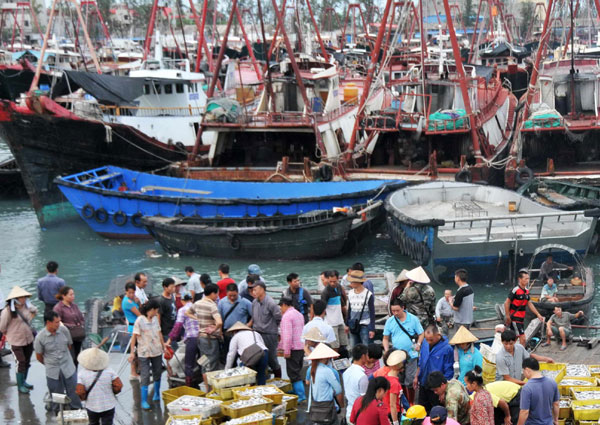
Fishermen return from deep-sea fishing at Qiaogang in Beihai in the Guangxi Zhuang autonomous region in August at the end of the annual three-month fishing off season. Li Junguang / Xinhua |
Clear water harder to find, fish stocks fall and construction boom damages beaches
Depleted fisheries and pollution have left Wu Ruiwei and his peers in South China's Guangxi Zhuang autonomous region needing to travel farther out to sea for fish and shrimp.
Fisherman Wu, from Qiaogang, said he used to earn at least 300,000 yuan ($48,400) annually until five years ago. "Without the country's diesel subsidies to fishermen, I would be losing money now," he said.
Fellow fisherman Fan Chengjin added: "When I was a child, our boat could be filled immediately with fish in one net near the port. But now only small fish can be found."
There are more than 10,000 fishermen in the town of Qiaogang, accounting for 60 percent of the population. In order to survive, some have to fish farther from shore. Others have left the industry.
Wu said excessive coastal development has also degraded China's marine environment.
In South China's Hainan province, for example, swarms of tourists and overdevelopment of coastlines have posed a serious risk to the local marine ecosystem. An island the size of Belgium, Hainan has earned a reputation as the perfect holiday destination, which has brought a local economic boom.
But researchers say more than 90 percent of the island's east coast has been used for real estate development.
This is a concern for people such as Wang Ying, a marine geologist with the Chinese Academy of Sciences. He said at a forum on Sunday that mass construction of tourist facilities, such as hotels and scenic spots along the coast, will lead to increased shoreline erosion.
A total of 4,200 meters of beach in the bays and harbors east of Haikou were eroded by seawater between 2009 and last year, Wang said, adding that bedrock was exposed due to erosion along the beach near hotel and villa developments west of the city.
Pollution is another serious problem in China's coastal areas.
Industrial and agricultural discharges, along with a sharp rise in the amount of household garbage as the island urbanizes, are mostly to blame for the pollution.
"It is difficult to find pristine clear waters and white sandy beaches anymore in some seaside areas," a Hainan resident surnamed Luo said.
Her sentiment is supported by research. The majority of China's coastal areas have unhealthy ecosystems due to heavy pollution, a report from the State Oceanic Administration said.
Of the areas monitored by the administration last summer, 81 percent, or 41,000 square kilometers, were polluted. According to the report, most of the polluted water was concentrated in river estuaries or sea bays. The main pollutants were inorganic nitrogen, reactive phosphate and oil.
Along with the rapid development of industry and cities, coastal pollution has caused frequent episodes of red tide, a type of harmful algal bloom, said Lyu Shuguo, a researcher with the Hainan Research Academy of Environmental Sciences.
Lyu said 14 bays along Hainan's 1,528-km coastline are at risk of red tide, which may threaten the health of locals and damage the environment.
In his message for World Oceans Day, UN Secretary-General Ban Ki-moon said that two out of every five people live near a shore, and three out of seven depend on marine and coastal resources to survive.
He called on people to use ocean resources peacefully, equitably and sustainably for generations to come.
To ease environmental strain, China has adopted measures including massive tree-planting and coral restoration campaigns, clamping down on illegal wastewater discharges, treating polluted rivers and launching public education activities.
Experts have called for local governments to enact rules and policies and evaluate the effects of projects near straits or islands before construction to prevent possible damage to the environment.
During this year's fishing offseason in Guangxi, which lasts from May until August, fisherman Wu Ruiwei and his colleagues will gather to discuss their future: deep-sea fisheries.
"When there are fewer fish in the coastal areas, we have to go farther from shore," he said. But he does not want to take the problems of overfishing and pollution farther out to sea.
"I hope with technology and fishery management, most fisheries can be made sustainable to protect our ocean," he said.


Copyright 1995 - . All rights reserved. The content (including but not limited to text, photo, multimedia information, etc) published in this site belongs to China Daily Information Co (CDIC). Without written authorization from CDIC, such content shall not be republished or used in any form. Note: Browsers with 1024*768 or higher resolution are suggested for this site.
License for publishing multimedia online 0108263 Registration Number: 130349