The average ecological footprint in China, a measure of how much of the Earth's natural resources people are using, is expected to reach its peak in 2029, according to a joint report released on Friday by the World Wide Fund for Nature and the Institute of Scientific and Technical Information of China.
Every person consumes natural resources as they go about their daily activities at work, school or home. Rapid urbanization is a major factor driving the use of natural resources in China, the report said.
"The larger the ecological footprint, the larger the human population is on the Earth," Li Lin, executive director of ecological footprint project at the World Wide Fund for Nature, said on Friday.
The ecological footprint, measured by global hectares, measures whether a region's development falls within the available supply of natural resources, the report said.
It quantifies both the ecological footprint of people or activities, and the biocapacity of a region or the earth as a whole.
The planet's biocapacity is calculated at 1.8 global hectares per capita. When the demand on the planet's resources exceeds supply, the usage becomes unsustainable.
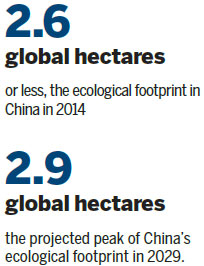
In 2014, China's ecological footprint was less than 2.6 global hectares. It will climb until it reaches a peak of about 2.9 global hectares in 2029, the report said.
In 2029, with China at its peak, the resources consumed by the population are expected to be far more than those provided by nature, meaning the biological deficit will peak as well. At that time, China will need 3.36 times the available natural resources to fully satisfy the demand, the report said
The average global ecological footprint in 2011 was 2.7 global hectares, a report from Chinese Academy of Sciences said.
After the peak, the country's excessive demand on the environment will ease, it added.
"The increase of the ecological footprint in China has a direct relation to rapid urbanization, including the changes in lifestyles and land uses," said Tong Hefeng, deputy head of strategy research at the Institute of Scientific and Technical Information of China.
In 2014, the urbanization rate in China had reached nearly 55 percent, a 29 percent increase over 1995. The report found the rising use of forestry land, which increased the country's ecological footprint, was a result of demand on wood and paper.
The per person ecological footprint in urban areas is double that in rural areas due to higher wealth and higher consumption, WWF's Li said.
zhengjinran@chinadaily.com.cn
(China Daily 08/29/2015 page3)


Copyright 1995 - . All rights reserved. The content (including but not limited to text, photo, multimedia information, etc) published in this site belongs to China Daily Information Co (CDIC). Without written authorization from CDIC, such content shall not be republished or used in any form. Note: Browsers with 1024*768 or higher resolution are suggested for this site.
License for publishing multimedia online 0108263 Registration Number: 130349