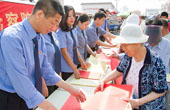
Pig, poultry farmers play a central role in Sichuan's battle to cut water pollution
Liu Huaiyu raises more than 200 pigs in her farmyard, which houses one of the largest piggeries in her village, and the prodigious amount of manure they generate every day never bothers her. It is a source of extra income for her family.
"The village government has subsidized us to expand our methane gas generating pit, and bought our extra biogas fluid. So nothing is wasted any more," said 43-year-old Liu.
The methane gas is used as household fuel, and pig urine becomes an organic fertilizer for Liu's fruit orchard. Any manure left over is collected for centralized processing, instead of piling up in her yard.
Many rural piggeries create a malodorous environment that not only smells but also attracts flies. But Liu's family lives next to their piggery in the village of Banqiao in Meishan, Sichuan province, and are growing used to their new, clean farmyard.
Song Chengquan has won the contract, after severe competition, to collect and transport manure from the village to processing plants, for which he receives a subsidy from the government of 100,000 yuan ($15,700) per year.
"Nine years ago, waste from three pigs contaminated my fishpond," said Song. "It killed my fish and lost me 150,000 yuan in income. Now my village is cleaner, and this gives me satisfaction from my job."
Banqiao is just one example of environmental work in Meishan. The city invested 250 million yuan in 2014 to reduce sources of water pollution, including from livestock breeding farms, in 194 villages. More than 100 large poultry farms have improved their waste processing facilities to make full use of the manure they produce, according to the city government's report in July.
Moreover, Sichuan has promoted central processing for waste from the poultry industry in rural regions, since poultry and livestock have been a major source of water pollution in the province.

Sichuan, the southwestern province located in the upper reaches of the Yangtze River, has faced severe challenges with water pollution from industrial waste, as well as from poultry and livestock breeding in rural areas.
The province's annual environment bulletin in 2014 showed that its five major rivers - part of the Yangtze River, along with Jinsha, Minjiang, Tuojiang and Jiangling rivers - were polluted.
Thirteen percent of these five major rivers have suffered pollution so severe that the water is not fit to drink, nor can it be used for irrigation, besides looking bad, the bulletin said.
The water quality across the province has deteriorated and the percentage of rivers that met national quality standards dropped by 17 percent year-on-year in 2014, largely due to an excessive concentration of phosphorus.
"As a major agricultural province, the accumulated use of chemical fertilizers and waste from the livestock breeding industry have discharged large amounts of pollutants into the water, making the total level of phosphorus excessive," said He Lyuzhang, deputy secretary-general of the provincial government.
Sichuan is facing growing pressure to improve water pollution because of the widening gap between growing demands on its agricultural output and limited natural resources, He said.
The province has imposed tough restrictions on the poultry industry to protect the water quality of the Yangtze and the Three Gorges Project.
In 2014, the province built 1,223 central processing plants for waste from the poultry industry, the province's environmental protection bureau said. Moreover, 1,100 large livestock farms have been required to improve their facilities. A further 183 small farms have been phased out.
"The efforts in the poultry industry are not only to curb pollutant emissions but to improve their production structure, to promote recycling and more efficient methods in agriculture," said Chen Weiguo, an official specializing in rural environmental protection under the Sichuan provincial environmental watchdog.
Maohua Ecological Breeding Garden, a pilot project in Meishan, has recycled waste from over 1,300 pigs to nurture fruit trees, which cover around 233 hectares.
"The recycling chain in our garden has brought profits but no pollution," said Zhao Jianhua, manager of the garden.
The provincial environmental protection bureau has found that intensive pig production, such as at the Maohua garden, has reduced the discharge of pollutants enormously.
"We will improve the subsidy for such efforts in rural areas in a bid to further cut water pollution, but it's a large amount of work so we need financial support from the central government," He, from the provincial government, said.
zhengjinran@chinadaily.com.cn



Copyright 1995 - . All rights reserved. The content (including but not limited to text, photo, multimedia information, etc) published in this site belongs to China Daily Information Co (CDIC). Without written authorization from CDIC, such content shall not be republished or used in any form. Note: Browsers with 1024*768 or higher resolution are suggested for this site.
License for publishing multimedia online 0108263 Registration Number: 130349