 |
|
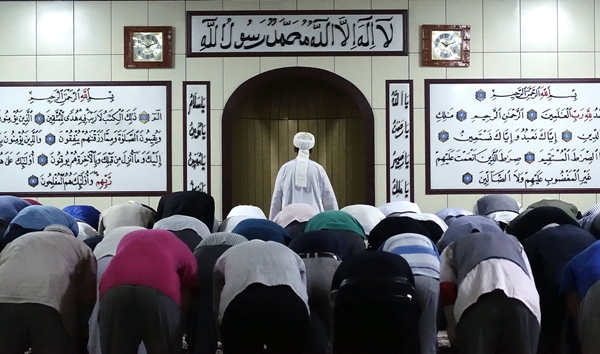
Muslims worship at a mosque in Urumqi, capital of the Xinjiang Uygur autonomous region, on Monday.[Photo by Wang Zhuangfei/China Daily] |
Another major problem is medical care. Although the diocese has a clinic, it can only provide very basic medical services.
"So the problem is, when the priests or nuns become ill, they must pay their own medical bills. The diocese wanted to help, but we cannot because we are having difficulties making ends meet," Ding said.
Zhang, of the Taoist association, also noted that the medical fees of some priests have eclipsed the capacity of some temples to pay.
"Without medical insurance, it would cost tens of thousands yuan for the treatment of a severe illness," he said.
For one Taoist priest in Beijing who was diagnosed with kidney failure, the cost of treatment exceeded 1 million yuan ($157,900), Zhang said.
That was one of a number of cases of serious illness pushing an entire temple into financial difficulty, he said.
Coping with a crisis
Many clergymen said the support of local authorities is crucial to averting a potential social security crisis. In some areas, such as Beijing, Chongqing and the Tibet autonomous region, local authorities have offered to cover all fees required for the clergy to join the country's social security system.
Since 2012, all monks and nuns in the Tibet autonomous region have pension and medical insurance policies, which are aimed at extending their service to religious sites. According to the regional government, Tibet invested more than 1.3 million yuan in the new policies.
"In the past, if I needed to see doctors, I paid a majority of the cost and the monastery paid some. Now I pay very little, and medical insurance and the monastery cover most costs," said Gelek Gyatso, a monk master and the lead chanter at Lingbu Monastery.
The monastery in Xigaze, Gyangze, is small with one living Buddha and 16 monks.
One 41-year-old monk who suffered renal failure received a kidney transplant that cost around 300,000 yuan for the surgery and follow-up treatment, Gelek said. Insurance covered about 45 percent of the cost, the monastery paid 40 percent and the local government provided 10 percent. The monk paid about 5 percent.
In Henan province, local authorities have offered the clergy a retirement plan that is similar to that provided to enterprise employees. It requires recipients to pay 8 percent of the pension plan, and the church to pay more than 30 percent.
"We did a calculation and the church must pay about 280,000 yuan as a whole before a priest can claim pensions. That is way too expensive for us," said Li, the leader in the Xinxiang diocese.
As for health insurance, local authorities offered a new rural cooperative medical care system that requires priests to obtain medical care at hospitals where their household registration, or hukou, is located.
"However, most priests were dispatched to areas where they were needed. It would be very inconvenient for them to go back to their hometowns to receive treatment when an illness strikes," he said.
Li said he is considering commercial health insurance, even though it requires thousands of yuan per year for each person.
"We need to be prepared for the worst scenario. To cure a critical illness could cost all the possessions of a church," he said.
A majority of the clergy agree the social security problem must be solved sooner rather than later, while acknowledging it could not be resolved comprehensively without help from local authorities.
"In some temples, priests are given a monthly allowance of about 120 yuan. Can you imagine any way either the priest or the temple can afford the social insurance bills?" Zhang asked.
Luo Wangshu contributed to reporting from Gyangze county, Tibet autonomous region.


Copyright 1995 - . All rights reserved. The content (including but not limited to text, photo, multimedia information, etc) published in this site belongs to China Daily Information Co (CDIC). Without written authorization from CDIC, such content shall not be republished or used in any form. Note: Browsers with 1024*768 or higher resolution are suggested for this site.
License for publishing multimedia online 0108263 Registration Number: 130349