|
|
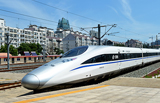
A high speed train heading to Yujiabao Station leaves Tianjin Railway Station in August, marking the extension of the Beijing-Tianjin intercity to Yujiabao in Tianjin's suburban Binhai area. YANG BAOSEN/XINHUA |
Improved infrastructure
Beijing is surrounded by cities and counties in Hebei, while Tianjin, one of the largest container ports in the world, lies just 117 km to the east. Heavy industrial activity in Hebei, such as the production of iron and steel, has resulted in heavy emissions of airborne pollutants and caused a serious smog problem across the cluster. The new plan aims to integrate the three provincial-level areas to create a more-balanced industrial structure, reduce pollution and raise efficiency.
According to the plan, 23 intercity lines, running a combined 3,452 km, will be built within the cluster by 2050. Eight lines, including the Beijing-Tangshan line, will be completed by 2020 and will boast a combined length of 1,012 km. The following decade will see a further 10 lines, totaling 1,817 km, opened, and from 2030 to 2050, another five lines, with 623 km of track, will be opened within the cluster.
Four North-South lines and four East-West lines will connect Beijing, Tianjin and Shijiazhuang, the capital of Hebei, with smaller cities in the area.
When the project is completed, it will be much easier for residents of Beijing and Tianjin to travel to Tangshan, Qinhuangdao, Zhangjiakou, Chengde, Cangzhou, Hengshui and Handan in Hebei. More exchanges will occur between the authorities in Beijing, Tianjin and Hebei to overhaul the current pollution-causing economic model.
To create better-balanced, sustainable development, the government of Beijing is committed to further developing the city's suburban areas, such as the districts of Daxing, Pinggu and Changping, and counties such as Miyun and Huairou. To facilitate the transportation of passengers and freight, a circular line will be built to connect the outlying areas with the capital's new airport-Beijing Daxing International Airport, currently under construction-and adjacent cities in Hebei.
In addition to the Beijing-Tangshan link, work will begin on two further lines at the end of the year to connect Beijing with Bazhou in Hebei and Binhai in Tianjin. With trains designed to run at speeds of 350 km/h, journey times will be cut to 30 minutes, station to station.
Although the project has attracted much public attention, many people are waiting to see the effect the new lines will have. Liang Aili, a 32-year-old software engineer in Beijing, said he expects the journey from the capital to his home in Qian'an, a county-level city administered by Tangshan, to become more convenient.
"I can't predict the influence of the new lines, but they will certainly give people the option of easier travel," he said.
Employment boost
The rail project will have a positive impact on local economies too, especially in terms of employment and consumption of resources. About 600 workers will be required to build each kilometer of track, according to Ji Jialun, secretary-general of the Transportation Department of the China Railway Society.
He said at least 400,000 temporary workers will be required to build all the lines, but at present it's difficult to estimate the number of permanent staff members that will be required at each station. Ji's estimate was more conservative than one provided by the China No 3 Railway Survey and Design Group, which predicted the creation of 1.1 million temporary and permanent jobs by 2050.
Ji, who is also a railway expert at the Beijing Jiaotong University, said the project will stimulate economic growth because the construction process will consume large volumes of commodities, such as steel, iron, wood and concrete.
The China No 3 Railway Survey and Design Group said 2 metric tons of concrete and 0.32 tons of steel will be used for every 10,000 yuan invested in the project, and calculated that 38.64 million tons of concrete and 6.18 million tons of steel will have been used by 2020.
The extended network will boost the consumption of commodities until about 2050, which should help to ease the overcapacity in China's iron and steel and concrete industries, and also help to promote the development of sectors such as agriculture, forestry, tourism and mining by providing easier access to convenient shipping services.
"Amid the slowdown of the Chinese economy, infrastructure investment will promote economic growth by increasing consumption and job opportunities," Ji said.
Contact the writer at huyongqi@chinadaily.com.cn


Copyright 1995 - . All rights reserved. The content (including but not limited to text, photo, multimedia information, etc) published in this site belongs to China Daily Information Co (CDIC). Without written authorization from CDIC, such content shall not be republished or used in any form. Note: Browsers with 1024*768 or higher resolution are suggested for this site.
License for publishing multimedia online 0108263 Registration Number: 130349