|
A worker checks a natural gas boiler that provides heating to residents in a village in Beijing's Mentougou district in November. The capital launched two projects that enabled rural residents to use electricity and natural gas for heating this year. [Li Xin / Xinhua] |
Ministry inspections find practices in rural areas haven't been monitored
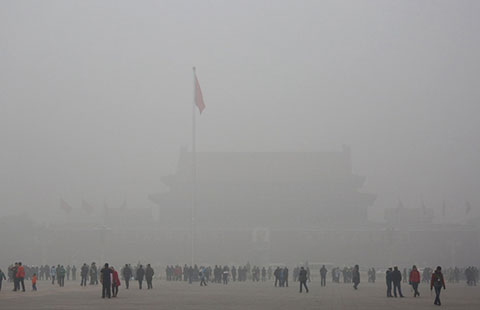
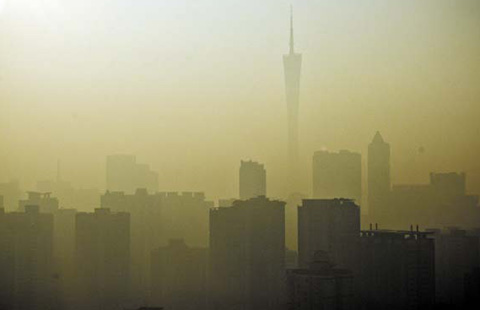
The recurring gray smog in Beijing is a symbol of the thorny side of the country's modernization. The challenge is how to alter the use of the inferior coal that's responsible for much of it.
Around 200 million residents in rural China, mostly in the northern parts of the country, use coal for household heating during the winter. To save money, many of them tend to use inferior types, Economic Daily reported.
Twenty to 30 years ago, most farmers primarily burned wood or crop stalks for winter warmth. Coal was considered a luxury.
Now, as that luxury from bygone days has become commonplace, its dirty reputation as a polluter has begun to rub off on those who use it. Contributing to smog has become tantamount to committing a crime.
In a recent inspection by the Ministry of Environmental Protection of 22 cities in northern China, officials came to the conclusion that coal burning - especially the low-quality coal - is the main cause of the steep deterioration in air quality over the winter months.
Coal burning for heating is a widespread phenomenon in the vast rural areas surrounding the few large modernized cities that have made the shift to cleaner energy.
The inspectors found that 22 percent of the coal samples from Beijing failed to meet national standards, along with 27 percent from Tianjin and 38 percent from Hebei province, which has a much larger rural population.
In many cities in Henan province, the coal used in rural areas was not covered by the local environmental authorities' regular monitoring system, the inspectors said. In fact, the management of coal usage in rural China has been loose, they said.
Related government agencies, such as those in charge of housing and rural development, were also criticized for having failed to be environmentally responsible.
As winter came around and many rural households started to use coal stoves for heating, it took only days for smog to build up in the skies of the region.
The national environmental watchdog's data show that in November the reading of the major hazardous airborne pollutant PM2.5 - particles 2.5 microns or less in diameter that endanger human health - saw an increase of close to 60 percent from last year in the Beijing-Tianjin-Hebei area, one of the three largest city-clusters on the Chinese mainland. There were four more smoggy days in Beijing in November compared with last November.
Rural residential heating makes up only 2.6 percent of China's coal use, according to the National Bureau of Statistics. "But its impact on smog can't be ignored," said He Zhicheng, chief economist at Agricultural Bank of China.
Northern China's air quality is mainly the result of the region's "irrational industrial structure", He said, mainly excessive dependency on coal for heat, or its use in industries such as steelmaking.

Other than the two municipalities of Beijing and Tianjin, coal generates 90 percent of the energy in Hebei.
In most small cities and their nearby rural areas, infrastructure development has been inadequate, experts said. In the worst cases, local governments at the county or township level still support some highly polluting industries as economic pillars.
Banning the use of inferior coal must be the next step toward improving the country's air quality, they said.
Along with the efforts to increase the supply in clean energy, there have been repeated government calls for the adoption of energy-saving equipment, such as more energy-efficient boilers and stoves.
"If the government can replace all old boilers with the more energy-efficient ones, and can forbid the use of inferior coal in rural areas, northern China can cut its carbon emissions by at least 30 percent," said He, the economist.
But that poses a dilemma, said Zhang Lin, a senior analyst of dz18.com, an energy information website. The government cannot force all rural households to use more expensive coal, even if it pollutes less, because "farmers care more about prices".
On average, inferior coal can be cheaper than the good quality variety by 220 yuan per metric ton, Zhang said.
Beijing's municipal government plans to take the lead in ironing out the difficulty. It began in November to allocate 360 million yuan ($56.3 million) to subsidize suburban households that acquire good-quality coal. The subsidy would amount to 800 yuan per ton, said Li Dongwei, a rural development official. The program is expected to run until March.
But it would take five years for Beijing to cut the use of low-quality coal in its suburban areas by 4.3 million tons.
For all provincial governments it is a difficult task to take care of the heating resources for a much larger rural population, He said.
Feng Yinchang, an environmental professor at Nankai University in Tianjin, said the soaring consumption of low-quality coal for heating in rural areas is the major contributor to air pollution in the winter.
It is a problem without an immediate solution. Connecting all villages to central heating would come at immense cost. It might be more realistic to hope that more rural people move to the cities as part of the country's urbanization process.
In some places, "governments can help villagers replace coal with other energy sources, such as electricity and gas", Feng said.


Copyright 1995 - . All rights reserved. The content (including but not limited to text, photo, multimedia information, etc) published in this site belongs to China Daily Information Co (CDIC). Without written authorization from CDIC, such content shall not be republished or used in any form. Note: Browsers with 1024*768 or higher resolution are suggested for this site.
License for publishing multimedia online 0108263 Registration Number: 130349