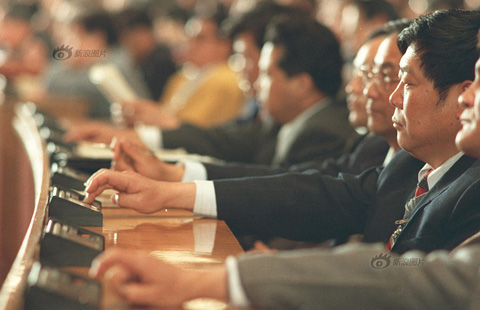
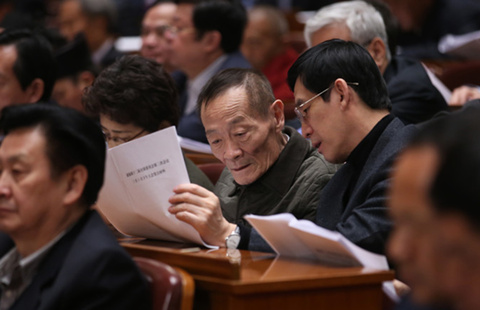
The NPC Standing Committee is the permanent body of the NPC.
The NPC Standing Committee is composed of Chairman, Vice Chairmen, the Secretary-General and other members. They are all elected by the NPC from among its deputies for a term of five years, the same term as an NPC. The Standing Committee continues to function until a new Standing Committee is elected by the next NPC. The Standing Committee of the 11th NPC has 175 members.
None on the NPC Standing Committee shall hold office in any of the administrative, judicial or procuratorial organs of the state. The Chairman and Vice Chairmen of the Standing Committee shall serve no more than two consecutive terms. The following persons successively served as Chairman of the NPC Standing Committee since the establishment of the NPC: Liu Shaoqi, Zhu De, Ye Jianying, Peng Zhen, Wan Li, Qiao Shi and Li Peng. The Chairman of the Standing Committee of the 11th NPC is Wu Bangguo.
The Chairman of the NPC Standing Committee directs the work of the Standing Committee. The Vice Chairmen and the Secretary-General assist the Chairman in his work. The Chairman, Vice Chairmen and Secretary-General constitute the Chairmen’s Council, which handles the important day-to-day work of the Standing Committee.
The NPC Standing Committee normally meets once every two month. It may hold interim meetings when there is a special need.
The NPC Standing Committee is responsible to the NPC and reports to it on its work. The NPC has the power to alter or annul inappropriate decisions of its Standing Committee and to remove its members from office.
Functions and Powers of the Standing Commitee
Legislative power. The NPC and its Standing Committee jointly exercise the power to enact laws in China. The Standing Committee enacts and amends all laws except laws that should be enacted and amended by the NPC. When the NPC is not in session, its Standing Committee may partially supplement and amend laws it enacted, provided that the changes do not contravene the laws’ basic principles. The Standing Committee also has the power to interpret the Constitution and other laws.
Supervisory power. The NPC Standing Committee has the power to oversee the enforcement of the Constitution. It oversees the work of the State Council, the Central Military Commission, the Supreme People’s Court, and the Supreme People’s Procuratorate. It has the power to revoke the administrative regulations, decisions and decrees of the State Council that contravene the Constitution and other laws and to repeal the local statutes and resolutions of organs of state power of provinces, autonomous regions, and municipalities directly under the Central Government that contravene the Constitution, other laws or administrative regulations. The basic form of oversight by the Standing Committee are: listening to and examining work reports made by the State Council and its departments, the Supreme People’s Court and the Supreme People’s Procuratorate; inspecting the enforcement of laws; and putting on record and reviewing the administrative regulations of the State Council and such regulatory documents of local people’s congresses as local statutes and regulations concerning autonomy and local needs. In addition, the Standing Committee can also exercise oversight on the work of the State Council, the Supreme People’s Court and the Supreme People’s Procuratorate by addressing inquiries and investigating into specific issues.
The power to decide upon major state issues. When the NPC is not in session, the Standing Committee examines and approves proposals for making partial adjustments to the plan for national economic and social development or to the central budget that become necessary in the course of their implementation. The Standing Committee decides whether to ratify or abrogate treaties and important agreements concluded with foreign states; prescribes systems of titles and ranks for military and diplomatic personnel and specialized systems of titles and ranks; institutes state decorations and honorary titles and decides who should receive them; makes decisions on the granting of special pardons; declares general or partial mobilization; and declares a state of emergency throughout China or in particular provinces, autonomous regions or municipalities directly under the Central Government. When the NPC is not in session, its Standing Committee decides whether to proclaim a state of war in the event of an armed attack on China or in fulfillment of international treaty obligations concerning common defense against aggression.
The power to appoint and remove from office members of state organs. When the NPC is not in session, its Standing Committee appoints ministers in charge of ministries or commissions, the Auditor-General and the Secretary-General of the State Council based on nominations by the Premier of the State Council; it appoints other members of the Central Military Commission based on nominations by the commission’s Chairman; it appoints or removes the Vice Presidents and judges of the Supreme People’s Court, members of its Judicial Committee and the President of the Military Court based on the recommendations of the President of the Supreme Court; it appoints or removes the deputy Procurators-General and Procurators of the Supreme People’s Procuratorate, members of its Procuratorial Committee and the Chief Procurator of the Military Procuratorate based on recommendations of the Procurator-General of the Supreme People’s Procuratorate; it appoints or removes the Chief Procurators of the people’s procuratorates of provinces, autonomous regions and municipalities directly under the Central Government; and it appoints or recalls plenipotentiary representatives abroad.
Meetings of the Standing Committee and their Procedures
Holding meetings. In general, the NPC Standing Committee meets once every other month, usually near the end of even-numbered months. It may hold interim meetings as needed. Its meetings are called and chaired by its Chairman. The Chairman can delegate a vice Chairman to preside on his behalf. A meeting of the Standing Committee must have a majority of its members in attendance to be valid. The agenda of a meeting of the Standing Committee is drafted by the Chairmen’s Council and is submitted to a plenary meeting of the Standing Committee for approval.
Types of meetings. When the Standing Committee is in session, it holds plenary meetings, workshops and joint meetings. Plenary meetings are held mainly to set agendas for the meetings of the Standing Committee, to hear testimony on bills and work reports on specific issues made by the State Council, the Supreme People’s Court and the Supreme People’s Procuratorate, and to vote on bills. Workshops are held mainly to examine relevant bills and reports. The Tenth NPC Standing Committee is divided into six groups to examine bills. Joint meetings are held mainly to, on the basis of the work of the workshops, listen to and examine the reports presented by special committees on the results of their examinations of bills, discuss the main questions concerning the bills and have supplementary explanations from leaders of the sponsors of the bills.
Submitting bills. The Chairmen’s Council may submit bills concerning matters within the scope of the Standing Committee’s authority to the Standing Committee for deliberation.
The State Council, the Central Military Commission, the Supreme People’s Court, the Supreme People’s Procuratorate and the NPC special committees may submit to the Standing Committee bills concerning matters within its scope of authority. The Chairmen’s Council then decides whether to refer a bill to a plenary meeting of the Standing Committee for deliberation or to give it to the appropriate special committee to deliberate and report on before deciding whether to refer it to a plenary meeting of the Standing Committee for deliberation.
A group of 10 or more Standing Committee members may jointly submit to the Standing Committee bills that are within the scope of its authority. The Chairmen’s Council then decides whether to refer the bill to the Standing Committee for deliberation or to give it to the appropriate special committee to deliberate and report on before deciding whether to refer it to the Standing Committee for deliberation. If a bill is not referred to the Standing Committee, this needs to be reported to the Standing Committee or an explanation needs to be given to the bill’s sponsor.
Deliberating bills. In general, a bill on the agenda of a meeting of the Standing Committee is deliberated at three different meetings of the Standing Committee before it is voted on. At the first meeting, the whole Standing Committee listens to an explanation of the bill by its sponsor, and the bill is given preliminary deliberation at workshops. At the second meeting, the entire Standing Committee listens to a report by the Law Committee on the draft law’s revisions and on the major issues relating to it, and the draft law is given a further examination at workshops. At the third meeting, all Standing Committee members listens to a report by the Law Committee on the results of the deliberation of the draft law, and the examination of the revised draft law is carried out at workshops. After the revised draft law is examined at the meetings of the Standing Committee, the Law Committee revises it in accordance with the results of the examination by the Standing Committee and prepares the final version to be voted on. Then the Chairmen’s Council decides whether to refer the version to the plenary meeting for a vote, and a simple majority of all Standing Committee members is required to pass it. If key controversial issues remain and further study is required following the three meetings, the bill may not be voted on for the time being at the suggestion of the Chairmen’s Council and subject to the approval of the joint meeting or the plenary meeting; and it may be further deliberated by the Law Committee and other relevant special committees.
Bills on the agenda of the meeting of the Standing Committee on which all quarters generally agree may be voted on after they are examined at two meetings of the Standing Committee. Partially revised bills on which all quarters concerned generally agree may also be voted on after they are examined at one meeting of the Standing Committee.
If a bill before the Standing Committee for examination and approval has been shelved for two full years due to significant differences of opinion among committee members concerning such important matters such as its necessity or feasibility, or if two years have lapsed without a vote and it has not been placed on the Standing Committee’s agenda for examination and approval again, then upon notification of the Standing Committee by the Chairmen’s Council, the examination and approval process is terminated.
Laws passed by the Standing Committee are promulgated in decrees signed by the President of the People’s Republic of China.
Related Stories
Copyright 1995 - 2015 . All rights reserved. The content (including but not limited to text, photo, multimedia information, etc) published in this site belongs to China Daily Information Co (CDIC). Without written authorization from CDIC, such content shall not be republished or used in any form. Note: Browsers with 1024*768 or higher resolution are suggested for this site.
License for publishing multimedia online 0108263 Registration Number: 130349