|
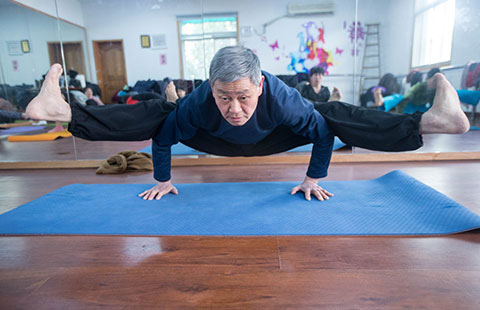
A community worker takes a profile photo for a resident who is covered by the basic pension insurance system in Mengcheng, Anhui province, in December. Hu Weiguo / For China Daily |
Easing companies' social security payment obligations would reduce business costs and encourage hiring, according to experts who have studied the issue.
The annual Central Economic Work Conference, a tone-setting meeting for the 2016 national economic agenda, called for reducing companies' social security expenses and for studying ways to streamline other administrative payments, according to a statement issued afterward.
For Chinese economists, the statement is an overdue acknowledgment of a problem businesspeople have complained about for years: the high costs of running a business. Lowering those costs is a central piece of China's supply-side reform.
Liang Hong, chief economist at China International Capital Corp, who has followed the issue closely, said that unlike Western countries, taxes in China are just part of the corporate burden, which also includes various administrative fees and social insurance obligations.
There is lots of room to alleviate the burden on companies by cutting payments, she said.
Chinese employers must disburse 20 percent of an employee's monthly payroll to the pension fund, compared with the global average of a little over 10 percent of the combined contribution of employers and employees.
Adding other funds, total payments by employers amount to 44 percent of an employee's monthly payroll.
In 2014, total social security payments grew 13 percent to 3.98 trillion yuan ($605 billion). By comparison, the combined profits of China's industrial firms was 6.8 trillion yuan.
High social insurance fees have deterred companies' hiring or forced them to devise ways to circumvent the levies-especially during economic downturns.
Michael Lan, president of Chinahrs, a national human resources service company, said a common practice is to make a cash payout to employees before the monthly salary disbursement. Employers might also pay part of the wage while having remaining wages paid by human resources companies-to keep the payroll base artificially low on the books.
"Unlike the United States, Chinese retirees' pensions are not directly linked with their pension payments before retirement, which reduces employees incentives to participate. Employers also feel overburdened by the obligation," he said. China has already eased some obligations. However, analysts said such moves are patchwork: Unless pension fund obligations are lowered, they will not change much because pension payment takes up about 70 percent of total payments.
If the pension payment ratio were to be substantially cut, say from 20 percent to 10 percent, the problem would shift to how to make up the losses, especially in face of an aging society.
Economists have long suggested two ways to plug the hole: raising the retirement age and diverting more profits and equities of State-owned enterprises. Both have been accepted by the government and listed as a reform direction. But neither is easy job.
"Raising the retirement age inevitably faces public resistance; the other encounters resistance from SOEs. A key reform blueprint urged the diversion of 30 percent of an SOE's dividend to the public coffers but did not specify how much equity should be diverted," Liang said. "You can see the difficulties."
A report by China International estimated that if SOEs converted 10 percent of their equities to pension funds every five years, the government could afford to reduce the corporate contribution ratio to the funds by 5 percentage points.
"If the obligations were reduced, companies undoubtedly would like to hire more, and more would sign labor contracts with employees," Lan said.


Copyright 1995 - . All rights reserved. The content (including but not limited to text, photo, multimedia information, etc) published in this site belongs to China Daily Information Co (CDIC). Without written authorization from CDIC, such content shall not be republished or used in any form. Note: Browsers with 1024*768 or higher resolution are suggested for this site.
License for publishing multimedia online 0108263 Registration Number: 130349