Going underground
Going forward, many first-tier cities have prioritized the development of underground facilities in their urban development programs.
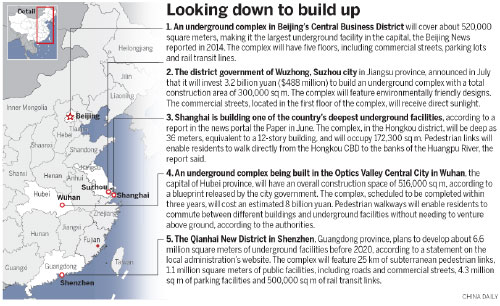
The underground complex in Wuhan has been designed to incorporate commercial walkways lined with stores, cinemas, fitness clubs and other leisure facilities, according to the Optics Valley Central City administrative committee.
The deepest facilities in the complex, including the rail transit system, parking lots and pipeline corridors, will be built 27 meters below the streets.
Jian Jianyong, deputy head of the project's management committee, told the online news portal People that the growth of underground facilities will be an important part of the development of central urban districts in the years to come.
"The fact that the facilities are located underground will protect them from the changing weather and effect of the above-ground environment. Thus, they will provide urbanites with cozy, modern and consistent user experiences, even during cold, rainy or snowy conditions," he said.
A report published by the Shanghai Municipal Department of Urban Planning and Land and Resources said that by 2011, the city was home to more than 31,000 underground facilities, including railways and roads, retailers and cultural and sporting facilities covering an area of almost 57 million sq m.
Research conducted in 2014 by Tsinghua University's institute of underground engineering showed that in Beijing, real estate and urban transit development have resulted in the construction of more than 3 million sq m of underground facilities every year in the past decade.
Yang Xu, vice-president of the China City Development Academy and a political adviser to the Chinese People's Political Consultative Conference, the nation's top consultative body, said Beijing should expand the development of underground space in tandem with construction of a new airport in Daxing district.
"The development of such facilities should be in line with the growth of the urban transit system," he said.
Many cities, including Guangzhou and Shenzhen, still have huge potential for more-efficient land use, according to a report, called "Urban China: Toward Efficient, Inclusive and Sustainable Urbanization", jointly published by the World Bank and the State Council's Development Research Center in March 2014.
"If Guangzhou had the same density as Seoul, it could accommodate 4.2 million additional inhabitants on the existing land, while Shenzhen could accommodate an additional 5.3 million inhabitants," the report said.
Shaun Brodie, head of China Strategy Research at DTZ Cushman & Wakefield, a multinational provider of property services, said he expects underground retail project investors and owners in Shanghai to have an even greater interest in improving the design and layout of future projects because the cost of above-ground development continues to escalate in line with the growing pressure on land available in the center of the city.
He said underground properties have a number of advantages. For example, geothermal energy was used to provide 30 percent of the air-conditioning at the Shanghai World Expo in 2010.
Brodie, who is based in Shanghai, said the opening of new urban metro transit lines will result in much more foot traffic being attracted to underground commercial facilities, given the convenient point-to-point access and the stable environment.
Zhu Wenjun, a researcher with Tsinghua University's institute of underground engineering, said subterranean projects can be two to three times more expensive than surface-based projects because the construction costs are higher. "The cost can only be balanced when the economy, density of urban development and real estate price reach certain levels," he said.
Zhu said underground commercial facilities would be a main source of revenue for developers, and the money they generate could effectively cover the costs of other facilities, including pedestrian links and parking lots which usually make little profit.
Based on the experience of similar construction projects in Japan, it takes about 10 years for real estate developers to recoup their investment and begin making a profit, he said.


Copyright 1995 - . All rights reserved. The content (including but not limited to text, photo, multimedia information, etc) published in this site belongs to China Daily Information Co (CDIC). Without written authorization from CDIC, such content shall not be republished or used in any form. Note: Browsers with 1024*768 or higher resolution are suggested for this site.
License for publishing multimedia online 0108263 Registration Number: 130349