|
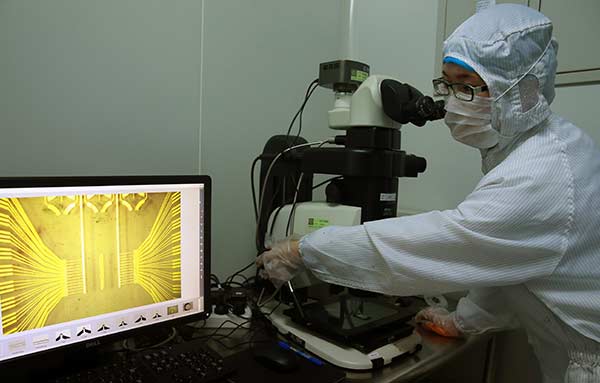
An engineer examines the microstructure of a biochip at the National Engineering Research Center for Beijing Biochip Technology in Beijing this month.Zou Hong / China Daily |
New-generation technology could boost the chances of conception for infertile couples, and aid the government's plans to expand the population, as Yang Wanli reports.
When China relaxed its four-decade family planning policy in January to allow all couples to have a second child, population experts confidently predicted a massive baby boom over the next few years.
However, that may not happen because a rise in the infertility rate among people of optimum reproductive age is likely to pose an obstacle to the government's plans to increase the size of the average family.
In 2014, Li Rui, who has been married for three years, discovered that she and her husband are unlikely to conceive naturally, although they still don't know why.
"I never thought it would be such a long slog to have a baby. I read an article in Scientific American that said about 150 babies are born around the world every single minute. Sadly, none of them is mine," she said.
In the past year, the 32-year-old Beijing resident has tried artificial insemination several times, but has been unable to get pregnant.
Now Li and her husband are considering in vitro fertilization, which may be their last chance to have a child.
Infertility affects at least about 15 percent of the Chinese population ages 20 to 49, or 40 million people. One in eight couples cannot conceive naturally, according to a report published in January by Woyaoyun, a website jointly operated by the China Sexology Association and the Chinese Medical Association's andrology department, which focuses on male reproductive health issues.
Based on cases nationwide, the report says the infertility rate has risen 10 times since the early 1970s.
However, the scenario may be worse that thought. Wu Jingchun, former deputy director of the National Health and Family Planning Commission, estimated that 25 percent is a more accurate estimate of the infertility rate. "The number is still rising. A birth crisis is approaching," she said.
Twenty kilometers from Beijing's downtown, scientists at the National Engineering Research Center of Beijing Biochip Technology, which made the biochips, are attempting to use bioscience to avert the potential crisis.
They hope that three recently developed biochips - mini-laboratories that can run several tests at the same time - will bring hope to infertile couples via human-assisted reproductive technology.
The development process has now ended and the biochips, each no bigger than the palm of a 6-month-old baby, will undergo clinical testing in the near future, according to Xing Wanli, the center's deputy director and also vice-president of CapitalBio Corp in Beijing.
Two of the biochips have been designed to test and evaluate the quality of sperm, while the other checks that the eggs are in the best position to be fertilized. "Trials conducted on mice indicate that the biochips work successfully," Xing said.
"We haven't used any costly materials in them. If they can be manufactured on a large scale for clinical use, the price of each one is expected to be within 1,000 yuan ($154)," she said.
"We hope to separate a single test - such as the one to assess the movement of sperm - from the biochip that tests the quality of sperm and embed it in a portable device, similar to a pregnancy testing kit. People only need to collect a few drops of semen. The method is as simple as the pregnancy testing kit," she said.
Unlike biochips that require a specific power supply, the three new biochips can be used in any lab. Patients only need to provide samples to the medical professionals.
The samples are carried to the biochip via a pipette - a tool used for liquid transportation in chemistry, biology and medicine.
Once in the biochip, the activity of the sperm and eggs can be studied through a microscope to provide a clear picture of the interaction.



Copyright 1995 - . All rights reserved. The content (including but not limited to text, photo, multimedia information, etc) published in this site belongs to China Daily Information Co (CDIC). Without written authorization from CDIC, such content shall not be republished or used in any form. Note: Browsers with 1024*768 or higher resolution are suggested for this site.
License for publishing multimedia online 0108263 Registration Number: 130349