 |
|
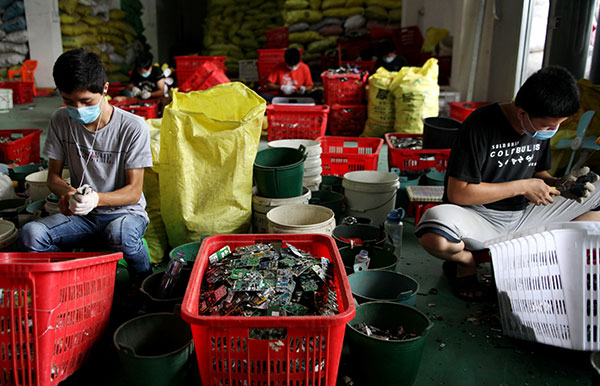
Workers recycle e-waste in Guiyu township, Shantou, on July 12. Guiyu has been nicknamed 'the e-waste capital' by the locals, and almost every family works in the recycling sector. QIU QUANLIN/CHINA DAILY |
Known as the e-waste capital of the world since the 1990s, Guiyu has grown into a major hub for its disposal. In its heyday, more than 100,000 people, about 50 percent of the permanent residents, made a living dismantling electronic equipment to harvest the expensive metals inside, according to Lin Qiurong, head of the township government.
It seemed that on every street, people could be seen heating circuit boards over coal fires to recover lead, while others used acid to burn out copper or bits of gold.
Before the restrictions were imposed three years ago, Guiyu's e-waste industry recovered about 20 metric tons of gold and 450,000 tons of copper every year, Lin said.
Business was booming, but the family-run workshops, teeming with unskilled, poorly equipped laborers, not only damaged the environment but also affected the workers' health.
"Many workshops discharged untreated acid wastewater directly into the rivers," said Zheng Jinxiong, deputy director of the Guiyu Recycling Economic and Industrial Zone, who witnessed the severe air, water and soil pollution caused by unregulated businesses.
A tributary of the Beigang River, which runs through the town, had high levels of acidity, and its muddy bed had a copper content equivalent to that of copper ore, according to the local environmental protection authority.
Declaration of war
"Via the regulations, we declared war on the dismantling of e-waste, until all the family workshops moved into the industrial zone, and were transformed into environmentally friendly outfits," said Lin Qiurong, head of the township.
In 2012, Guiyi was home to more than 5,000 small workshops. It now hosts about 1,400, and they have consolidated to form 29 joint-venture companies located in the recently opened industrial zone.
"Guiyu currently processes around 400,000 tons of discarded e-waste (a year). We have established a system to cover the whole recycling process-from keeping records of all the waste that enters the town, to dismantling and on to the final re-sales," Zheng said.
In March, a comprehensive inspection by the Guangdong provincial environmental team indicated widespread reductions in the levels of pollutants in the air, water and soil.
In 2010, a report published by the United Nations Development Program said the boom in Guiyu's e-waste dismantling industry and the pollution it triggered reflected the general situation in China, which, with 2.3 million tons a year, was seen as the world's second-largest producer of e-waste.
In recent years, the volume of e-waste in China has risen as a result of the nation's growing economic strength, which has boosted demand for electronic appliances as residents replace or upgrade old equipment.
In the first 11 months of last year, cellphone production exceeded 1.6 billion units, a year-on-year rise of 2.9 percent, according to figures released by the Ministry of Industry and Information Technology.
Shan Mingwei, a researcher in electronic device recycling technology for the China Household Electric Appliance Research Institute, said an estimated 187 million cellphones were thrown away in the country last year.
The institute's annual white paper shows that last year 75 million units of e-waste were dismantled and processed nationwide, a year-on-year rise of 6.8 percent.
"The central government has facilitated e-waste businesses via improved laws and policies to regulate their growth and protect the environment. It has also issued preferential measures to boost legal, certified recycling and dismantling businesses," Shan said.
In 2012, the central government introduced subsidies that gradually covered 109 e-waste companies nationwide. The companies enjoyed subsidies of about 5.4 billion yuan ($809 million) last year, according to the white paper
However, subsidies alone will not be enough to keep the booming sector on the straight and narrow, and more measures are expected to be released to further facilitate business growth, according to participants at a UNDP forum held in Beijing last month.
There is a lack of necessary supplementary regulation for central government policies, and the subsidies often fail to reach the companies' coffers on time, which makes it difficult for some of the businesses to survive, Shan said.
"But I am very confident that the booming trend will continue, because of the extra attention being paid by local governments," he said.
China has made significant anti-pollution efforts in recent years, and the e-waste disposal sector has attracted extra attention because of its adverse environmental impact.
In 2013, a UNDP report on China's e-waste industry said the sector generated toxic pollutants during the dismantling and processing phases as a result of people burning circuit boards, plastic and copper wires, or through the use of hydrochloric acid to extract valuable metals. The processes exposed both the workers and the environment to toxic heavy metals such as lead, beryllium and cadmium, and released large amounts of ash into the air, water and soil.
Promotion, expansion
Liu Lili, a researcher at Tsinghua University's School of the Environment, said the large number of small, family-owned workshops, such as those in Guiyu, have exacerbated both environmental pollution and damage to workers' health.
"Those 109 companies, which have been approved by the governments (local and central), have better facilities and advanced dismantling technologies, which help reduce pollution and offer better protection. All of these things need to be promoted and expanded across the country."
Shan and Liu said governments have made huge strides in regulating the sector. In addition, the institutes the two researchers work for have provided a range of further suggestions for companies and authorities to boost the healthy development of the sector.



Copyright 1995 - . All rights reserved. The content (including but not limited to text, photo, multimedia information, etc) published in this site belongs to China Daily Information Co (CDIC). Without written authorization from CDIC, such content shall not be republished or used in any form. Note: Browsers with 1024*768 or higher resolution are suggested for this site.
License for publishing multimedia online 0108263 Registration Number: 130349