 |
|
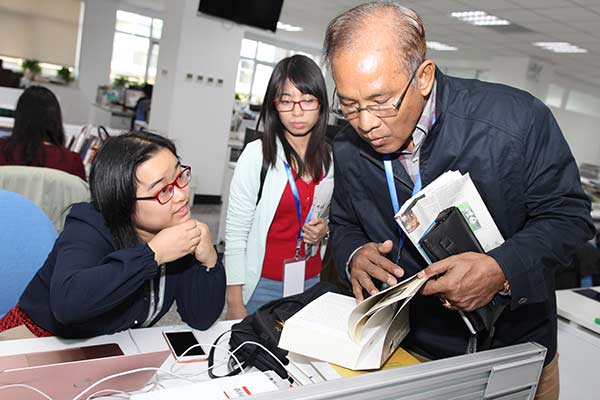
Win Tin (right), from Myanmar, and Pham Thi Hai Ha (middle), from Vietnam, visit China Daily newsroom during their training program in Beijing on Sept 28. [Photo/China Daily] |
Two months ago, Tin, with 25 years of experience in journalism, started an online news outlet, Northern Light Media, but realized he knew little about online media.
So he jumped at the offer to join a 10-day media workshop provided by the university's China-ASEAN Center of Training that targets media executives and journalists from Southeast Asian countries.
"I want to be a lifelong learner, and China is the country I'm most interested in," said Tin, whose fellow trainees, totaling 21, come from Vietnam, Thailand, Malaysia and the Philippines.
The training program-supported by the Chinese Ministry of Foreign Affairs, Ministry of Education and Huaneng Industry, a State-owned energy company-is not the first international project at top Chinese journalism schools.
Since 2014, the School of Journalism and Communication at Renmin University of China has trained at least 10 journalists from African media each year in an exchange program organized by the China-Africa Press Center. This year, the program has received 28 African journalists, the largest group yet.
Every year, the university also admits five young journalists from Pakistan. In nine months, "they studied various aspects of China, built friendships and strengthened their Chinese counterparts' understanding of Pakistan", said Zhong Xin, director of the school's international affairs.
Tsinghua University's master's program in global business journalism, taught in English, admits 20 international students each year. About 200 of them from 50 countries have graduated, said Hang Ming, the program's co-director.
Some programs that train foreign journalists at CUC and Remin University programs is fully paid by schools or sponsors, while the master's program at Tsinghua costs 39,000 yuan ($5,850) per year. Most of the training is done in Beijing, with opportunities for trainees to visit rural areas or small cities.
Hu Zhengrong, president of the CUC and a lecturer of the program for Southeast Asian journalists, estimated more than 100 foreign journalists study in China each year, most from developing countries in Africa, Asia, and Europe.
"China is the world's second-largest economy and a significant stakeholder in global affairs, but its soft power needs to manifest itself through people to people, heart to heart dialogues," Hu said.
"Training foreign journalists in China allows them to experience the country's full complexity, thus ensuring more objectivity and consideration when they portray China to their audience," he added.
CUC provides practical training in new and innovative techniques such as media convergence, big data, smart solutions and next-generation network technology. The lectures are in English.
"The courses are very informative," said Shamim Abdullah Zahedy, executive editor for the Independent in Bangladesh. "It introduced me to new dimensions in new media and broadened my understanding of the medium."
Professor Zhang Wenhui of CUC, who teaches media technologies, said that China's hands-on experience can serve as a blueprint for the trainees to develop the media industry in their home countries.
Zhang had an interpreter for his lecture, but the presentation was in English and he made sure all terminologies were in sync with international standards. "If someone were to purchase a set of equipment, it would be helpful to know exactly what it is called on the international market," Zhang said.
But Hu said some material is geared towards understanding China.
"I avoid using Western concepts like liberal or conservative because they are loaded with implications and stereotypes that may not reflect China's true conditions," Hu said.
When introducing China to foreigners, it is crucial to let them see China through a Chinese conceptual system, he said, adding that teachers have to be thorough and honest in the process.
International graduates of Tsinghua's program often go into international media, public relations or government organizations. "Some become the bridge that connects China and the world," said Hang, the program's co-director.
The work of graduates has been significant.
Compton Nicholas James, a US graduate of the program, published an investigative report on how Chinese governmental and nongovernmental organizations tackle the issue of left-behind children in China.
After graduating from the program, Park Jinbum, a South Korean student, became a producer at South Korean broadcasting network KBS and produced Super China, an in-depth documentary on China's rise that went viral in 2015.
The training programs not only allow journalists to acquire skills, but also broaden their network of contacts for their future endeavors in content creation, said Steven Dong, dean of the Faculty of Continuing Education at CUC.
Dong said he would like to see more media collaboration, such as Legends of Song and Dance, a joint, 2013 Chinese-Myanmar television series telling the stories between the Tang Dynasty (618-907) and the Kingdom of Myanmar. The series was broadcast in both countries.
Apart from teaching technical skills, future media training programs should include courses on content production, thus "laying the foundation for all-around media cooperation", he said.
Contact the writer at zhangzhihao@chinadaily.com.cn




Copyright 1995 - . All rights reserved. The content (including but not limited to text, photo, multimedia information, etc) published in this site belongs to China Daily Information Co (CDIC). Without written authorization from CDIC, such content shall not be republished or used in any form. Note: Browsers with 1024*768 or higher resolution are suggested for this site.
License for publishing multimedia online 0108263 Registration Number: 130349