Spotlight: Astronauts reveal life in space
 |
|
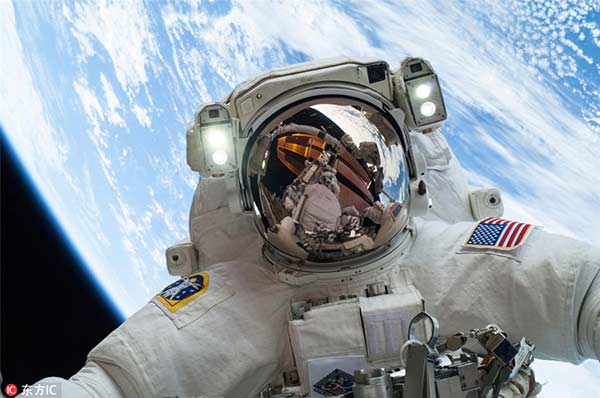
NASA astronaut Mike Hopkins, Expedition 38 Flight Engineer, takes a selfie while participating in spacewalk on Dec 27, 2013. It was designed to allow the crew to change out a degraded pump module on the exterior of the Earth-orbiting International Space Station. [Photo/IC] In photos: Glimpse into lifestyle of astronauts in space |
BEIJING -- Chinese astronauts Jing Haipeng and Chen Dong entered the space lab Tiangong II Wednesday morning aboard the Shenzhou XI?spacecraft. It's story that has garnered plenty of international media attention.
But what is life actually like in space? In two separate interviews, former NASA astronaut Leroy Chiao and Alexander Zheleznyakov, a member of the Tsiolkovsky Russian Academy of Cosmonautics, tell us about the day-to-day routine of astronauts along with the mental and physical challenges they face. Excerpts of the interviews are below.
Q: How was your day scheduled in space? Were you still on duty during the weekend?
Chiao: A typical day begins with a short conference with the mission control centers to discuss the days activities. Then, each astronaut works off of his or her schedule for the day. The schedule includes experiment operations, repair/maintenance tasks, housekeeping/inventory tasks, meals, short breaks, and an exercise period. At the end of the day, there is another short conference with mission control.
Weekends are lighter for work, and we do get some time off for major holidays.
Q: What is the most common problem in space?
Chiao: The most common problem in space for me is trying not to lose things. Everything must be secured in place, usually with velcro or a rubber bungee. But, if someone bumps into the object, it can come free and become lost. Most lost items end up in the air filters, but sometimes things stay lost for much longer, or even indefinitely!
Q: What are these lost items? Anything important?
Chiao: Could be anything, from small parts to a bag of disk drives, to personal items, like watches, pens, etc. Nothing dangerous.
Q: What health problems could come out of the long-time stay in space?
Zheleznyakov: We have special medicines to prevent lose of calcium in our bones and other negative changes in the human organs, and physical exercises to reduce threats to our health. All possible problems in an astronaut's health have been properly handled in the space missions so far.
Q: How do you manage to stay healthy, both physically and mentally, in space?
Chiao: The two-hour exercise periods take care of physical health. Mental health is up to the individual. Most of us spend our free time looking at the Earth and taking photographs. We also take time to use email or the VOIP phone to keep in touch with family and friends.
Q: Any common psychological problems?
Zheleznyakov: The mental conditions of astronauts during their space missions are largely linked to preparations before they go into space. What should be taken into consideration is whether or not their personalities suit the missions facing them.
Q: What if depression his an astronaut?
Zheleznyakov: You have to make a tight schedule to leave no time for too much mental excursion. I personally know no case of mental problems as going so far as disrupting an astronaut's mission in space. One day or two with a bad mood is common, but they come around in the end.
Q: How important are the experiments you'll be carrying out?
Chiao: Most experiments are biomedical in nature. That's because we really need to understand the negative effects of spaceflight on astronauts, and develop countermeasures to keep them healthy. Only then, can we expect to mount successful missions that are longer and farther from the Earth.
Q: Anything you want to say to your Chinese colleagues in space?
Chiao: I want to wish them good luck on their mission! I'm sure they are well prepared, and will do a good job.






- Is it a thing? 10 odd jobs where you can make good money
- Message on a bottle: Mineral water company launches drive to find missing children
- Sun Yat-sen champion of national integrity, unity: Xi
- Four killed, two injured after house collapses in C China
- Cross-Straits forum held to commemorate Sun Yat-sen