Family-planning policy may need more 'adjustment'
The country's dwindling labor force might negatively impact the economy
The universal two-child policy "should not be the end of the family-planning policy adjustment", and further relaxation is expected to ease the population challenges China is facing, according to experts.
"A dwindling workforce population and an aging population are inevitable in China, and a further adjustment of the family-planning policy is needed, based on consistent monitoring of births," according to the Green Book of Population and Labor 2016, which was released by the Population and Labor Economics Institute of the Chinese Academy of Social Sciences on Wednesday.
The latest family-planning policy, which allows all couples to have two children, will not result in a big population increase, due to reasons such as a reduced willingness to give birth and the increased ages of eligible women, said Zhang Chewei, director of the institute and an author of the book.
As a result, the universal two-child policy will not effectively ease the social and economic challenges China is facing, such as a reduced workforce and a population that is rapidly aging, he said.
"Judging from the experiences of some other countries, with people continuously delaying marriage and pregnancy, it is possible that Chinese people's willingness to give birth will continue to decrease," Zhang said. "China may need to further relax its family-planning policy in the future, and it may even abolish restrictions on birth."
In recent years, China has been relaxing its family-planning policy-which used to allow most couples in urban areas to have only one child-amid a reduced fertility rate and challenges such as an aging population.
Since early 2014, couples where one partner is an only child have been allowed to have a second child in most areas of China. Of 11 million eligible couples, only 1.45 million applied to have a second child by the end of May last year, according to a report by Beijing News.
At the beginning of this year, all couples were allowed to have a second child.
The number of people over 60 years old in China reached 222 million last year, accounting for more than 16 percent of the population. That percentage is expected to exceed 30 percent by 2050, according to some population experts.
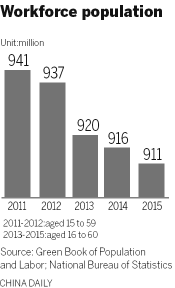
China's workforce population, or those between 16 and 60 years old, has been declining since 2012, which may negatively impact the economy.
"It is an irreversible trend, and the workforce population will continue to decrease even if the family-planning policy is totally abolished," said Lai Desheng, a professor of economics at Beijing Normal University.
Yuan Xin, a professor in population studies at Nankai University in Tianjin, said that although problems such as population aging and a dwindling workforce population are inevitable, more research and evaluation should be made before adjusting the current family-planning policy.
"The universal two-child policy will not have a significant impact on China's population growth in the short or even medium term, due to generational gaps in birth," he said. "But with several generations having two children, the policy will contribute greatly to population growth by the end of the century."
The National Health and Family Planning Commission, China's top health authority, will monitor population changes for possible policy adjustment, according to a statement provided to China Daily by the commission in October.
China's large population will continue to be a burden on economic and social development until the middle of the century, so the fertility rate in China should be continually monitored, the commission said.