China issues white paper on right to development
I.The Philosophy of the Right to Development Abreast with the Times
Equal access to development opportunities and development benefits are the ideals of human society wherein each and every citizen can achieve well-rounded development and enjoy full right to development.
The Chinese people are diligent, wise, innovative and progressive. In traditional Chinese culture, concepts such as "moderate prosperity" (xiao-kang), "great harmony" (datong), "having ample food and clothing" ??(fengyi zushi) and "living and working in peace and contentment" (anju leye) fully reflect the Chinese people's aspiration for and pursuit of a better, happier life. In the long course of history, the Chinese people have always striven for better and shared development opportunities, conditions and benefits. In ancient times, China was for long the world leader in agriculture, and contributed to human progress with extraordinary development achievements. Studies reveal that until the mid-19th century, China's GDP and per capita GDP were the world's highest. Before the 16th century, China contributed 173 of the world's top 300 innovations and discoveries.
After the Industrial Revolution started in the 18th century, China began losing its leadership. Foreign aggression and expansion by Western colonialists completely destroyed conditions for development in China. Repeated invasions by foreign powers, particularly from the West, from 1840 to 1949, and China's corrupt ruling class and backward social system reduced China to a semi-colonial and semi-feudal society. There was constant warfare, an unstable society, economic depression, no security of livelihood, and extreme poverty. The Cambridge History of China: Republican China 1912-1949 describes China's situation in the first half of 20th century as follows: "...the great majority of Chinese merely sustained and reproduced themselves at the subsistence level ... the standard of life for many fell short even of that customary level." [Note: The Cambridge History of China (Volume 12): Republican China 1912-1949 Part I, Cambridge University Press, 1983, p. 28.] "As a system, China's economy which was 'pre-modern' even in the mid-twentieth century ceased to be viable only after 1949..." [Note: Ibid. p. 29.] In these 110 years, the Chinese people struggled arduously for their right to development and equal access to development opportunity. The Chinese people are fully aware of the value of development and of their right to development.
The founding of the People's Republic of China (PRC) in 1949 ushered in a new era for China's development. The PRC has provided full development opportunities and conditions to the people, and vast scope to realize that right. Through more than 60 years of effort, China's overall national strength has greatly increased; standards of living have achieved a historical leap from poverty to moderate prosperity; the people's right to development in economy, politics, culture, society and environment has been effectively protected.
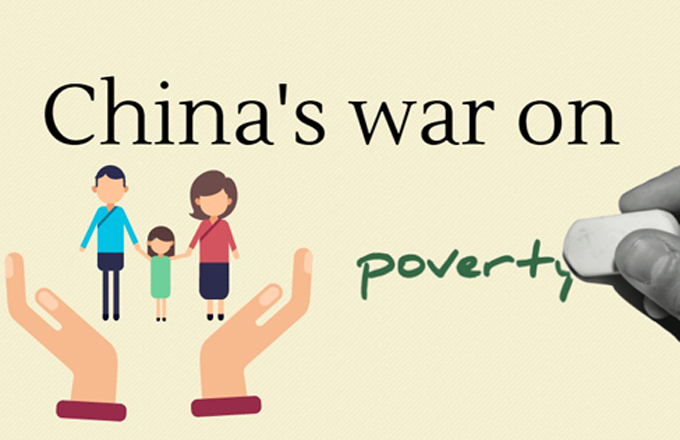
China feeds more than 20 percent of the world's population with less than 10 percent of the world's arable land. Through more than 30 years of reform and opening-up, China has lifted 700 million people out of poverty, accounting for more than 70 percent of the global reduction in poverty. China has established the world's largest social security system, and average life expectancy had grown from 35 years in 1949 to 76.34 years in 2015, ranking high among the developing countries. The level of education has soared: in 1949, more than 80 percent of the national population was illiterate, and the enrollment rate of school-age children was only 20 percent. In 2015, net enrollment rates were as follows: primary school-age children-99.88 percent; nine-year compulsory education--93 percent; high school-87 percent. The enrollment rate for higher education has reached a level approaching that of medium-developed countries. According to the "China National Human Development Report 2016" released by the United Nations, China's Human Development Index (HDI) in 2014 ranked 90th among 188 countries, already in the high human development group. Over the years, proceeding from reality and following the trend of the times, China has maintained the people's principal position in the country and created its own path by taking the central task of economic development and upholding the Four Cardinal Principles [Note: The Four Cardinal Principles refer to the principles of adhering to the socialist path, the people's democratic dictatorship, the leadership of the CPC, and Marxism-Leninism and Mao Zedong Thought. The Four Cardinal Principles are the foundation of the state, and the political cornerstone for the survival and development of the Party and the state.] and the policy of reform and opening-up to serve its practice of Chinese socialism, and following the philosophy of innovative, balanced, eco-friendly, open and shared development, and thus contributed to enriching and improving the concept of right to development.
The rights to subsistence and development are the primary, basic human rights. Poverty is the biggest obstacle to human rights. Without the production and supply of material goods, it is difficult or even impossible to realize any other human right. Development is a means of eliminating poverty. It provides necessary conditions for realizing other human rights, and releases human potential. The right to development is incorporated into other human rights, while the latter create the conditions for people to facilitate development and realize the right to development. Safeguarding the right to development is the precondition for realizing economic, cultural, social and environmental rights, and obtaining civil and political rights. China appreciates the articulation in the UN's "Declaration on the Right to Development" : "The right to development is an inalienable human right by virtue of which every human person and all peoples are entitled to participate in, contribute to, and enjoy economic, social, cultural and political development, in which all human rights and fundamental freedoms can be fully realized."
The people hold the principal position concerning the right to development. China values the people's supremacy and regards the people as the fundamental driver of development, striving for the people, relying on the people, and sharing among the people. It takes improving popular wellbeing and well-rounded development as the starting point and ultimate goal, and fully mobilizes people's enthusiasm, initiative and creativity to participate in, contribute to and benefit from development. To build a moderately prosperous society in all respects and realize the Chinese Dream of revitalizing the Chinese nation means to provide better education, more secure employments, more satisfying income, more reliable social security, better medical services, more comfortable housing, and a better environment, so that all individuals can develop, contribute to society, and share the opportunity to pursue excellence and realize their dreams.
The right to development is a unity of individual and collective human rights. China values both individual and collective human rights as well as balance and mutual promotion between the two. "The free development of each individual is the condition for the free development of all people." Only through individual development can a collective develop; only in a collective can individuals achieve well-rounded development. The right to development is a human right owned by each individual as well as by the country, the nation and the entire population. The right to development can be maximized only in the unity of individuals and collective. China values the articulation in UN's "Declaration on the Right to Development" : "Equality of opportunity for development is a prerogative both of nations and of individuals who make up nations." They are all entitled to participate in and share the benefits of development on an equal basis.
The realization of the right to development is a historical course. There is no end either to development or to realizing the right to development. The latter is an ongoing process of improvement. China is still in the primary stage of socialism and will long remain so. The inadequacy in meeting the ever-growing material and cultural needs of the people because of backward social production will remain the principal social problem. As a major developing country, China faces challenging problems and heavy tasks in development. In pursuit of more equal participation and development, China needs consistent efforts to fully realize the people's right to development.
The protection of the right to development must be sustainable. Sustainable development is a prerequisite for materializing the right to development, an embodiment of intergenerational equity. Imbalanced, uncoordinated and unequal development reflects unsustainable development, as does an extensive development model. China is pursuing a sustainable approach to production, utilization and consumption of natural resources. China now follows a sustainable and resilient socio-economic development path so as to meet the needs of both present and future generations. China has a development mindset of balance and sustainability, regarding the harmonious development between humanity and nature, between economy and society, as a new means of realizing and protecting the right to development.
The right to development must be enjoyed and shared by all peoples. Realizing the right to development is the responsibility of all countries and also the obligation of the international community. It requires governments of all countries to formulate development strategies and policies suited to their own realities, and it requires concerted efforts of the international community as a whole. China calls on all countries to pursue equal, open, all-round and innovative common development, promotes inclusive development, and creates conditions for all peoples to share the right to development. Global economic governance must be based on equality. It must better reflect the new world economic pattern, give an enhanced voice and representation to emerging markets and developing countries, ensure that all countries enjoy equality of rights, opportunities and rules in international economic cooperation, and ensure the right to development is shared.