'Green' producers look to grow stronger
As preparation for the certificate, he will only use natural fertilizers and pesticides derived from plant sources while his land, which was previously waste ground, recovers from decades of misuse.
He doesn't even consider using pig manure because it may contain antibiotics ingested by the pigs, and that could pose the risk of the land failing official inspections.
"We have to be very careful because technicians from the institute that awards the certificates inspect the land every year," he said.
Wang will grow vegetables such as eggplants and tomatoes on the converted land, and may make his farm wholly organic in the next few years if his produce proves popular with consumers.
Rising costs
Man, the farmer from Wuchang, said organic farmland usually produces lower yields than conventionally farmed land because the ban on the use of synthetic fertilizers and pesticides means some of the seeds and crops will be eaten by pests.
In addition to the higher cost of organic fertilizers, rising labor costs are another prime contributor to the high price of organic food.
"On nonorganic land, you can spend 100 yuan to buy some weed killer and suddenly a hectare will be clear of weeds," he said.
"But on organic land we have to rely on laborers to pick the weeds before we plant the crop, and we have to repeat the process at least three times prior to planting because the weeds grow back quickly."
Man began organic cultivation in 2012, when he was approached by technicians from Organic and Beyond. "At that time, few villagers had heard of organic food and even fewer knew how to grow it," he said.
Under the technicians' guidance, he learned how to use a mixture of burnt straw ash and pig manure to fertilize his land. He then moved on to organic fertilizers, which were so expensive the company provided him with an annual subsidy. He now sells most of his rice to Organic and Beyond.
"Many farmers will not consider growing organic rice if they can't find a reliable buyer," he said. "They can't take the risk of producing food but not being able to sell it."
Development
Qiao Yuhui, an associate professor of agricultural ecology at the China Agricultural University, said it will take time for the country's organic industry to mature, despite the great progress made in production techniques in recent years.
"The industry still lacks customer recognition. Organic products are too expensive in China," she said, adding that only about one-third of organic produce sold in the country every year is labeled as such.
"Many organic products don't sell because of the high price," she said. "Also, many consumers lack knowledge about organic products and distrust them."
According to Qiao, tightened supervision of the sector and rising public awareness of organic food mean it's easy to see the sector developing, but more government support will be needed to make that happen.
"The organic industry needs technical support, which is largely lacking in China. There is no ministry in charge of providing technical support for the sector, but farmers and producers need to be better equipped in terms of aspects such as improved farming methods and fertilizers," she said.
Moreover, organic producers need education so they will understand the industry better, she added: "Many farmers believe organic just equals no use of chemical fertilizers or pesticides, so they will buy a new kind of fertilizer from hundreds of miles away to raise output. However, they fail to realize that the primary way to develop organic farming lies in local management of their farms, such as using intercropping - the cultivation of at least two types of plant in close proximity - to resist weeds and raise yields."
|
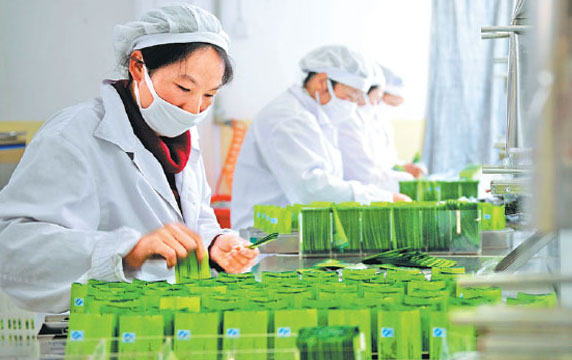
Workers pack organic oolong tea in Baoshan, Yunnan province. Liu Yongzhen / Xinhua |