Can we grow human organs in space? Chinese scientists ask
Xinhua | Updated: 2017-04-21 15:40
BEIJING - Scientists around the world are looking for the "keys" to enable humans to regrow tissues or organs lost due to illness or injury, just like gecko can regrow a tail.
Their quest now extends into space.
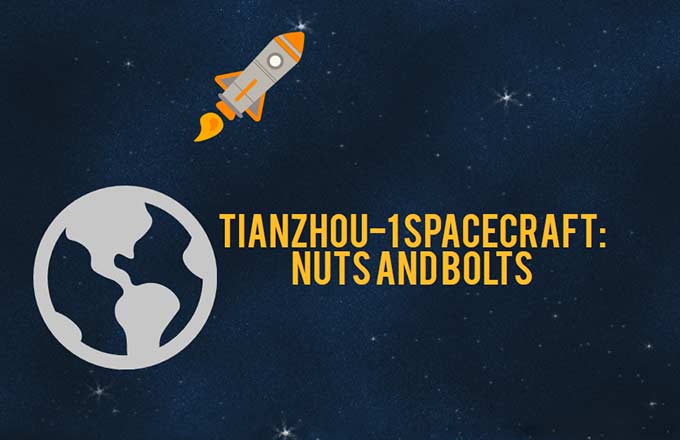
Stem cell research on Tianzhou-1, China's first cargo spacecraft, is far from realizing this dream, but it's the first step to explore the possibility.
Scientists from the Institute of Zoology of the Chinese Academy of Sciences (CAS) are conducting experiments on Tianzhou-1, which launched Thursday, to study the effects of micro-gravity on embryonic stem cell proliferation and differentiation.
The spacecraft is carrying embryonic stem cells and embryoid bodies of mice. Scientists will observe the process of their proliferation and differentiation in space through telescope images. Parallel experiments will be conducted on the ground to compare the results, says lead researcher Duan Enkui.
"We hope to get an initial understanding about the space micro-gravity effects on stem cell proliferation and differentiation," said Duan.
The basis of tissue engineering and regenerative medicine research, stem cell biology is regarded as one of the most important research fields of the 21st Century.
Embryonic stem cells are pluripotent cells that have the potential to become any type of cell in the body. One of the main characteristics of stem cells is their ability to self-renew or multiply while maintaining the potential to develop into other types of cells. Stem cells can become cells of the blood, heart, bones, skin, muscles, brain or other body parts. They are valuable as research tools and might, in future, be used to treat a wide range of ailments.
The study of micro-gravity's effects on the proliferation and differentiation of stem cells is a hot topic in the field of space life science.
"In ground experiments simulating micro-gravity conditions, we found the differentiation ability of mouse embryonic stem cells is enhanced. We also discovered the key gene responsible for this change and the molecular signaling pathway," says Lei Xiaohua, a member of the research team.P "Can we use micro-gravity conditions to realize large-scale proliferation of stem cells and tissue engineering construction? That's what we want to find out," says Lei.
"As the ground experiments are conducted in simulated micro-gravity, we must move the study to a real micro-gravity environment in space to understand how it will affect the proliferation and differentiation of embryonic stem cells."
The experiment might provide a new method to better realize in-vitro expansion of embryonic stem cells, and might explore a new way to apply multi-potent stem cells in tissue engineering and regenerative medicine, Lei says.
"Maybe scientists will be able to induce stem cells to grow into certain tissues or organs in space in the future to serve people on earth. In another scenario, if a human is injured and loses organs in future space migration, the lost organs might be regenerated," says Lei.
Previously, the research team conducted a series of space life science experiments on China's recoverable satellites Sj-8 and Sj-10.
"We expect to continue our research into embryonic stem cells on China's future space station. We aim to try to culture functional tissues, such as heart, kidney, liver and spleen tissues," Lei says.
The current life science experiments on Tianzhou-1 are remotely controlled, which is very difficult, he adds. Scientists hope to enter China's space station in future to personally conduct the experiments.
Their quest now extends into space.
Stem cell research on Tianzhou-1, China's first cargo spacecraft, is far from realizing this dream, but it's the first step to explore the possibility.
Scientists from the Institute of Zoology of the Chinese Academy of Sciences (CAS) are conducting experiments on Tianzhou-1, which launched Thursday, to study the effects of micro-gravity on embryonic stem cell proliferation and differentiation.
The spacecraft is carrying embryonic stem cells and embryoid bodies of mice. Scientists will observe the process of their proliferation and differentiation in space through telescope images. Parallel experiments will be conducted on the ground to compare the results, says lead researcher Duan Enkui.
"We hope to get an initial understanding about the space micro-gravity effects on stem cell proliferation and differentiation," said Duan.
The basis of tissue engineering and regenerative medicine research, stem cell biology is regarded as one of the most important research fields of the 21st Century.
Embryonic stem cells are pluripotent cells that have the potential to become any type of cell in the body. One of the main characteristics of stem cells is their ability to self-renew or multiply while maintaining the potential to develop into other types of cells. Stem cells can become cells of the blood, heart, bones, skin, muscles, brain or other body parts. They are valuable as research tools and might, in future, be used to treat a wide range of ailments.
The study of micro-gravity's effects on the proliferation and differentiation of stem cells is a hot topic in the field of space life science.
"In ground experiments simulating micro-gravity conditions, we found the differentiation ability of mouse embryonic stem cells is enhanced. We also discovered the key gene responsible for this change and the molecular signaling pathway," says Lei Xiaohua, a member of the research team.P "Can we use micro-gravity conditions to realize large-scale proliferation of stem cells and tissue engineering construction? That's what we want to find out," says Lei.
"As the ground experiments are conducted in simulated micro-gravity, we must move the study to a real micro-gravity environment in space to understand how it will affect the proliferation and differentiation of embryonic stem cells."
The experiment might provide a new method to better realize in-vitro expansion of embryonic stem cells, and might explore a new way to apply multi-potent stem cells in tissue engineering and regenerative medicine, Lei says.
"Maybe scientists will be able to induce stem cells to grow into certain tissues or organs in space in the future to serve people on earth. In another scenario, if a human is injured and loses organs in future space migration, the lost organs might be regenerated," says Lei.
Previously, the research team conducted a series of space life science experiments on China's recoverable satellites Sj-8 and Sj-10.
"We expect to continue our research into embryonic stem cells on China's future space station. We aim to try to culture functional tissues, such as heart, kidney, liver and spleen tissues," Lei says.
The current life science experiments on Tianzhou-1 are remotely controlled, which is very difficult, he adds. Scientists hope to enter China's space station in future to personally conduct the experiments.