Government tackles growing waste problem
 |
|
A resident of Xiamen, Fujian province, displays a credit coupon she received for sorting her household trash. The coupon can be exchanged for household items. [Photo/Xinhua] |
Growing awareness
Calls for the classification of waste have become louder in recent years, especially because many cities are surrounded by growing mountains of trash as a result of China's rapid economic development.
For decades, household trash has been processed by burying or burning. In 2015, the amount buried or burned accounted for 92 percent of the total volume generated in cities nationwide, according to data from the National Bureau of Statistics.
However, many landfills are now full or nearing capacity, and some processing plants are overloaded, including those in cities included in the plan.
This month, the results of environmental inspections conducted last year on behalf of the State Council, China's Cabinet, were released. The inspectors assessed conditions at Beijing's waste processing plants, and discovered that 11 of the city's 21 facilities are overburdened, according to a statement issued by the Ministry of Environmental Protection.
The inspectors also reported violations of the regulations related to household waste, including random and illegal dumping.
In July, cargo vessels were found to be illegally transporting and dumping household trash from Shanghai in areas close to Tianhu Lake in Jiangsu province.
"Trash-sorting should be introduced as soon as possible, because it would improve burning efficiency and reduce residue," said Xue Tao, executive head of the E20 Institute, an environmental think tank that has partnered with Peking University's College of Environmental Sciences and Engineering to start a research platform for businesses in the sector.
Most important, rapid introduction would raise public awareness of environmental protection and help reduce the amount of trash generated by households, he added.
Utilization measures
Since 2010, the National Development and Reform Commission has overseen pilot measures to avoid burying or burning by utilizing kitchen waste as compost or to produce methane.
Restaurants in pilot cities are required to either process waste themselves or hand it over to local governments for processing.
So far, 100 major cities have been listed as pilots and have established composting and processing plants, aided by more than 2 billion yuan ($290 million) provided by the commission, according to statements it published last year.
"The authorities have pushed forward these projects to control the illegal use of recycled cooking oil, known as 'gutter oil'," said Xue, referring to the illegal practice of retrieving used oil from drains and bins and recycling it for further use. He added that most of the recycling projects approved by the authorities use waste to produce methane via anaerobic fermentation. The gas is then used to generate electricity.
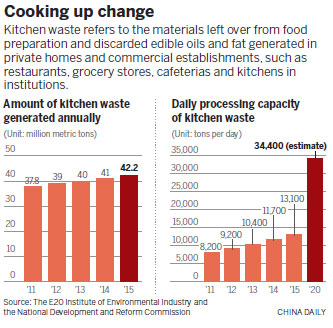
E20's analysis of the market for household waste shows that the amount generated is rising by 10 percent every year, and is expected to reach more than 48 million metric tons by 2020.
That growth is providing opportunities for processing companies.
"Encouraged by preferential policies and a huge injection of funds, the domestic market for kitchen waste has soared," Ren Lianhai, a professor of environmental science at the Beijing Technology and Business University, said at a forum on the treatment of solid waste in December.
"The developing industry has helped to reduce the amount of gutter oil being processed, and also improved food security."
For example, Changzhou in Jiangsu province has processed more than 140,000 tons of kitchen waste since May 2012, while the government of Jinhua, Zhejiang province, collects almost all the waste generated by more than 3,400 restaurants and canteens at schools and government buildings in its downtown districts.
However, many problems still exist, such as wide fluctuations in the amounts of trash transferred to processing plants, which has resulted in some facilities struggling to stay in operation.
"In Beijing, the collection capacity of some companies and institutes is quite low, meaning the volume of waste being processed is not recorded," according to a statement issued by the State Council's environmental inspectors on April 12.
An official with the Gaoantun Kitchen Waste Processing Plant in Beijing who preferred not to be named, said the volume of waste varies, and the plant usually works at half capacity.
In response, Xue said: "The high profits from the production of gutter oil is still an attractive channel for companies that wish to avoid the legal and environmental requirements to deal with kitchen waste."
Some experts believe the fluctuating volumes constitute a major problem that is hampering the development of the processing industry.
Poor management
The risk of pollution from poor management of waste has also attracted public attention.
The inspectors discovered that the amount of leachate - contaminated water produced by the treatment of kitchen waste - at the Gaoantun plant had "disappeared from the records".
Last year, operations were suspended at the plant, believed to be the biggest in China, and no resumption date has been given.
Despite the problems, the processing industry is developing, and its work to control production of gutter oil is making a notable contribution to resolving the issue, E20's Xue said.
"In the initial stage, the sorting of trash requires strong government support and promotion, so it's necessary to provide both policies and financial aid," he said. "After all, we are now in a position where we have had to introduce mandatory action to deal with the problem."