Two teams face plants, worms, year of inner space
China started a yearlong experiment on Wednesday using an airtight advanced life-support system to house eight volunteers as a way to help with the nation's goal of long-term manned deep-space exploration, the project's operator said.
The Lunar Palace 365 experiment was launched at the Lunar Palace 1 bioregenerative life-support laboratory in Beihang University in Beijing.
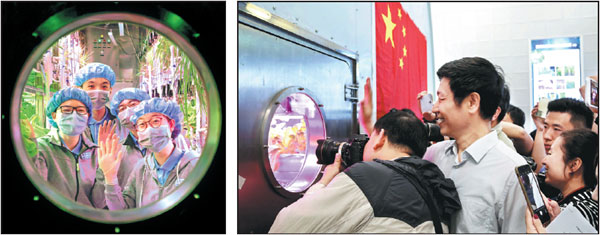
The eight volunteers, all postgraduate students at the university, are divided into two teams of four and will undertake the experiment in three shifts - one team entered the lab on Wednesday morning and will stay for 60 days before the second team takes over. They will live in the lab for 200 days before the first team will complete the remaining 105 days, the university said.
Lunar Palace 1 is capable of providing a habitable environment similar to Earth's biosphere and can support four people. It was designed to test and verify technologies to be used on space missions of extended duration in deep space, and with multiple crews.

The 500-cubic-meter lab is sealed from the outside. It consists of three cabins with a total area of 160 square meters - one for volunteers to live in and control the facility and the other two to simulate cultivating plants on the moon, the university said.
During the experiment, volunteers will not leave the lab during their shifts unless they encounter emergencies.
They will plant several kinds of grains, such as wheat and corn, as well as many types of vegetables, such as carrots, tomatoes, mushrooms and cucumbers.
The harvest will be part of their food. They also will experiment with growing mealworms to consume as a source of protein.
Liu Hui, one of the volunteers and a doctoral student in biomedicine at Beihang University, said before entering the lab on Wednesday that their main tasks are to grow plants, to observe inner biology within the lab, to record their own metabolism and to test the equipment.
She noted that in the lab they can use a computer, make phone calls or conduct video chats with their families and do physical exercise with the proper equipment.
Professor Liu Hong, director of the Research Center of Space Life Science and Life Support Technology, who heads the project, said astronauts would carry all their necessities with them in short- or medium-length space journeys, such as China's Shenzhou manned missions that last at most one month.
For space stations, cargo spaceships would be used to transport supplies. However, longer-lasting missions in the future, such as constructing a lunar station or manned expeditions to Mars, will require the station or spacecraft itself to be self-sustaining, which mean they must carry physical and chemical instruments that can generate the necessities of life.
"Therefore, such experiments will check whether our bioregenerative life-support system can work well and explore how astronauts can resolve possible psychological problems in a sealed environment for a long time," Liu Hong said, adding the experiment's data and findings also will be useful in manned deep-sea exploration programs.
The professor noted that Lunar Palace 365 is the world's first experiment to examine the recyclable applications of animals and microbes in the space environment.
The Lunar Palace 1 housed a three-person, 105-day airtight experiment in 2014.
|
The first group of four volunteers (at left) greet people through the window of the airtight laboratory in Beihang University in Beijing on Wednesday. In photo at right, Xu Huibin (center), president of the university, waves back to the graduate students taking part in the life-support experiment.Kong Xiangming / For China Daily. |




- Preserving a Chinese icon: Great Wall needs rescue
- Chinese museums receive 900m visitors each year
- Chinese man sentenced over selling wildlife online
- Former senior Jiangsu official sentenced to four years for bribery, illegal foreign exchange purchase
- Police crack down on illegal online animal trade