Phones ease way to doctor-and bills
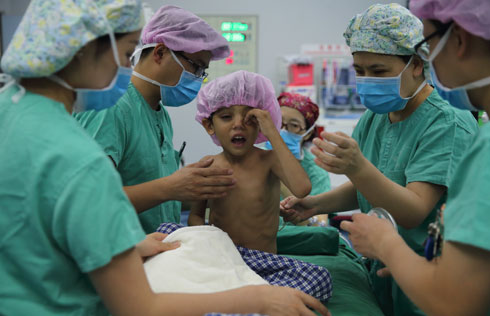
Patients needing a doctor can now make an appointment using a mobile phone and then pay for treatment and medicine with Alipay on the same phone at the Guangzhou Women and Children's Medical Center.
Using a phone can save the time once spent waiting in long lines.
"I started coming to this hospital when it was established," a patient surnamed Zhou said recently. "The new technology has made things much easier."
Virtually all nonemergency patients are coming to the hospital with appointments made beforehand through mobile apps, phone calls, electronic equipment at the hospital or with the doctor during the previous visit. About 70 percent of the appointments are made with smartphones, said Xia Huimin, president of the hospital, which is the largest medical facility in South China for women and children, with 4.5 million outpatients in 2015.
The apps have all but eliminated big crowds at the hospital's registration desk, a sight that has been common at all major hospitals in the country.
Long waiting lines at cashiers have been shortened, too, thanks to multiple online payment methods that are allowed at the hospital, with social medical insurance payments also available online.
On the mobile phone app, patients can check the progress of their medical tests, review their spending and electronic medical records, make appointments, register for blood tests and receive health-related information.
It is estimated that the mobile system has reduced the time an outpatient spends at the hospital by about 60 percent-to about 37 minutes during peak hours.
Meanwhile, the hospital has distributed several hundred kits of wearable devices free to allow pregnant women to check their blood pressure, blood sugar, fetal heart rate and other key measures at home. The kit, which is returned to the hospital after the baby is born, can send data to the hospital and the mother can consult an on-duty doctor online regarding abnormal situations.
Xia, who was diagnosed with diabetes during her pregnancy, checked her blood sugar three times a day.
"I could see curves comparing normal and abnormal figures. It reminded me all the time to check my blood sugar.
"I controlled my blood sugar pretty well during pregnancy. Occasionally, the figure was high after a meal. So I made food and exercise adjustments," Xia said.
In its goal of meeting international standards, the hospital has focused on reengineering its processes to improve patients' experience. Part of that has been a large capital and human resource investment in information technology, Xia said.
In 2012, the hospital became the first one in the country with more than 1,000 beds to be accredited by Joint Commission International, the world's leading evaluation system for medical management and healthcare service quality.
Last year, it became the first Chinese hospital to gain certification of Stage 7 EMRAM (electronic medical records adoption model) by Chicago-based Healthcare Information and Management Systems Society, for both inpatient and outpatient records.
Behind the scenes, with the help of information technology, the hospital applies closed-loop management of 19 major medical processes related to fields including medicine for patients, blood transfusions and handover and testing after surgery, to reduce medical accidents.
The hospital is currently developing Doctor Bear with partners. It's an artificial intelligence technology that can diagnose patients based on an evaluation of huge amounts of medical records and academic documents.
"By inputting symptoms, signs and test results, it can basically tell if a child's fever is caused by a virus or not, and whether there are complications. Its diagnosing accuracy is now 87 percent," Xia said.