Reform brings China closer to strong army goal
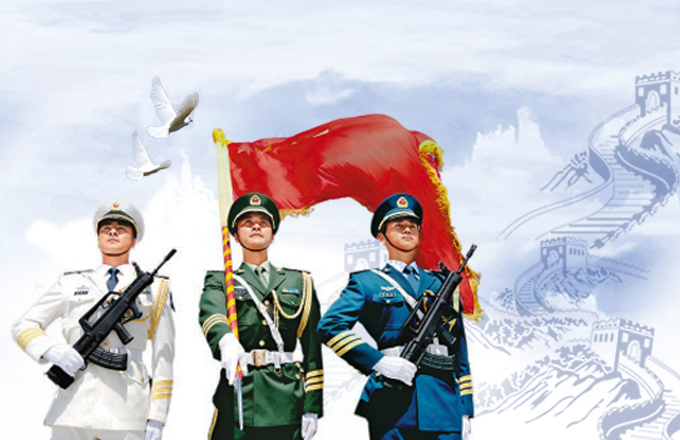
More than 12,000 service personnel from the army, navy, air force, armed police as well as the newly formed rocket force and strategic support troops took part in the parade, which also featured China's tanks, armored vehicles, missile launchers and fighter jets.
President Xi Jinping reviewed the armed forces as part of the commemorations that marked the 90th founding anniversary of the People's Liberation Army (PLA), which fell on Aug. 1.
Two days later, at a grand gathering in celebration of the anniversary, Xi, also general secretary of the Communist Party of China (CPC) Central Committee and chairman of the Central Military Commission (CMC), said the Chinese military has reshaped its political environment, organizational form, system of military strength and work style over the past five years.
During those five years, China has advanced the reform of national defense and the armed forces under the leadership of the CPC Central Committee with Xi at its core, making historic steps in building a system of military strength with Chinese characteristics.
REFORM DETERMINATION
In December 2012, just about 20 days after Xi took office as the general secretary of the CPC Central Committee and CMC chairman, he boarded a PLA Navy destroyer, examined an armored vehicle, observed a military drill and had dinner with soldiers during an inspection tour.
On March 11, 2013, when joining a PLA delegation at a meeting during the annual session of the 12th National People's Congress, Xi, for the first time, put forward the goal of building the Chinese military into one that follows the Party, fights to win and forges exemplary conduct.
About eight months later at the third plenary session of the 18th CPC Central Committee, the reform of national defense and the armed forces was included in China's national roadmap for comprehensively deepening reforms.
A CPC decision said China will optimize the size and structure of the army, adjust and improve the proportion between various troops, and reduce non-combat institutions and personnel.
Xi, who is head of a leading group for deepening reform of national defense and the armed forces, has stressed that the country's military reform should be guided by the objective of building a strong army.
Observers noticed that the ongoing reform of China's military would not be a patch up but a comprehensive overhaul that targeted problems with the military's system, structure and policies.
PRUDENT APPROACH
Comparing the reform to a ship on the sea, Xi once said that a skiff may be easy to steer but a mistake by the Titanic may cause the ship to wreck completely, warning of the danger of serious misjudgment in the reform.
Under Xi's arrangement and command, research, study and discussions have been conducted involving the reform leading group, special teams and expert panels.
More than 800 forums and symposiums have been held and opinions from incumbent and retired military and civilian leaders, academics, senior officers and soldiers were collected in drafting the reform plan, which underwent over 150 amendments and modifications.
At a meeting in November 2015, Xi stressed the need for breakthroughs in reform of the country's armed forces by 2020, vowing to reorganize the military administration structure and military command system.
On April 20, 2016, Xi inspected the CMC joint battle command center as its commander in chief for the first time ever, where he called for a joint battle command system that was "absolutely loyal, resourceful in fighting, efficient in commanding and courageous and capable of winning wars."
The visit and the call were based on the PLA's decades-long exploration of a joint battle command system, which started in the 1980s but failed to materialize, which made Xi stress a sense of urgency.
The efforts have paid off in recent years.
A series of major structural reforms have been made, including the establishment of the PLA Army General Command, PLA Rocket Force and PLA Strategic Support Force.
The four general departments were reorganized into 15 agencies of the CMC, and five theater commands have replaced the seven military area commands.
The CMC has taken charge of the overall military administration, while theater commands focus on operations and different services on troop developments.
INNOVATIVE STEPS
The reforms on one hand streamlined the military and optimized its structure, while on the other hand added to the demand for high-quality military talent.
During an inspection tour of the National Defence University of the PLA in March, 2016, Xi noted that to achieve the goal of building a world-class army, military-affiliated colleges must be strengthened, and thus asked for the advancement of reforms and innovation to provide talent and intellectual support for this goal.
As a result of the subsequent reshuffle, there are now 43 military education institutions, including two -- the National Defense University of PLA and the National University of Defense Technology -- directly under the CMC, 35 specialized in specific armed services, and six for armed police forces.
Addressing heads of these institutions in July, Xi stressed that China must make greater efforts to build stronger armed forces and boost fighting capability through science and technology innovations to gain a competitive initiative.
"It takes first-class military talent, theory, and science and technology to build the PLA into a world-leading military," he said. "Science and technology is the core fighting capacity in modern warfare."