'Bathing-crab' overseas students facing tough job market
Some Chinese studying abroad have found it difficult to find a well-paid job when returning to China after graduation in recent years. This is quite unlike they'd imagined.
In fact, some of these job hunters may have just wasted their school time in another country. They thought an overseas diploma alone would guarantee them a decent job, but the job market disagreed, contrary to expectations.
A Xinhua report defined these people as "bathing crabs".
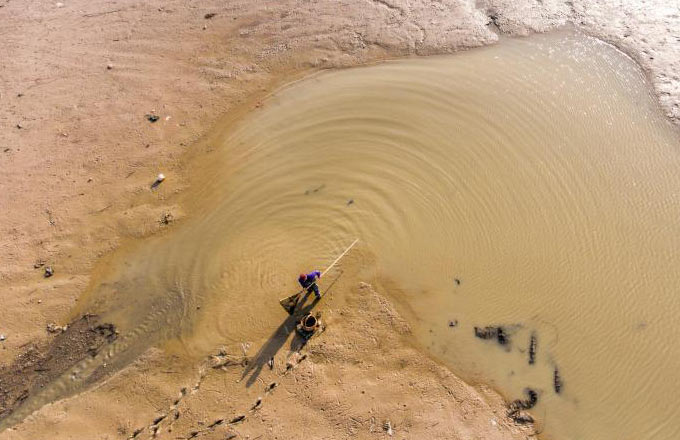
The Yangcheng Lake in East China's Jiangsu province produces a variety of freshwater crabs, called Yangcheng Lake Hairy Crab, every autumn. These crabs are raised in the lake for at least six months, which is what makes them authentic and fetch a high price.
But some counterfeit ones spend a short time - perhaps only a few hours, like taking a bath - in the lake before being passed off as genuine. Those who had not taken their academic careers seriously abroad are seen as "fake" crabs.
Beyond these bathing-crab students who find it difficult to obtain employment, the job-seeking destinies of haigui, or "turtles" - overseas returnees who have studied or been trained abroad - varies, too. Some haigui earn tens of thousands of yuan annually, while others net more than one million yuan (about $150,000) a year.
About 45 percent of haigui earn less than 6,000 yuan ($900) monthly in 2017, according to a survey by the Center for China and Globalization, a Chinese think tank based in Beijing. Nearly 70 percent of them think their current salary is far less than what they had expected.
"Take the United States as an example. A student needs at least $40,000 a year to study there, or $120,000 for three years. One returnee has to be paid at least 10,000 yuan ($1,500) monthly for seven years before he or she gets academic cost back," said Qi Lixin, president of the Beijing Entry & Exit Service Association. He thought this was why the haigui community has high salary expectations.
Development opportunities and favorable policies have attracted a growing number of haigui. According to data from the Education Ministry, about 430,000 came back to China for employment in 2016, 160,000 more than in 2012 — an increase of 58 percent.
There has been a dividing line taking shape to distinguish two groups of returnees, with one group having special skills and the other, not. Quite a few Chinese companies came to this conclusion, based on their recruitment experience. The former are called "big turtles" and the latter "small turtles".
"'Small turtles', without techniques or experience, are sure to be overshadowed in salary by 'big turtles' from prestigious universities and with hands-on backgrounds," said Xu Chuanhai, who represents an overseas education service agency.
In the IT industry, a returnee who has mastered the world's leading technologies can earn up to around 800,000 yuan ($120,000) a year, and those with further managerial experience can even get one million yuan (about $150,000), said Yang Zhiguo, himself an overseas returnee.
Yang studied in Germany for eight years before coming back to China in 2009 and starting up a tech company. His company has been well-developed.
In addition to factors within students' control, like making an effort in study or work, there are also reasons for employment difficulties which are totally objective. One is the choice of major — quite a few haigui had learned something that didn't match what the Chinese market needed.
More than 46 percent of returnees majored in business administration, while humanities and social sciences majors numbered 20 percent, applied science majors 16 percent and natural science about seven percent, according to a report on the haigui community's employment and entrepreneurship in 2017.
If "bathing-crab" returnees want to avoid losing out in job competition, experts said, they should seize every possible opportunity to gain valuable experience when they study abroad, and have more than just a diploma when they return.